Relevance- GS II | International Policies and Politics | International Institutions
Introduction :
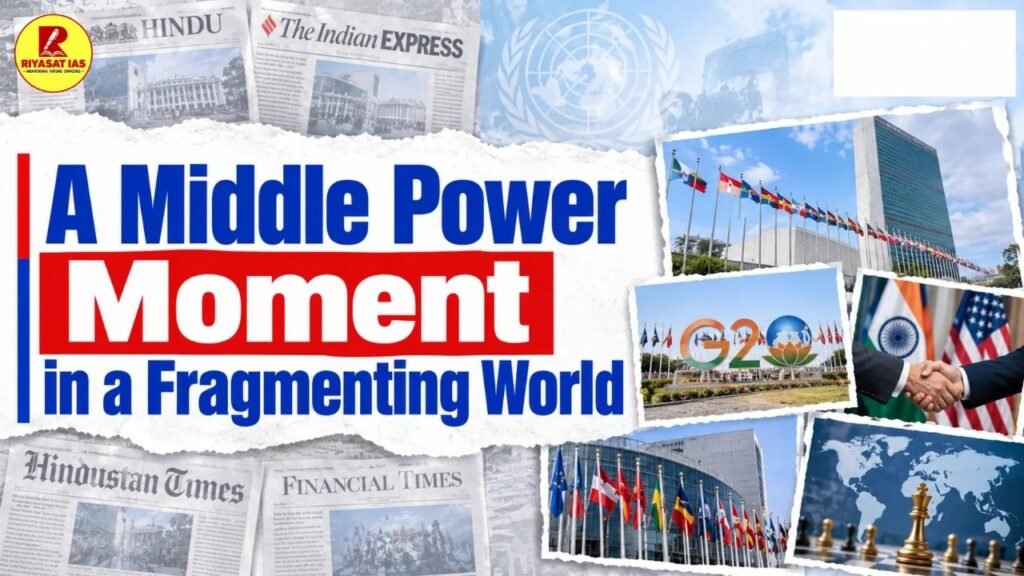
- Context : the world is no longer defined solely by the gravitational pull of superpowers, nor by the binary alignments of the Cold War, but by a wider constellation of states which is categorized by the EAM Jaishankar as “ The Middle Power Moment “.
- In today’s international politics, Middle powers influence derives from strategic positioning, economic weight, diplomatic agility, and normative ambition.
The middle power profile :
- The definition must remain a loose one but what binds them all is not uniformity of size or interests but a shared sense that the existing global order neither fully reflects their aspirations nor adequately accommodates their agency.
- There are many middle powers such as India, Brazil, Canada, Egypt, South Africa, Japan, Indonesia, Türkiye, Mexico, and Germany etc.
- They are typically characterised by a combination of attributes such as
> significant regional presence and influence,
>desire for greater relevance,
>growing economic capabilities,
>credible diplomatic networks, and
> the political will to act beyond their immediate neighbourhoods
- Middle powers possess enough weight to matter in global governance, and enough autonomy to pursue independent strategies.
For example, India’s issue-based coalitions at the time Russia-Ukraine war to secure crude oil.
- Their influence is exercised less through coercion than through coalition-building, agenda-setting, and the ability to act as bridges between different parts of the international system.



For example, Brazil’s stewardship of climate diplomacy, South Africa’s activism on global health and vaccine equity, and Germany’s efforts to stabilise the European order.
The current Global Political Order is under pressure; Why ?
- The paralysis of multilateral institutions.
> Lack of representation of Global South in the UNSC ( United Nation Security Council ) and Its failure to resolve current wars.
> Democratic deficit in the Multilateral development banks (MDB) such as IMF, World Bank.
> Non-Functional WTO – US blocked the appointment of judges in WTO’s Appellate Body for years.
- Declining US hegemony : US commitment to the existing international order has become less predictable. For example, tariff wars, Iran war, Venezuela issue etc under the Trump leadership.
- Economic & technological evolution of semi-peripheral countries such as India, China etc
- The fragmentation of global supply chains create uncertainty and limit the scope for collective action
The Middle power’ Task :
- The middle powers’ task is to make the international order more representative and more credible while preserving its capacity to restrain power and sustain cooperation
- Peace by pieces approach : cooperating on the non-confrontational issues such as digital governance, climate finance, health security, and development cooperation to shape the global norms.
- Providing mediation in conflicts where great powers are distrusted.
Issues pertaining to the Middle Powers :
- Middle powers are more vulnerable than superpowers to economic shocks, which can limit their influence. For example, the Asian Financial Crisis crumbled the growth of Asian Tigers.
- Diverging interests of the middle powers restricts the capacity to act collectively. For example, India-China rivalry affects the functioning of the SCO ( Shanghai Cooperation organisation).
- Great Power scuffles limits the scope of non alignment posture in global politics. In fact, the Quad, BRICS, the India-Middle East-Europe Economic Corridor (IMEC) initiative, the Belt and Road Initiative, and the International North-South Transport Corridor, all include co-operation between middle powers and established great ones.
Way Forward :
- The role of Middle powers will not be to replace great powers but to moderate, mediate and innovate — to act as stabilisers in a world where stability is increasingly scarce.
- Middle powers must seek a more equitable distribution of voice and influence in global institutions, advocate for reforms in multilateral governance via International platforms like G20, BRICS, P4M etc.
Conclusion :
The weakening of the post-war international order has created an opening for countries that possess considerable diplomatic, economic or technological influence. Their ability to speak simultaneously to the West and the Global South gives them diplomatic leverage that neither superpowers nor smaller states possess. Thus, the vacuum created in the International political order must be filled by the collective action presided over by the middle powers.
| Mains Practice Question : Q.Discuss the emergence of ‘Middle Powers’ as key stabilizers in a fragmenting global order marked by paralyzed multilateral institutions. What are the primary challenges that limit their collective influence in global governance? |
Join Riyasat IAS GS Foundation Course 2027 and build the knowledge and analytical skills required to excel in UPSC Mains.
Read this also- UPSC Mains Result 2026


 Ravi Raaz
 Hassan Khan
 Shadab Ali