
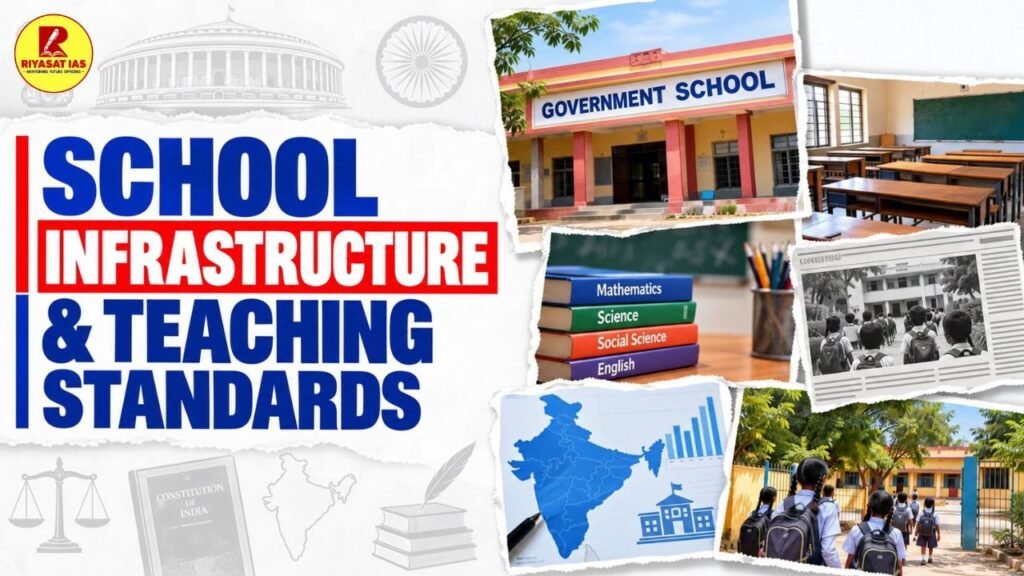
GS-II | Education | Right to Education Act, 2009 | Governance | Social Justice | Human Resource Development
Introduction
- Context: The Cockroach Janta Party (CJP) has called attention to the poor condition of many school buildings throughout India.
- RTE Implementation Gap: Even the relatively low standards set forth by the Right of Children to Free and Compulsory Education Act, 2009 (commonly referred to as the Right to Education Act or the RTE Act), have still been unachieved in many schools.
- Real Life: Despite what is implied by the government’s official data on schools (e.g., UDISE), India’s schools continue to be filled with:
- Leaky roofs.
- Clogged toilets.
- Broken handpumps.
- Missing playgrounds.
- School Audit: It is hoped that the audit of government schools being conducted by the CJP will assist in identifying those fundamental structural failures that have led to these problems.
Structural Failures in School Infrastructure
- Inadequate Infrastructure: Not only are there issues regarding funding amounts, but even more importantly, the ability of corrupt contractors to earn a great deal of money for doing poor quality work has also been problematic.
- Lack of Maintenance System: There isn’t an efficient system established for the purpose of maintaining or repairing school facilities.
- Discontinuation of School Funding: For the past two years, the small amounts of money typically used for school funding in Jharkhand have also been stopped.
- Maintenance Impact: It is extremely difficult to address even the most basic of maintenance issues like purchasing broom and mop.
Teaching Standards and Learning Outcomes
- What We Can Improve: This is why it would be incorrect to assume that teaching standards in government schools cannot improve until there are improvements to infrastructure.
- Active Teaching: As a matter of fact, there are numerous opportunities for enhancements, beginning with an increased emphasis on active teaching.
- Lack of Classroom Engagement: Many times, young students are allowed to wander about, or sit alone, for many hours.
- Learning Outcomes Impact: Active teaching has been identified as the single largest contributor to the low level of learning achieved by most students in schools.
- Socio-economic Consequences: They will be forced into low-wage, temporary employment as adults.



Non-Teaching Duties and Teachers’ Workload
- Teachers’ Complaints: On the other hand, teachers complain about non-academic responsibilities continually cutting into instructional time.
- Section 27 of the RTE Act: Section 27 of the Right to Education Act states that teachers can never be used for “non-educational purposes” except:
- Population census.
- Disaster relief.
- Election-related duties.
- “Educational Purpose” Loophole: The “educational purpose” loophole exists because the term “educational purposes” can be interpreted in multiple ways.
- Non-Teaching Responsibilities: Under the pretense of education, teachers are being asked to complete many non-teaching related duties including but not limited to:
- Taking digital attendance.
- Extensive recordkeeping.
- Helping children to open Aadhaar-linked bank accounts.
- Generating their APAAR (Automated Permanent Academic Account Registry) number.
- Record-Keeping Burden: The burden of record keeping is increasing because of the Aadhaar-augmented double burden of physical and digital records.
RTE Act: Prescribed Working Hours for Teachers
- Minimum Working Hours: The RTE Act requires that all school teachers must have at least 45 hours of work each week.
- Classroom Teaching Norm: In addition, there is a hidden norm of at least four hours of classroom teaching each day in primary schools.
- Annual Teaching Hours: This amounts to 800 hours over 200 days, as a minimum.
- Time Available for Non-Teaching Tasks:
- Over a six-day week, a primary school teacher has as much as twenty-one hours available for non-teaching duties, outside of classroom time.
- Even if you take away an hour per day from your time spent on preparing for classes, you will still have 15 hours left over each week to do other education related things.
- Question on Teacher Teaching Time: I agree with the fact that teachers do have a lot of non-teaching responsibilities, but I would like to question whether those responsibilities typically keep teachers from meeting the required amount of teaching time per week under the RTE Act.
Conflict Between Teaching and Non-Teaching Duties
- Lack of Clear Demarcation: The lack of clear demarcation results from the fact that most teachers often complete non-teaching related activities within their classroom instruction time.
- Administrative Pressure: Sometimes this is forced on them, for instance:
- When teachers are summoned to the Block Resource Centre during school hours.
- When they receive WhatsApp messages asking them to submit reports “immediately”.
- Teachers’ Own Practices: Sometimes teachers take on non-teaching responsibilities while they are supposed to be teaching, so that they can avoid working excessively long hours.
- Teaching Impact: No matter who is responsible for this issue, the truth remains that in most schools there isn’t a defined line between teaching and non-teaching times, which results in the loss of teaching time.
Way Forward
- Clear Demarcation of Classroom Hours: The need for a better understanding of how classroom hours should be clearly demarcated and respected.
- Resolution of Teachers’ Workload: When a teacher has too much of their time taken up with non-teaching tasks, then this is something which should be worked out by both the teacher(s) and the School Education Department.
- Children’s Interests: Children should not be made victims of the conflict.
- Improved Infrastructure: More than just the better understanding, there needs to be improved infrastructure as well.
- Minimize Non-Academic Work: Minimize the amount of non-academic work so that there is no effect on the time spent instructing students.
- Clerical Assistance: Provide some clerical assistance to teachers.
- Infrastructure and Work Culture: The Cartwright and the Horse must be synchronized.
- Accountability: The first thing we need to do is to no longer tolerate the injustice being done to the millions of students stuck in failing schools.
Conclusion
- To improve government schools, we need to address both the physical condition of the schools and how well teachers are doing their jobs.
- The improvement of infrastructure, the maintenance of facilities, a decrease in the amount of non-teaching responsibilities, and the protection of classroom instructional time are all necessary.
- Children can only get the best possible education if we have both an appropriate infrastructure and work environment.
UPSC Mains Practice Question
Q. Analyze the factors which adversely affect the development of school infrastructure and teacher quality in government schools in India. Evaluate the provisions of the Right to Education Act, 2009 with reference to teachers’ responsibilities, and recommend steps to preserve the time spent on classroom instruction.





 Ravi Raaz
 Hassan Khan
 Shadab Ali