
GS-II | Education | Governance | Social Justice | GS-III | Employment
Introduction
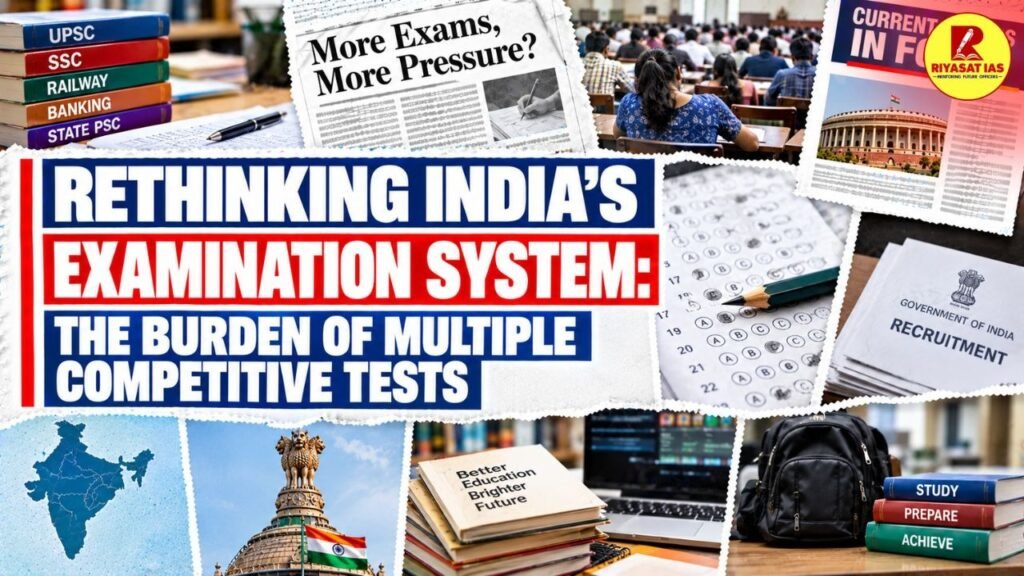
- Millions of young people in India are taking multiple entrance examinations (JEE, NEET, NATA, CLAT, CUET, GATE, CAT, CUET-PG and NET).
- Recruitment also takes place through exams given by UPSC, State Public Service Commission, SSC and IBPS.
- The rise of entry-level and hiring tests has created an endless loop of competing with others for education and employment through testing.
Cost of Multiple Examinations
- Financial Strain: The separation of coaching costs from the examination costs as well as the need for multiple attempts at the exams create a financial strain on lower-income families and those who are marginalized.
- Mental strain: Multiple exams create higher levels of anxiety, stress and emotional distress for students. They are then forced into a continuous loop of studying.
- Unfair Practices: Leakage of exam papers; use of fake test-takers; alteration of student scores; and misinterpretation of academic performance results result in the cancellation of exams, waste taxpayer dollars, and cause delays in students being admitted to schools and hiring individuals for jobs.
- Erosion of trust: The erosion of trust that results from the recurring failure to pass exams contributes to the loss of public faith in the integrity and reliability of the overall process.
How Multiple Examinations Undermine Education
- Unreliability issues: In addition to being inconsistent and easily manipulated by school boards and universities, the introduction of separate exams for entering into higher education was in response to these shortcomings; however, the use of entrance exams has also been found to have many of the same limitations.
- Narrow assessment of merit: Competitive examinations typically evaluate an applicant’s capacity to respond rapidly to inquiries during stressful situations as opposed to evaluating their long-term acquisition of knowledge.
- The decline of classroom learning: Students do not attend classes to learn, but to pass tests. As such, classroom teaching has become less important than attending coaching centers for practice.
- Systemic problems: The continued struggles of the National Testing Agency, even after the 2024 review and the establishment of a second, high-level committee in 2026, demonstrate that there are continuing systemic problems.



Merit Already Exists, Use It
- Restore credibility: Restore credibility by enhancing existing school and university examination systems instead of adding more examination layers.
- Holistic Assessment: The marks achieved during Class XII and the university’s Cumulative Grade Point Average (CGPA) are reflective of many years of continuous academic achievement, academic ability and academic diligence.
- Standardisation: Improve existing examinations through:
- Normalisation.
- Common moderation frameworks.
- External audits.
- Periodic score equating.
- Institutional changes: Improve the standard of evaluating boards and universities, instead of continuously assessing students.
Suggested Reforms
- Higher education admissions: Higher education admissions should use school leaving examination results that have been standardized and moderated as part of their criteria for admitting students.
- Scholarships and fellowships: Award scholarships and fellowships based on students’ academic performance and previous accomplishments.
- Public recruitment: Use verified academic records and structured interviews.
- A single national test: At a maximum, conduct one national test per exit level to evaluate student academic performance and to moderate final exams taken by students at the board/university level.
Global Practices
- Many countries use high school graduation results as the primary factor in determining whether or not to accept a student into their university programs. This is often supplemented with reference letters and written statements.
- Marginal weight is assigned to language and scholastic aptitude tests.
- India has a very unique way of repeatedly assessing the same abilities through multiple layers of exams.
Conclusion
- Dismantling the Entrance/Recruitment Examination Pyramid is not a Criticism of Standards.
- Repeated testing of students on the same skills is costly, promotes corruption, and negatively impacts children’s mental health.
- Reforming and trusting the current examination system in schools and universities would provide greater opportunity for students to demonstrate their real merit than adding additional layer of examinations.
UPSC Mains Practice Question
Q. “The rise of competitive examinations in India has made education more unequal and has had a negative impact on classroom-based learning.” Analyze the problems that exist with the examination system and provide potential solutions to these problems.



 Ravi Raaz
 Hassan Khan
 Shadab Ali