
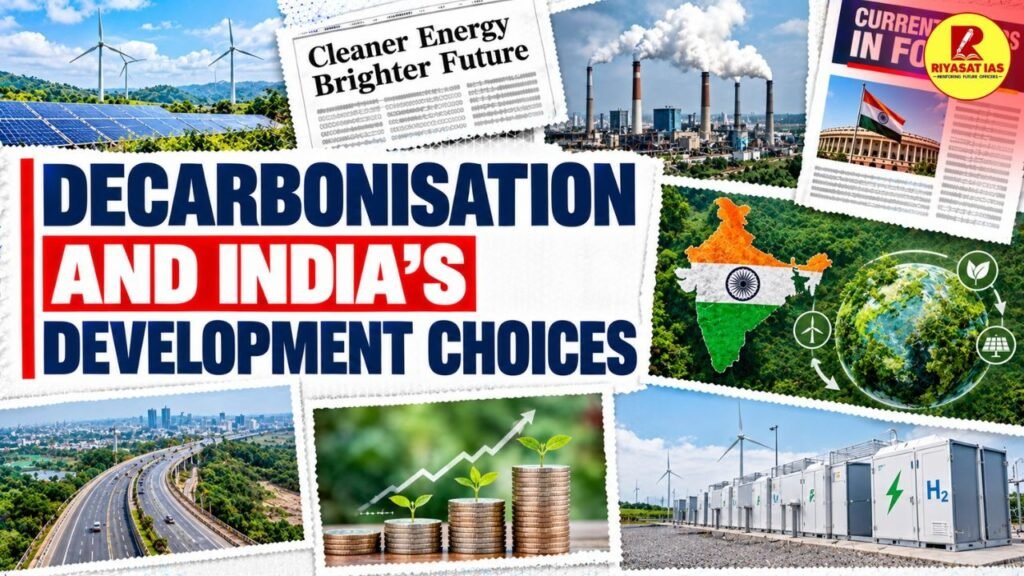
GS-III | Environment | Climate Change | Energy Transition | Infrastructure | Sustainable Development
Introduction
- Global Climate Pressure: The recent warning by the United Nations Environment Programme (UNEP) that the Earth may pass through the 1.5°C temperature increase limit in the next few years will probably result in renewed calls for quicker reductions in carbon emissions.
- India’s Development Choices: In addition to the same pressure from other countries, India also has the option of making decisions. A great deal of the housing, industrial infrastructure, power networks and urban development that is required for the next phase of India’s development has not been constructed.
- Future Building Stock: In 2070, 86 percent of the buildings India will have are still under construction, according to NITI Aayog. From 2020 to 2070, total floor area will increase by over two times, from approximately 18 billion square meters in 2020 to 42 billion by 2070.
- Industrial Expansion: India’s crude steel making capacity (at approximately 200 million tons per year) as of 2024/25, will have increased to 300 million tons per year by 2030/31. Cement production is expected to increase from approximately 427 million tons in 2024, to 660 million tons by 2030.
The Advantage of Choice
- Future Capital Stock: India has a great deal of control over its future capital stock, as much of this is determined by choices made today regarding investments and technologies. Therefore, India’s future emissions will be largely determined by the type of capital stock it decides to invest in today, as well as the technologies and standards used to develop that capital stock.
- Mature Economies’ Comparison: According to the International Energy Agency (IEA), it is estimated that approximately 80% of all the buildings that mature economies would have to utilize in 2050 exist today. In addition to this, 85% of buildings located within the European Union (EU) were constructed prior to 2000, and of those, approximately 75% are considered to be inefficient in terms of their use of energy. Additionally, it has been stated that on average, only about 1% of the existing buildings in the EU undergo renovation annually.
- Avoiding Future Costs: India has an opportunity to create efficiency in its systems at the beginning of their life cycle, thereby reducing the risk of being stuck with unusable equipment (stranded assets), having to replace equipment before it reaches the end of its useful life (premature retirement) or paying for costly upgrades to existing equipment at a later date (expensive retrofits).
- Implementation Gap: There are many areas of construction that can be done with existing technology. Regulatory frameworks exist. It is only the implementation of these technologies and regulations that are lacking.



Decarbonisation of Buildings
- Implementation Status: The Bureau of Energy Efficiency (BEE)’s State Energy Efficiency Index indicates that 27 States have published/notified the Energy Conservation Building Code (ECBC) 2017, however only 21 have legally adopted/incorporated it into law.
- Updated Building Standards: BEE has now developed the Energy Conservation and Sustainable Building Code (ECSBC) 2024 for both commercial and office buildings and the Eco-Niwas Samhita (ENS) 2024 for residential buildings.
- Effective Implementation: To ensure that the states implement the standards effectively they should incorporate them into all of their building permit processes, certificate of occupancy applications and grid connection procedures so that failure to meet the requirements of the standards will result in a penalty.
The Issue in the Power Sector
- Transmission Bottlenecks: India has grown its renewable energy generation rapidly over the past few years; however, the grid needed to transmit this electricity has been lagging behind. It is estimated by the International Energy Agency (IEA) that transmission bottlenecks have restricted approximately 60 GW of renewable energy capacity.
- Growing Generation Capacity: The Ministry of Power is planning for approximately 590 gigawatts (GW) of additional generation capacity to come online over the period from 2023 through 2032. However, the existing transmission deficit will only increase as the amount of generation continues to grow.
- Grid Reliability: The reliability of our electrical grid will determine how much we benefit from clean energy as we transition more and more of our transportation, cooling systems, and some industrial processes to electricity.
- Integrated Planning: Transmission and storage must be planned concurrently with, or in certain instances prior to, new generation and demand.
Decarbonisation of Steel and Cement
- Technological Barriers: Steel and cement have a more difficult transition to low-carbon. The Ministry of Steel stated that hydrogen-based green steel was not commercially viable in India at present, whereas NITI Aayog placed large-scale carbon capture in cement as an option that would likely be implemented later in the transition process.
- Risks of Technology Mandates: Technology mandates can result in increased costs for companies. Even more serious is the potential that mandates will force companies into using technology-based processes which ultimately become too expensive.
- Role of Public Procurement: The Union and State governments, along with Indian Railways, National Highways Authority of India and other public agencies buy massive amounts of steel and cement; therefore they could potentially assist in creating an early market for lower-emitting materials.
- Green Steel Taxonomy: India currently has a green steel taxonomy, and the Ministry of Steel has suggested an aggregation of procurement using a competitive bidding process.
- Emissions-Intensity Thresholds: Tenders can establish emission-intensity thresholds for materials without specifying how those materials should be produced. Bidders can compete based on their ability to meet the threshold at the lowest cost, which will show us what the green premium is, as well as reward those bidders that are able to find the most cost-effective way to achieve the required emissions-intensity level.
- Alignment with CCTS: The premium for CCTS will narrow due to economies of scale and technological advances. Therefore, the threshold could be lowered. Additionally, the threshold may be adjusted in accordance with the emissions intensity target set forth by the CCTS to provide clear and consistent policy signals.
Costs and Risks
- High Cost of Capital: According to the IEA, the cost of capital for grid scale renewable energy in India is roughly 80 percent higher than in other developed countries. Because clean energy infrastructure requires a large amount of upfront investment, this difference can turn a financially feasible project into one that is not economically viable.
- Targeted Financial Instruments: Partial credit guarantees, payment-security mechanisms, or concessional loans may be used to reduce off-taker risks and financing issues.
- Risks of Public Financing: Public financing can be cheaper when technology has yet to be proven. However, it will just move the risk to the public sector’s balance sheet.
Way Forward
- Energy-Efficient Buildings: States should include energy-efficiency standards in their permit processes for new construction, occupancy requirements, and when establishing utility connections.
- Integrated Power Planning: Power transmission and storage should be planned at the same time as, and possibly before, new power generation and consumption.
- Green Public Procurement: The procurement of goods and services by public agencies through competitive bidding, along with emissions intensity requirements, can assist in developing a market for low emission steel and cement at an early stage.
- Flexible Technology Choices: Flexible technology choices have value when technology continues to evolve.
- Targeted Financing: Partial Credit Guarantees, Payment-Security Mechanisms and/or Concessional Debt can help alleviate some of the risks associated with financing and/or off-taker risk. However, it is also important to recognize that there are risks in using public funds to finance technologies which have yet to be proven.
Conclusion
India cannot escape investing in the development of its economy. What’s important is the type of capital created by the investment. If technology is mature, then there’s no reason to develop inefficient systems in assets which are expected to exist for many years. However, if technology is developing, then keeping the ability to adapt can be valuable. Making these decisions today can help the nation avoid much more expensive adjustments in the future.
UPSC Mains Practice Question
Q. India’s development needs and climate commitments create both challenges and opportunities for reducing greenhouse gas emissions. How can India integrate low-carbon choices into its buildings, energy generation, steel, and cement production, all while balancing financial costs and technological risks?
Build a strong foundation for UPSC CSE with our GS Foundation Course. Get expert guidance, comprehensive syllabus coverage, current affairs updates, and answer-writing practice to strengthen your Prelims and Mains preparation.
Start your UPSC preparation today and move one step closer to your IAS dream!
Enrol Now | Explore GS Foundation Course



 Ravi Raaz
 Hassan Khan
 Shadab Ali