
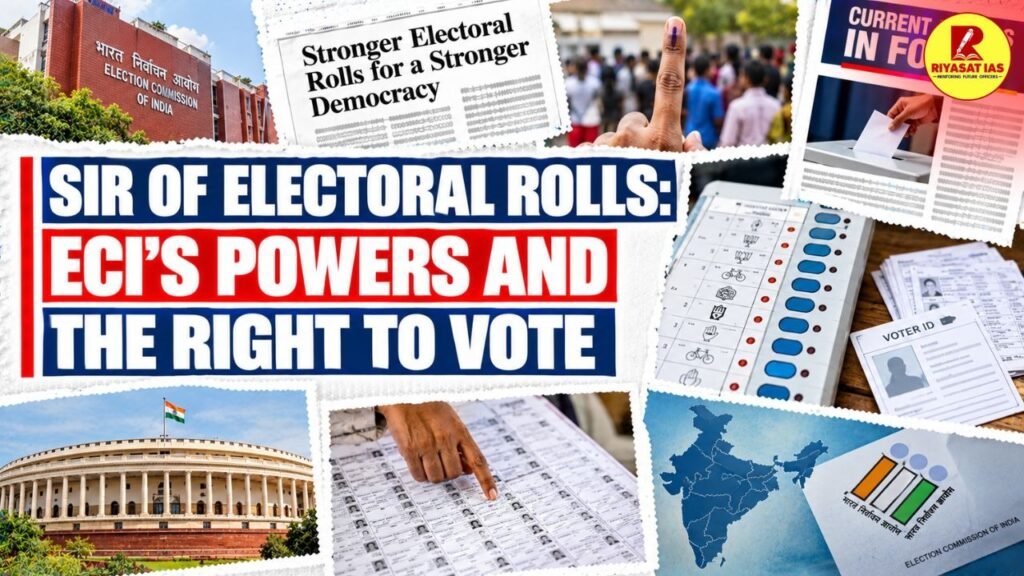
GS-II | Indian Polity | Election Commission of India | Electoral Reforms | Free and Fair Elections | Constitutional Bodies
Introduction
- Background: As of June 24th, 2025, the ECI has initiated a new SIR process starting in Bihar and replacing the SSR process initiated by ECI on January 6th, 2025.
- Concern: The process effectively put into doubt the electoral rolls utilized during the period from 2003 through 2025 which caused a large number of voters to be removed from the rolls and also resulted in many unexpected additions to the rolls.
The ECI’s Powers
- Citizenship Examination: The court made clear that the ECI does not have authority to make determinations of citizenship in the “strict sense.” However, the ECI’s authority affects whether a citizen is allowed to be included on the electoral rolls.
- Constitutional Question: The ECI’s right to investigate a person’s citizenship status is still highly debated. Even if the investigation were very basic, it would probably exceed what the ECI has the ability to do under the Constitution (i.e. conduct elections).
- Disenfranchisement: It appears the decision grants the ECI unlimited authority to take a person’s name off of their current voting registration list based on suspicions that they are not an Indian citizen.
- Ministerial Capacity: During the preparation of voter lists (electoral rolls), the ECI acts solely in a ministerial capacity, and its only duty is to ensure that all persons listed are adults and are citizens of India. The author believes that the ECI does not have the authority to investigate the citizenship status of individuals.
- No Single Document: No single document provides definitive proof of citizenship, leaving individuals with the problem of how to prove that they are citizens of India.
Documents, Citizenship and Deletion
- Uncertainty of Decision: The Court did not provide a specific document which would demonstrate a person has Indian Citizenship.
- Documentary Evidence: Paragraph 158 of the decision states that, unlike passports and birth certificates, ration cards cannot be used to conclusively prove an individual’s nationality.
- Unsolved Question: On Passport Seva Divas on June 24, 2026, the Ministry of External Affairs stated during a press conference that a passport is only a travel document, it is not an indication of being an Indian citizen.
- Legal Vacuum: The court had the option of specifying what documents would prove someone is an Indian citizen, or issuing a writ of mandamus requiring the government to identify which documents would be sufficient for this purpose.
- Existing Electoral Rolls: The main question here is if we may change the voter lists that were used for the last election based upon our suspicions of fraud and/or if we may strip someone of their right to vote in future elections because they voted in the prior one.

Constitutional Provisions and Disqualification
- Article 326: Lists the reasons why a person can be disqualified from voting: “not being a resident,” “having an unsound mind,” “committing a crime” or “using corrupt or illegal practices.”
- Qualifications for Inclusion: Qualifications for inclusion on the electoral roll include only two conditions, namely, being an adult and being an Indian citizen. No other qualification is required by the Constitution.
- Legal Framework: The Representation of the People Act, 1950, and the Registration of Electors Rules, 1960, must be in line with Article 326.
- Natural Justice: When a qualified voter is disqualified, there are fundamental rules that must be followed known as “natural justice.”
- Pre-decisional Hearing: A pre-decisional hearing is required before a person’s name may be taken off the voting list.
Supreme Court’s Constitutional Powers
- Article 32: Article 32 allows citizens to apply to the courts for a remedy when their fundamental rights are violated. It also gives the courts the authority to use writs as a means of enforcing those rights.
- Article 141: Declares that the Supreme Court’s declaration of law is binding on all courts within India.
- Article 142: The Court may issue such orders as are required to achieve full justice for each case or matter that is currently being heard.
- Article 144: This article requires that every authority within the government of India, whether it be a civil or a judicial one, will help support the Supreme Court.
- Judicial Intervention: Judicial intervention is the process through which the courts can resolve the legal gap caused by the lack of clear guidelines for determining Indian citizenship.
Protecting the Right to Vote
- The Basic Structure: Free and Fair Elections are an integral component of the Basic Structure of the Indian Constitution.
- Right to Vote: The right to vote is commonly seen as being based on law (statute) but how it can be used is essential for representative democracy and our constitutional commitment to free and fair elections.
- Judicial Decisions: I.C. Golaknath v. State of Punjab (1967), Kesavananda Bharati v. State of Kerala (1973) and Indira Nehru Gandhi v. Raj Narain (1975) are presented in terms of maintaining the democratic system of government that was established by the constitution.
- Constitutional Safeguard: The Kesavananda Bharati judgment established that even when Parliament uses its power to change the Constitution, it cannot destroy or harm the basic structure of the Constitution.
Way Forward
- Clear Citizenship Standards: The Court needs to establish an unambiguous standard to determine if an individual is an Indian citizen.
- Protection Against Arbitrary Deletion: An eligible voter’s name should not be deleted simply because it is suspected that they may not be eligible to vote.
- Natural Justice: Before removing a qualified voter from the electoral roll, there must be a pre-decision hearing.
- Free and Fair Elections: The constitutionally guaranteed commitment to having free, fair and timely elections must be maintained.
Conclusion
Free and fair elections are an essential component of the fundamental structure of the Constitution. Therefore, the Constitution provides for a system where eligibility for participation in elections, disqualification from voting and principles of natural justice are adhered to. Voters have the right to participate in elections freely, fairly and within a reasonable timeframe.
UPSC Mains Practice Question
Q. Discuss the constitutional concerns arising from the Election Commission of India’s Special Intensive Revision of electoral rolls, particularly regarding citizenship verification, disenfranchisement and the protection of free and fair elections.



 Ravi Raaz
 Hassan Khan
 Shadab Ali