GS-III | Environment | River Pollution | Industrial Waste Management | Environmental Governance
Introduction
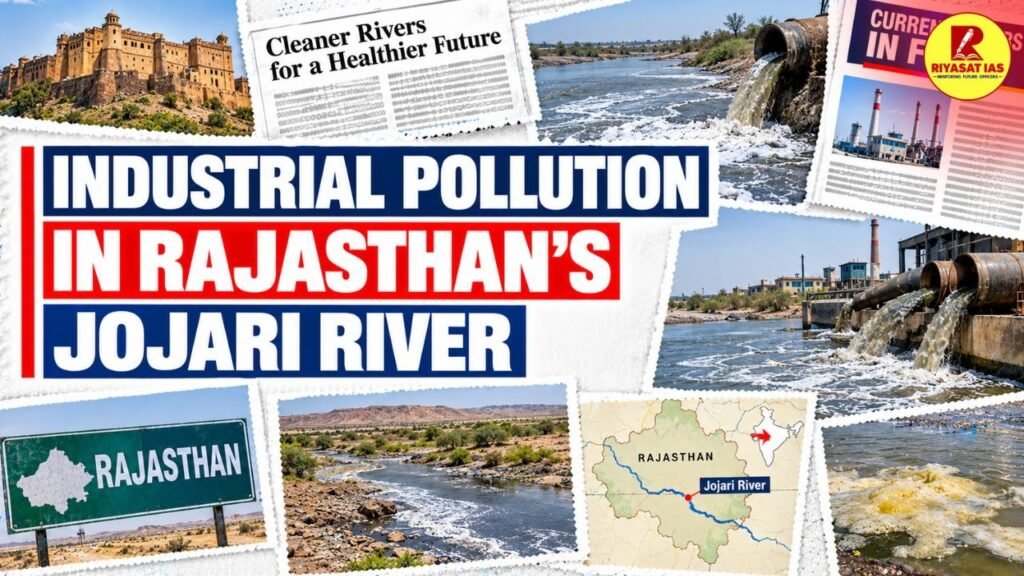
- Supreme Court Pulls Up Rajasthan Government: The Supreme Court has once again pulled up the Rajasthan government for allowing industrial effluent to flow into the Jojari river and creating a health hazard for people who rely on this water source.
- Long-standing Issue: The problem has been around for many years — public interest litigation in the Rajasthan High Court brought attention to the issue within state government agencies in 2011 — suggesting a failure by the State that bordered on being systematic.
- Rivers in the Arid West: The three major seasonal rivers in the arid western part of the state include the Jojari River, the Luni River, and the Bandi River. These three seasonal rivers flow through the following three districts: Jodhpur, Balotra and Pali.
- Industrial Pollution: This area has grown to become an important textile dyeing and steel working center, with the un-treated (or inadequately treated) waste water from these centers running directly into both the rivers and soils. The contamination of the river and soil will potentially affect the well-being of approximately 2 million people who live locally.
Key Issues and Challenges
- Illegal Sand Mining: This area has a lot of illegal sand mining happening in the beds of rivers.
- Inadequate Sewage Treatment: State submissions to the Court in 2025 indicate that the sewage treatment plants in each of the three urban areas can only treat approximately 50 percent of the total amount of sewage generated.
- Underutilization of Wastewater Treatment Facilities: The Court documented that there was significant underutilization of the common wastewater treatment facility.
- Possible Causes: The combination suggests that there may be some of the following issues: industrial sources are being bypassed around the treatment plant, there is a bad connection between the sources and the treatment plants, and/or there is not enough capacity in certain locations or during certain times.
Supreme Court Intervention
- Suo Motu Proceedings: A suo motu writ petition was filed by the Court in 2025 and a High-level Ecosystem Oversight Committee was formed, with Justice Sangeet Lodha as chairman, to conduct audits on the plants and create a strategy to revive the rivers.
- Restrictions on Construction and Industries: The committee’s damaging report led Justices Vikram Nath and Sandeep Mehta to place a ban on construction within 100 meters of both of the river banks, as well as on hazardous industries located within 500 meters of either of the rivers’ current course or the flood line, whichever was applicable.
- Failure to Enforce Pollution Standards: The court was also critical of the local authority’s failure to implement pollution standards based upon the court’s decision to temporarily halt the National Green Tribunal’s 2022 order to impose a fine on the Rajasthan State Industrial Development & Investment Corp., as well as the local government in both Jodhpur and Barmer.
Environmental Governance and Accountability
- Dysfunctional Regulatory Framework: There was a dysfunction within the regulatory framework of the State: officials knew that there were illegal mining activities being carried out in certain regions, but they approved leases for those regions.
- Possible Collusion: In light of the disregard for duty that has occurred, the Court is justified in taking the potential for collusion between state officials and organized crime groups (mafias) seriously.
- Polluter Pays Principle: Justice Mehta’s remark about how a State may be found guilty for violating the ‘polluter pays’ principle represents another serious indictment of State failure due to negligence.
Way Forward
- River Restoration: State’s responsibility remains to restore the Jojari and protect its health.
- Effective Regulation: Local authorities have the responsibility to fulfill their duties and enforce pollution control measures.
- Treatment Plant Auditing: An audit should take place of all treatment plants to determine whether there are problems with low use rates, lack of sufficient capacity, or poor connections from pollution sources to the treatment plants.
- Accountability: The potential for state official-industry mafia collaboration should be seriously considered.
Conclusion
The Jojari River Pollution Crisis demonstrates the long-term failure of the state to manage industrial waste and regulate industry. The Supreme Court’s action demonstrates the need for accountability and restoring the river. The state should restore the river and require its regulators to fulfill their duties instead of continuing to rely upon the court to intervene.
UPSC Mains Practice Question
Q. The contamination of the Jojari River in Rajasthan exemplifies the breakdown of both environmental policy and management of industrial waste. Discuss how regulatory bodies and courts address these issues
Stay ahead in your UPSC preparation with daily current affairs and editorial analysis. Strengthen your GS answers, improve analytical thinking, and prepare effectively for Prelims and Mains with expert guidance.
Start your UPSC preparation with our GS Foundation Course today!
Enrol Now | Explore GS Foundation Course

 Ravi Raaz
 Hassan Khan
 Shadab Ali