
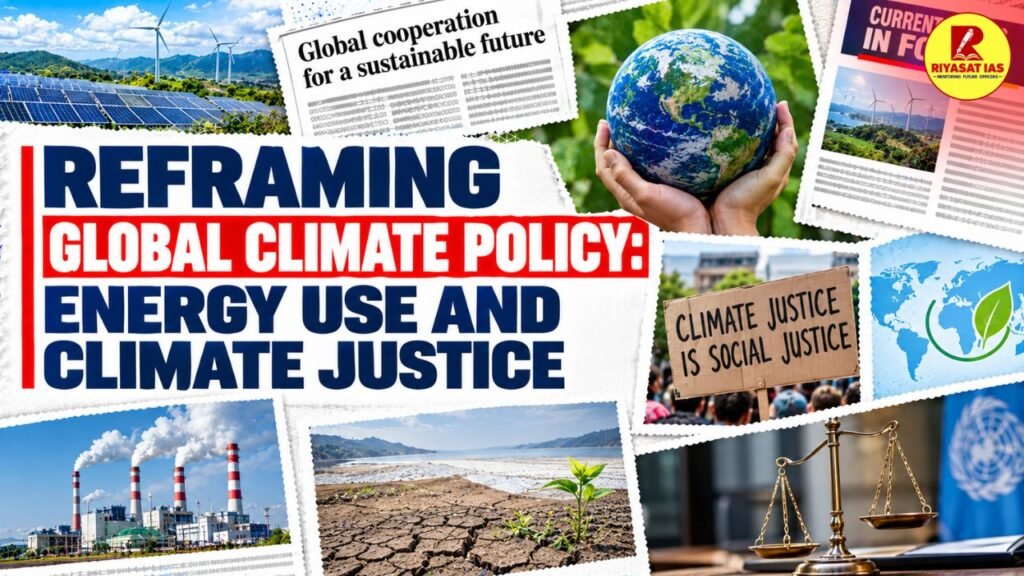
GS-III | Environment | Climate Change | Energy Transition | International Relations
Introduction
- Global Electrification: The world’s move toward electrification is acknowledged within the global climate change effort; however, the challenge for policymakers is that the transition to electrification will result in a decrease in commonality and an increase in differentiation.
- National well-being: The shift in focus from the global effects of coal-produced emissions to the role that electricity plays in a nation’s overall well-being.
- National actions: The national action will move from using global models to reviewing national actions. Global emissions of carbon dioxide are dealing with the effects of national energy use rather than the cause.
- Climate policy reform: The transformation of climate policy from a focus on production-side measures toward addressing the issues of consumption-side measures will necessitate a reorientation of the climate process.
The Limits of Global ‘Consensus’
- The global policy framework: Western academic groups, as part of “epistemic communities,” created the global policy and law for climate change. This includes “global values,” “global goods,” “global models,” and “global rules.”
- The role of international organizations: The role of international organizations was that they were utilized by official experts to create technical reports and establish policy frameworks which provided an aura of legitimacy through international collaboration.
- International law: The use of international law at that time was to force nations to implement what had been decided by the ‘consensus’ of the world.
- The unequal climate negotiation process: Resolving the tension between the world’s ecological constraints and the rapidly increasing need for energy as a result of urbanization in developing nations took place within the context of an unequal world where one side could pressure another into accepting certain conditions.
- There were no financial commitments to use these resources as “means of implementation.”
- Technology transfer: Technology transfer is generally considered to be a “scientific” issue as opposed to an “implementation” issue.
- Need for Re-framing: From 35 years of diplomatic negotiations and alternative models of development to those of Western countries, there is a clear requirement for re-framing climate policy.



Emerging Approaches to Climate Policy
- The executive order “America First”: The executive order “America First” on January 20th, 2025 emphasizes that the United States will focus on cost effectiveness, its citizens’ financial well-being, freedom of choice for consumers and budget control in all international agreements related to energy.
- Energy requirements of the Global South: With an increasing amount of energy being consumed in the Global South for the purpose of achieving similar standards of living as those found in developed nations, the process of carbonization (the addition of carbon) will occur before the process of decarbonization (the removal of carbon).
- Energy and wellness: The amount of energy that humans need to be well-off has never been addressed.
- The development model used by China: China is now the world’s second largest economy, as well as one of the world’s leading manufacturers. China has achieved a level of standard of living that is similar to that of the West, however they use significantly less energy.
- China’s National Transition from Fossil Fuels to Renewable Energy: An Alternative to Western Models: China has developed a national model for moving toward renewable energy, which is different than what is happening in the West.
- Renewable electrification: The technology side of the energy transition should concentrate on developing electrified systems powered by renewable energy, as opposed to trying to eliminate fossil fuel use.
China and India: Lessons for the Energy Transition
- Consumption patterns: China and India are providing a glimpse into how to limit consumption as a proportion of their respective GDPs, replace internal combustion engines, and use solar, wind, and hydropower to meet future energy demands.
- State intervention: The state must make a strategic choice about what kind of energy transformation to pursue because renewable energy is decentralized, intermittent and produces zero-marginal-cost energy.
- China’s renewable capacity: In 2025, China’s total amount of new renewable energy generation was greater than the combined total of all other countries. China added roughly ten times as much renewable energy capacity as the United States did.
- Electricity generation for the future: By 2030, as much as 50 percent of electricity produced in the U.S. may be generated using alternative energy resources rather than fossil fuels.
- Electric vehicles: In the first half of 2025, approximately 5.62 million new energy vehicles have been registered in China.
Global Trends
- Electrification and Quality of Life: Emerging nations are using significantly less electricity to create a high quality of life within urban areas than did Western countries at the same point in history, thereby creating new ways of living and defining ecological boundaries.
- Technological change: The internal combustion engine will become obsolete due to electrification. However, although there is a global technological shift in how we utilize energy, the models used by the UN to project future emissions do not capture this change.
- Demographic and Material Trends: The Rest’s development is sustained by the West having less than 20% of the world’s population. However, there has been a shift in demographic trends toward aging.
- The Unequal Use of Energy: In addition to the societal developments mentioned above, the continued unequal use of energy by Western countries indicates that there are no global energy crises but instead a number of national ones.
- Climate finance and extreme weather: The increasing frequency and intensity of extreme weather events in the Global South (where insurance availability is low) means that it’s time for the developed world to evaluate whether its current approach of providing minimal amounts of climate finance is sufficient.
- Practical Action: Some of the more practical steps that we can take together are to establish a Global Early Warning System (GEWS) and to create Regional Technical Cooperation for Disaster Relief (RTCDR).
Way Forward
- Reframe Climate Policy: Change the way that we view climate policies by changing the way that we look at climate policies from a global perspective. Instead of focusing on what is being produced, focus on how people are using products. Review the national policies of countries.
- Renewable electrification: Focus on electrification by utilizing renewable resources, and the production of new energy demands through solar, wind and hydro power.
- Climate finance: Review how developed countries are providing tokens of climate finance.
- Disaster Response: Build on global early warning systems and strengthen regional technical cooperation to provide relief from disasters.
- Climate justice: Build support for a new agenda centred on climate justice.
Conclusion
Climate policy must now evolve into a social issue through its implementation. For India, the primary challenge is to create support for a new approach based on climate justice.
UPSC Mains Practice Question
Q. Describe why there is a need to shift the perspective of global climate policy from focusing on the model of global emissions to addressing national energy consumption, electric vehicle adoption (electrification), and the issue of climate justice.
Prepare for UPSC Prelims and Mains 2027 with expert guidance, current affairs analysis, and a structured preparation strategy.
Join our UPSC Mentorship Program 2027 to strengthen your preparation and move closer to your IAS goal!





 Ravi Raaz
 Hassan Khan
 Shadab Ali