
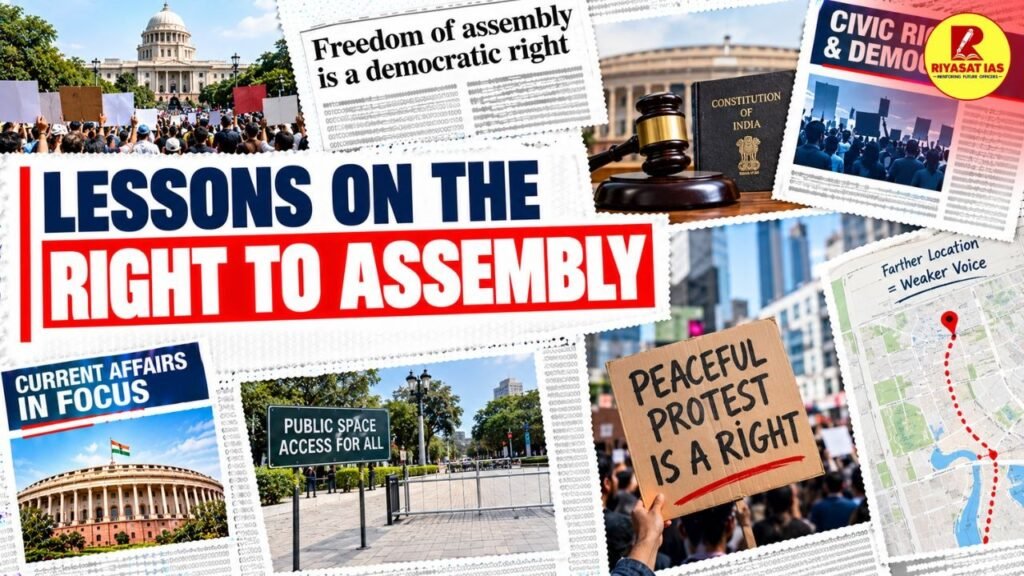
GS-II | Indian Polity | Fundamental Rights | Governance | Judiciary | Civil Liberties
Introduction
- The right to dissent and protest: A fundamental right in a liberal democratic society.
- Legacy of protests in India: Protesting through demonstrations and public meetings has a very strong historical connection with India as it can be traced from both the time of India’s independence movement and other forms of protests including those from trade unions, farmers, social activists, etc.
- Recent protests in Delhi: Lately there has been a lot of tension on the streets of Delhi due to protests against the central government. Many voters were excluded from the Special Intensive Revision (SIR), so now protesters are calling for the resignation of Chief Election Commissioner Gyanesh Kumar.
Constitutional Provisions for the Right to Protest
- Article 19(1)(a): Provides that every citizen has a right to express their thoughts, ideas, etc., freely.
- Article 19(1)(b): Guarantees the right to assemble peaceably without arms.
- Reasonable restrictions: The state has the power to pass laws that will benefit its sovereignty and integrity, as well as maintain public order, with the ability to place restrictions upon these laws that are considered “reasonable.”
- Fundamental rights: Fundamental rights operate as limits on state action.
Challenges to the Right to Protest
- A Culture of Suspicion: For several years now, there has been a growing trend toward a “culture of suspicion.” This type of atmosphere, where you are suspicious of anything that doesn’t agree with what the government wants, is pre-democratic in nature.
- Suspicion of protests: This perspective is based upon the idea of questioning whether a citizen group can “protest” and receive “funding” for doing so. This point-of-view will not allow for citizens to act as independent entities with the right to protest against something they believe in.
- Invocation of preventive laws: Immediately prior to the protests, the capital invoked Section 163 of the Bharatiya Nagarik Suraksha Sanhita (BNSS), 2023. The problem with this section is that it provides a great deal of discretion for the executive to order individuals to be removed from their location so as to protect public peace and order, along with other reasons.
- The disproportionate use of force: The use of excessive force against peaceful protestors, lengthy detentions with no disclosure of location, denial of access to legal representation and basic needs, as well as issuing deportation notices for Overseas Citizens of India (OCIs) that take part in the protest.
- Chilling effect on freedoms: The government’s use of its authority to create a chilling effect on the rights of individuals to speak freely and assemble with others is common.



Judicial Pronouncements on the Right to Protest
- Himmat Lal vs Commissioner of Police (1972): The Supreme Court stated that “reasonable regulation” of assemblies differs from “arbitrary exclusion.” Therefore, while the state may impose reasonable restrictions on the “time, place, and manner” of an assembly, the Supreme Court ruled that if the State were permitted to close all of its streets and parks to public meetings, the effect would be that it would be virtually impossible to conduct open air meetings in any major city.
- State monopoly over public areas: The court warned that a state’s monopoly over public spaces does not take away from the right of people to gather.
- Babulal Parate vs State of Maharashtra (1961): Although the constitutional validity of the previous version of section 163 of the BNSS was challenged, the Court did not intervene. However, the Court stated that the section is “only invoked in an emergency.”
Designating Protest Sites
- Accessibility of public spaces: Public spaces must be accessible and usable by everyone if there will ever be a real right to assemble.
- Removal of Jantar Mantar’s protest-site status: The removal of the status of Jantar Mantar as a place for protests is a very important issue.
- Impact of distant protest sites: The location of protests has a significant impact on the effectiveness of those protests. When people move their protests to distant locations, they render the purpose of protesting completely ineffective.
- Supreme Court directions: On October 9, the Supreme Court of India was considering several petitions regarding the total ban on all forms of transportation into Delhi. At that time, the Court ordered that there should be “suitable alternative sites” where people can protest.
- Inaccessibility of Jantar Mantar: The Supreme Court didn’t issue any interim order on the case that was filed to challenge the de-notification of Jantar Mantar as a protest site. Therefore, Jantar Mantar continues to be closed off to the public for protests.
Way Forward
- Reasonable restrictions: The state may impose reasonable ‘time, place and manner’ restrictions on speech; however, it cannot use arbitrary exclusion.
- Accessible public spaces: In order for there to be a real right to assemble, then the public spaces must be accessible and available.
- Judicial intervention: The court has to look again at whether it will give legitimacy to a government that takes away the people’s right to gather together.
- Constitutional spirit: The spirit of the constitution should aim to bridge the divide between those who believe in constitutionalism (and therefore support the right to assemble) and those who are conservative and do not.
Conclusion
- Core value of the right to protest: The core value of the right to protest, as defined by our Constitution, is that protesters should not be treated suspiciously.
- Balancing state authority and rights: In every democracy, there exists a conflict between individuals exercising their rights and the state using its authority. Therefore, any limitation of an individual’s right to assemble must be governed by Article 19(3).
UPSC Mains Practice Question
Q. Discuss the constitutional provisions relating to the right to dissent and protest in India. Examine the problems caused by preventive laws, restrictions placed on the use of public spaces, and the excessive use of force used against peaceful demonstrators.
Prepare for UPSC 2027 with our UPSC Mentorship Program. Get personalised guidance, a structured study plan, regular answer-writing practice, mock test analysis, and expert mentorship to boost your Prelims and Mains preparation. Join now and take the next step towards your IAS dream!





 Ravi Raaz
 Hassan Khan
 Shadab Ali