
GS-III | Economy | Science & Technology | Renewable Energy | International Trade
Why in News?
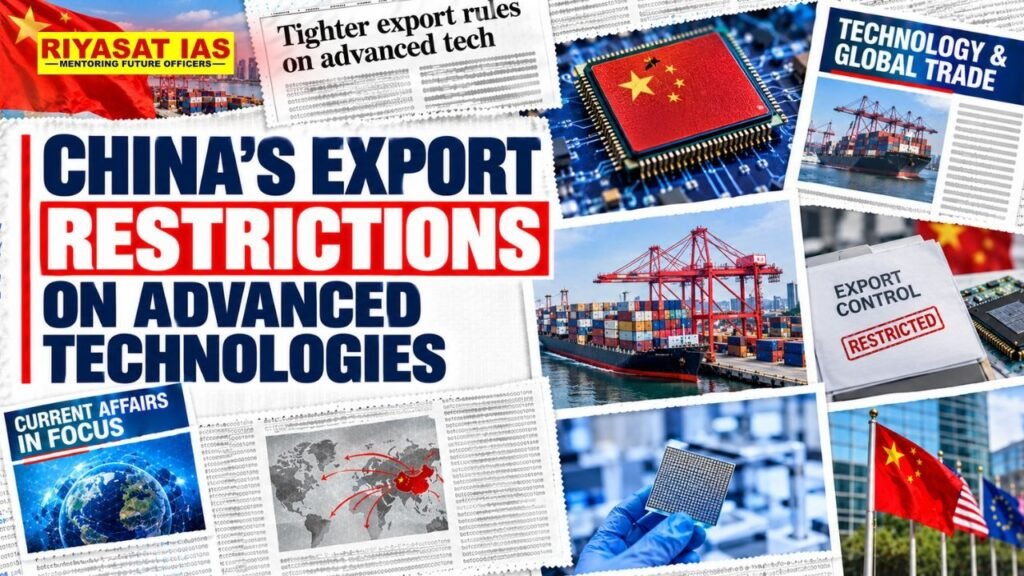
- China announced a sweeping draft plan to restrict exports of more than 40 cutting-edge technologies, including solar manufacturing technologies, AI models and some biotech platforms.
- The draft plan was announced by the Ministry of Commerce and the Ministry of Science and Technology and is titled “Announcement No. 48”.
Key Provisions of the Draft Plan
- Technologies Covered: The plan covers 40 key technologies in the fields of AI, biomedicine and photovoltaics.
- Complete Export Prohibition: 14 technologies were proposed for a complete prohibition of exports, including:
- Perovskite and tandem solar-cell module manufacturing technologies.
- AI-driven technology that could be used to generate and mutate malicious code.
- Some platforms related to cell and gene therapy.
- Restricted Exports: A further 26 technologies were listed for restricted exports, including polysilicon engineering technologies used to make solar cells, if they involve production lines with annual output capacities of at least 30,000 tonnes.
Impact on India
- Solar Manufacturing: New controls on next-generation solar manufacturing technologies could impact India’s efforts to reduce dependence on China as it looks to move up the solar chain.
- Export Restrictions: The draft plan does not restrict most solar exports, but imposes controls on a number of technologies related to the manufacture of solar cells.
- Potential Delays: Indian manufacturers in the solar sector may be impacted by licensing delays.

Way Forward
- Strengthen Domestic R&D: Strengthen the country’s research and development capabilities by investing in next generation solar cell technology such as perovskite and tandem solar cell technology.
- Diversify Technology Partnerships: Create technology relationships with several different nations so as to minimize reliance upon a singular provider.
- Promote Indigenous Manufacturing: Use appropriate industrial policy to promote local manufacturing of solar cells, equipment, and key components.
- Support for Start-Ups and Industry: Improve access to funding for research, testing equipment/facilities, and technology development for commercialization.
- Enhance supply chain resiliency: Identify critical technological dependencies and develop alternative sourcing arrangements.
- Balance Trade and Security: Improve international collaboration for technology access while safeguarding critical capabilities.
Conclusion
China’s suggested export restrictions demonstrate how much value there is in maintaining a position as a leader in technology for the purpose of global commerce. In response to this, India has to find a way to preserve their ability to obtain necessary technologies, enhance their own capabilities to innovate internally, expand on their supply chain diversification efforts and develop a strong, competitive domestic solar manufacturing sector.
UPSC Mains Practice Question
Q. Discuss the potential impact of China’s proposed export restrictions on advanced solar manufacturing technologies on India’s efforts to reduce dependence on China.
Master UPSC Current Affairs with Riyasat IAS Mentorship! Connect global technology developments with GS preparation and Mains answer writing.



 Ravi Raaz
 Hassan Khan
 Shadab Ali