
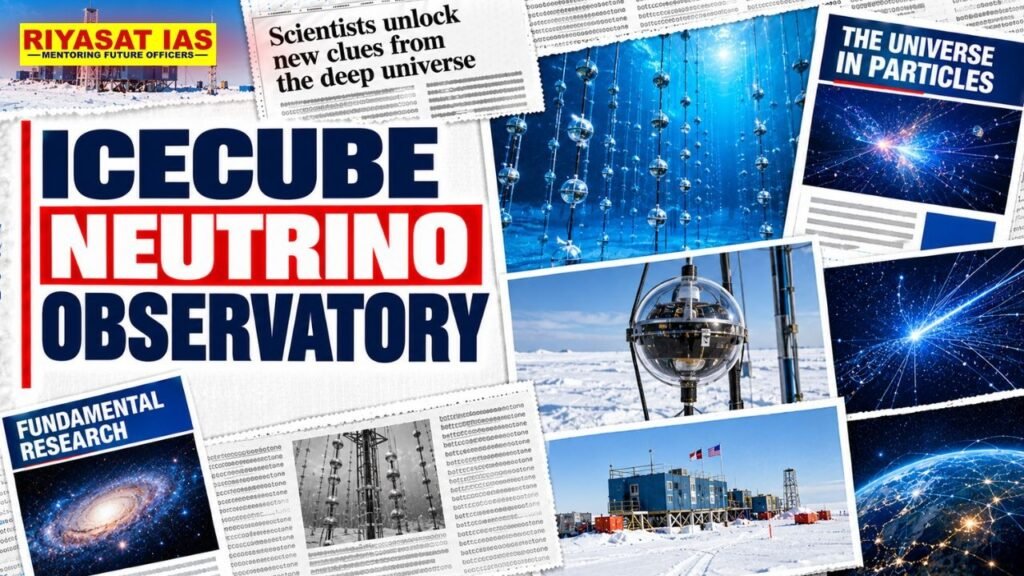
- The IceCube Neutrino Observatory is a scientific facility designed to detect neutrinos, tiny, electrically neutral subatomic particles.
- It is located at the Amundsen–Scott South Pole Station, Antarctica.
- It is one of the world’s largest neutrino detectors.
Important features
- Location: South Pole, Antarctica.
- Detector medium: Deep Antarctic glacial ice.
- Detection method: Uses thousands of optical sensors embedded deep in the ice.
- Working principle: When a neutrino interacts with matter, it can produce charged particles that emit faint blue light called Cherenkov radiation. The sensors detect this light.
- Neutrinos: Have no electric charge and interact very weakly with matter, allowing them to travel vast distances through space and even pass through Earth.
Scientific significance
- Studies high-energy neutrinos originating from distant cosmic sources.
- Helps investigate cosmic rays, black holes and extreme astrophysical environments.
- Contributes to multimessenger astronomy, which studies the universe using different signals, including neutrinos, electromagnetic radiation and gravitational waves.
Important terms for Prelims
- Cherenkov radiation: Light emitted when a charged particle travels faster than light travels through a particular medium, such as ice. It does not travel faster than light in a vacuum.
- Neutrino oscillation: The phenomenon in which neutrinos change from one flavour to another as they travel.
- IceTop: Surface detector array that complements the underground detector.
- DeepCore: A densely instrumented region that improves the detection of lower-energy neutrinos.



UPSC Prelims Practice Questions
Q1. Consider the following statements about the IceCube Neutrino Observatory:
- It is located in Antarctica.
- It uses Antarctic ice as its detector medium.
- It detects neutrinos primarily through their electric charge.
Which of the statements given above are correct?
A. 1 and 2 only
B. 2 and 3 only
C. 1 and 3 only
D. 1, 2 and 3
Answer: A — 1 and 2 only.
Explanation: Neutrinos have no electric charge. IceCube detects light produced by charged secondary particles generated when neutrinos interact with matter.
👉 Start Your UPSC Mains Mentorship
Your Current Affairs. Your Strategy. Your UPSC Journey.
👉 Explore UPSC Mentorship Program 2027 / 2028





 Ravi Raaz
 Hassan Khan
 Shadab Ali