GS-II | International Relations | Global Governance
Why in News?
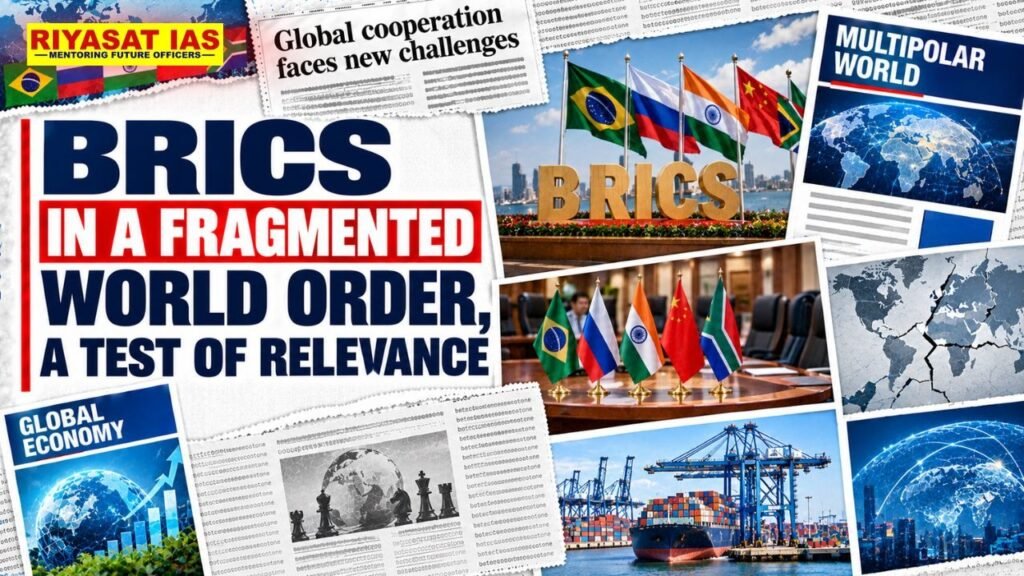
- 18th BRICS Summit: Held in New Delhi on 12–13 September 2026.
- The New Delhi Declaration: The unanimous adoption of this outcome document was a significant achievement in bridging the vastly diverging views within the 11-member grouping.
- India’s Role: That consensus under the chairmanship of India was a reflection of India’s standing within BRICS and its role in global affairs.
Key Highlights of the New Delhi Declaration
- Reform of Global Governance: Pushed for reform of the United Nations (UN) and international financial institutions, placing special emphasis on the interests of developing countries.
- Trade and Finance: Local-currency trade proposals and interoperable cross-border payment systems.
- Economic Cooperation: BRICS Economic Partnership Strategy 2030 adopted; Global Value Chain Action Plan for 2026–2030.
- West Asia: Efforts for de-escalation in West Asia and humanitarian access in Gaza.
- Artificial Intelligence (AI): Recognised the prospective role of AI in boosting economies, enhancing public-service delivery and speeding up sustainable development.
- AI Cooperation: As a top priority, support for international cooperation on AI governance, broader access to computing resources, research, skills and innovation.
- Multilateral Trading System: Reaffirmed support for the WTO and a rules-based multilateral trading system, including a two-tier WTO dispute settlement mechanism.
- Palestine: Advocated the Palestinian people’s right to self-determination and a just and lasting resolution according to international law.
- Common Principles: Promoted mutual respect, sovereign equality, non-alignment and openness to consensus between world leaders.
Political Message and India’s Approach
- Reform of Global Institutions: Global institutions are no longer properly representative of the economic and demographic realities of the 21st century. The voice of emerging markets and developing economies needs to be even stronger in such bodies.
- Multipolarity: Reform of the Bretton Woods institutions, with a greater voice for developing countries.
- Dialogue and Diplomacy: Emphasise political solutions, dialogue and diplomacy.
- Sustainable Development: Sustainable development without so many strings.
- Strategic Autonomy: This Declaration was interpreted as being broadly in line with India’s policy of strategic autonomy, multi-alignment and multi-vector engagement.
- PM’s Vision: Prime Minister Narendra Modi argued that BRICS leaders need to prepare a list of 10 global governance reform proposals and that, if the future is common, there should also be assurance on who will shape it.
- Diplomatic Significance: The presence of Chinese President Xi Jinping and Russian President Vladimir Putin, along with the lack of mutual recriminations about the participation of the UAE and Iran, highlighted this diplomatic aspect.
- Substantive Cooperation: A degree of substantive cooperation that the Summit seemed to signal beyond mere diplomatic pageantry, towards consultation, discussion and dispute settlement.



A Candid Assessment of BRICS Limitations
- Variable Geometry: The current international system is defined by fluid cooperation rather than fixed alliances.
- Ad Hoc Cooperation: Cooperation is aligned around interests, as opposed to values and intentions.
- Decline of Multilateralism: Many believe that global cooperation now mostly takes place in the form of plurilateral agreements rather than truly multilateral ones.
- Unmet Demands: The original BRICS countries — Brazil, Russia, India, China and South Africa — also had unmet demands, such as reforms of the IMF, World Bank and UN.
- Weak Economic Integration: BRICS was expected to create better trade opportunities, but it has proved to be a less well-integrated economic bloc, unable to effectively challenge the dominance of the Bretton Woods institutions.
- Insufficient Cooperation in the Global South: BRICS has been insufficiently effective at advancing South–South cooperation or reducing reliance on Western financial architecture.
- Altered International Order: Expectations of continued cohesion among Brazil, Russia, India and China on the basis of the grouping’s foundations at Yekaterinburg in 2009 are anachronistic, given subsequent transformations in the political and economic order.
The China Factor
- Economic Heft: China has grown economically far larger than other BRICS members, leading to an asymmetrical relationship within the group.
- Political Clout: China’s political clout is now strong enough that China casting BRICS as a united grouping to oppose Western hegemony may no longer be viable.
- Changing Role: With its economic strength and political clout, does China represent what the typical BRICS countries and the Global South demand?
- India–China Tensions: Despite diplomatic efforts following the serious conflict at Galwan in 2020, relations remain uneasy.
- Implications for BRICS: Ongoing frictions between India and China undermine the coherence of the grouping and its ability to deliver on common goals.
- Asymmetry of Power: The concentration of economic and political power among members lessens the relevance and importance of BRICS over the coming years.
Implications for India
- Limited Combined Leverage: India does not gain much in terms of its political or economic standing simply by becoming a member of BRICS.
- Strategic Autonomy: India focuses on independent choices in foreign policy while balancing between different power centres.
- Bracing for BRICS: India needs to understand the limits of what can be achieved in a more fragmented global order.
- Future Relevance: The future of the grouping lies in whether it can manage internal divergences and reinforce economic collaboration while providing significant reforms to global governance.
Way Forward
- Global Governance Reform: Pursue UN, IMF and World Bank reforms that recognise modern economic and demographic realities.
- Enhancing Economic Integration: Enhance trade, local-currency transactions and cross-border settlement.
- Promote South–South Cooperation: Strengthen cooperation among developing countries and lessen over-reliance on Western financial systems.
- Normative Role: Resolve internal discord through dialogue, diplomacy and consultations.
- Balance National Interests: Embrace the diversity of members’ interests but find areas of pragmatic collaboration.
- Improve Institutional Effectiveness: Deliver on pledges and promises by achieving results in trade, technology, climate, health and food security.
- Keep Expectations in Check: Treat BRICS as a forum for cooperation, not an integrated organisation bound by cohesive strategic goals.
Conclusion
BRICS demonstrated its potential to build consensus through the New Delhi Declaration. That said, it is constrained by a lack of institutional reforms, restricted economic integration and growing Chinese dominance. India’s challenge is to leverage BRICS to advance strategic autonomy, multipolarity and representation of developing countries, while remaining cognisant of its own collective-action limits in a fractured international order.
UPSC Mains Practice Question
Q. While the unanimous adoption of the New Delhi Declaration is testimony to BRICS’ continued diplomatic relevance, structural power asymmetries among members and divergent national interests inhibit its utility. Discuss the significance of BRICS for India’s international relations and foreign policy.


 Ravi Raaz
 Hassan Khan
 Shadab Ali