
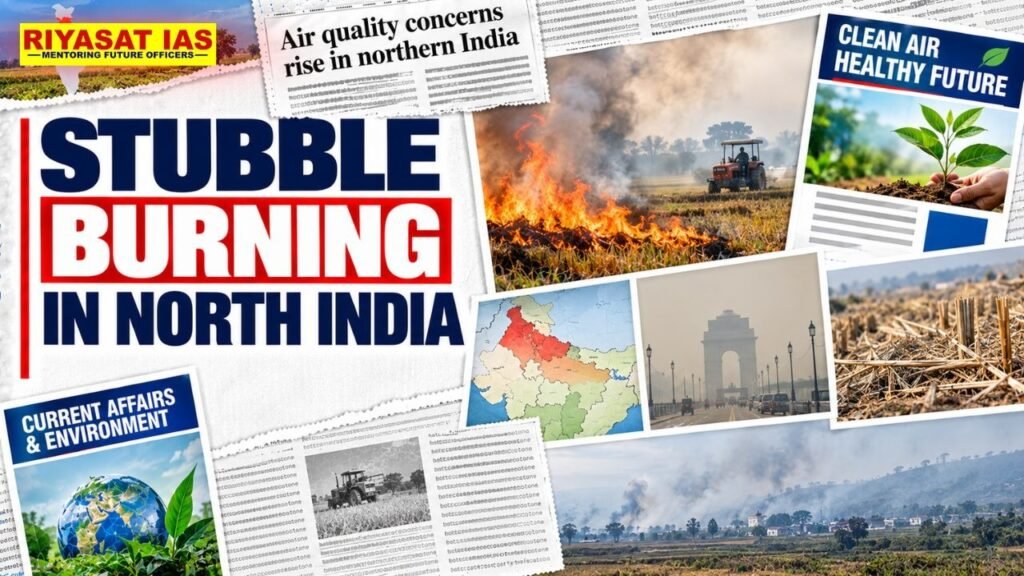
GS-III | Environment | Agriculture | Air Pollution | Crop Diversification
Why in News?
- Seasonal Air Quality: Air pollution in north India, particularly Delhi, comes to the forefront at this time of the year. A largely cited cause for deteriorating Air Quality Index (AQI) is stubble burning by farmers.
Why Do Farmers Burn Stubble?
- Stubble burning : Stubble burning is the practice of setting fire to crop residue – the remains of harvestable crops and the lower parts of plants.
- Extent of Practice: Occurs periodically from the beginning of October to the end of November across a large area covering northwest India, particularly in Punjab, Haryana and parts of Uttar Pradesh.
- Feature: Stubble burning is mainly attributed to paddy straw, with Punjab and Haryana producing about 29 million metric tonnes of paddy straw.
- Air Pollution: Stubble burning emits huge volumes of particulate matter, carbon monoxide, volatile organic compounds (VOCs) and other carcinogenic chemicals, leading to dense fog which is life-threatening for human health.
- Loss of Soil Fertility: It diminishes nitrogen, sulphur, potash, phosphorus and other micronutrients.
- Decreased Dryness of Soil: Stubble burning helps in lowering moisture levels and soil organic content, consequently helping in reducing the need for fertiliser in succeeding cropping seasons.
Historical Background
- The practice of stubble burning in Punjab has been around since the late 1970s and early 1980s, largely after the introduction of combine harvesters that leave part of the plant behind in the soil post-harvest.
- Change in Timing: What has, however, changed is its timing, as it now falls during the winter months in North India. This change came after the promulgation of the Punjab Preservation of Sub-Soil Water Act, 2009 (PPSSWA 2009).
Water Crisis and PPSSWA, 2009
- Groundwater Dependence: Groundwater extracted from 73% of the cropped area in Punjab was aided and irrigated by groundwater resources in 2012.
- Water Deficit: There was a gap between the amount of water needed and the available water. The deficit in this case is 12.04 billion m³, which was supplied by over-abstraction of groundwater.
- A Decline in Groundwater Levels: The rate of declining groundwater levels in Punjab increased rapidly by 0.36 metres per year in this decade (1999–2009) due to its over-exploitation for agriculture.
- NASA GRACE Satellite Study: The first was a landmark satellite study of the US Geological Survey and the German Aerospace Centre in 2009, which found Punjab, Haryana and Rajasthan lost 109 cubic kilometres of groundwater from 2002–08 alone—the largest instance of depletion anywhere in the world at that time.
- Objectives of PPSSWA, 2009 :To stop overexploitation of groundwater and to avoid sowing paddy nursery early, as well as transplanting it before the monsoon arrives.
- Ban on Sowing: Farmers were not allowed to sow paddy before May 10 and transplant it in the field before June 10 to postpone transplantation until the onset of the monsoon, according to the Act.
- Penalties: Officers had the power to destroy paddy that was planted in defiance of the Act and impose a penalty of ₹10,000 per hectare every month it was cultivated. Those measures by officials were not subject to legal review as well.



The Role of Water Conservation Measures in Stubble Burning
- Late Harvest: Sowing prohibitions imposed by the PPSSWA 2009 delayed harvesting of paddy to late October and early November, which left farmers with barely 10–15 days to prepare their lands for the wheat crop next.
- PUSA-44: The variety has high yield capability, but only allows a window of paddy harvesting and wheat sowing between 150–160 days.
- Combine Harvesters: These leave about 1 foot of stubble and provide a fast residue-clearing option for the farmer.
- Manual Clearing: It is time-consuming and costly.
- Combined with these, the two factors practically made stubble burning a necessity for the farmers.
Incentive Problem: Farmers Still Want to Grow Paddy and Wheat
- MSP and Procurement Framework: The current minimum support price (MSP) and procurement framework is skewed in favour of rice and wheat procurement from Punjab and Haryana.
- Paddy Procurement: For the period from 2012 to 2024, average paddy procurement in India was about 37% of production. In Punjab and Haryana, it was 87% and 74%, respectively.
- Wheat Procurement: Only 30% of production nationally was procured, compared to 70% in Punjab and 63% in Haryana.
- Regional Split: If Punjab and Haryana are excluded from the national averages, the differences may well be larger.
- Assured Income: It gives assured incomes to the producers of these two crops in these States, preventing them from diversifying into other crops.
- Free or Low-Cost Power: For example, Punjab farmers pay no fees for electricity and Haryana nearly free. This only promotes farmers to extract water, which can be used for the cultivation of paddy and wheat, taking advantage of groundwater.
Technical Solutions and Their Limitations
- In-Situ Measures: CRM machines—Happy Seeders, Super Seeders and Rotavators; short-duration rice varieties; direct seeding of rice.
- Ex-Situ Measures: Utilisation of crop residue for energy use, such as bio-ethanol and compressed biogas.
- Cost of CRM Machinery: Happy Seeders and Super Seeders require an expensive 60-horsepower (HP) tractor, which remains unused for most of the year.
- Hiring Costs: Hiring one typically costs a farmer ₹10,000 and involves a long waiting period.
- Ex-Situ Costs: Ex-situ measures incur a cost of ₹1,500–2,500 per acre, which is high for many farmers.
- The Core Challenge: Both methods are confronted with significant challenges. The other economic approach is to create an incentive structure for farmers to move away from paddy and towards other crops.
Policy Response and State-Level Approaches
- 2018 NGT Ruling: The National Green Tribunal established the case against farmers burning stubble and said that perhaps the MSP policy should not apply to them.
- Supreme Court, 2023: The apex court confirmed this viewpoint.
- Monitoring: During the stubble-burning season of 2025, 31 flying squads by the Central Pollution Control Board (CPCB) were deployed in 18 districts of Punjab and 13 districts of Haryana, involving 10,500 field functionaries in Punjab and 10,000 in Haryana.
- CAQM Direction: The Commission for Air Quality Management (CAQM) ordered that officials who fail to monitor properly may face pleas in the courts.
- Parliamentary Committee: The air quality committee has recommended that action against farmers should be the last resort.
- Guaranteed Income: The Committee recommended setting a minimum price covering all the costs for selling stubble for ex-situ measures, ensuring farmers’ guaranteed income.
The Case of Punjab
- The government in Punjab primarily relied on the in-situ CRM-based measures and fewer ex-situ ones.
- CAQM Observation, 2025: CRM and enforcement-related actions, in terms of availability of machines and norms, need to be completed on an urgent basis in Punjab specifically for the forthcoming residue-burning period.
Haryana
- Haryana followed an incentive-based mechanism along with in-situ and ex-situ measures.
- Financial Incentives:
- ₹1,000 per acre for CRM use by Haryana.
- Direct seeding of rice: ₹4,000 per acre in Punjab and Haryana.
- Up to ₹7,000 per acre for diversion to alternative crops in Haryana.
- Additionally, incentives to panchayats based on performance.
- Reported Decrease: In the paddy harvesting period of 2025, Punjab and Haryana reportedly achieved a 90% reduction in stubble-burning incidents compared to October–November 2022 (Lok Sabha Starred Question No. …).
Measurement Issue: Caution Is Needed in Interpreting This Measure
- CREAMS Protocol: The Consortium for Research on Agroecosystem Monitoring and Modeling from Space (CREAMS) protocol employs NASA’s MODIS and VIIRS satellites to measure stubble burning.
- Fixed Observation Times: These polar satellites orbit the poles of the Earth and observe India at fixed times in a day, i.e., 10:30 a.m.–1:30 p.m.
- Limitations: They see active fires but cannot quantify how many actually burn across a 24-hour period.
- International Forum for Environment, Sustainability and Technology Report, 2025: When results for area burned are computed using data from multiple satellites, the decrease is slower—about 30%.
- Current Science Study – November 2025: A study by ISRO scientists (Indian Space Research Organisation), combining geostationary satellite observations, indicated that farmers had moved stubble burning to night hours, avoiding polar satellites.
- Better Measurements: Both polar and geostationary satellite data can be used to monitor stubble burning.
Way Forward
- Diversification of Crop Production: Build an incentive structure for farmers to move away from paddy towards other crops.
- Balanced Technical Options: Integrate on-farm and off-farm short-term, in-situ and ex-situ remediation with alien tree plantation, as well as medium- and long-term diversification of cropping systems away from paddy.
- Guaranteed Returns: As a measure for securing ex-situ measures, stubble must be sold at the minimum price necessary to cover all costs related to the harvesting of stubble in order to guarantee farmers full income.
- On-Time Availability of Machinery: Timely availability of CRM and support to CBG plants, as well as other industries employing paddy straw.
- The Approach Based on Incentives: Direct seeding of rice and diversification to alternative crops through incentives.
- Better Measurement: Assess the burning of stubble by way of polar and geostationary satellite data for a robust assessment.
- Finally, Penalties as Last Resort: Penalising farmers should be the last resort; penal provisions which force collusion between farmers and officials may lead to an actual reduction, albeit showing a reduction.
Conclusion
On the contrary, stubble burning is a net result of technology, economy and law. The answer lies in a careful combination of short-term on-ground and off-ground measures with mid- and long-term crop diversification away from paddy. The way to measure it needs to improve. And, since there can be perverse incentives for collusion between farmers and officials, whereas showing a reduction is an outcome that may have some importance, reducing would not mean much one more time; penal provisions are unlikely to work.
UPSC Mains Practice Question
Q. Stubble burning in North India is a multi-faceted problem rooted in technology, economics and law. Discuss the reasons for stubble burning and suggest some measures to avoid it.
Prepare Environment and Ecology Current Affairs with Riyasat IAS Mentorship
Stay updated with important environmental issues, analyse government initiatives and strengthen your UPSC Prelims and Mains answer-writing skills with personalised mentorship.
Explore our UPSC Mentorship Program for structured preparation and daily current affairs guidance.





 Ravi Raaz
 Hassan Khan
 Shadab Ali