
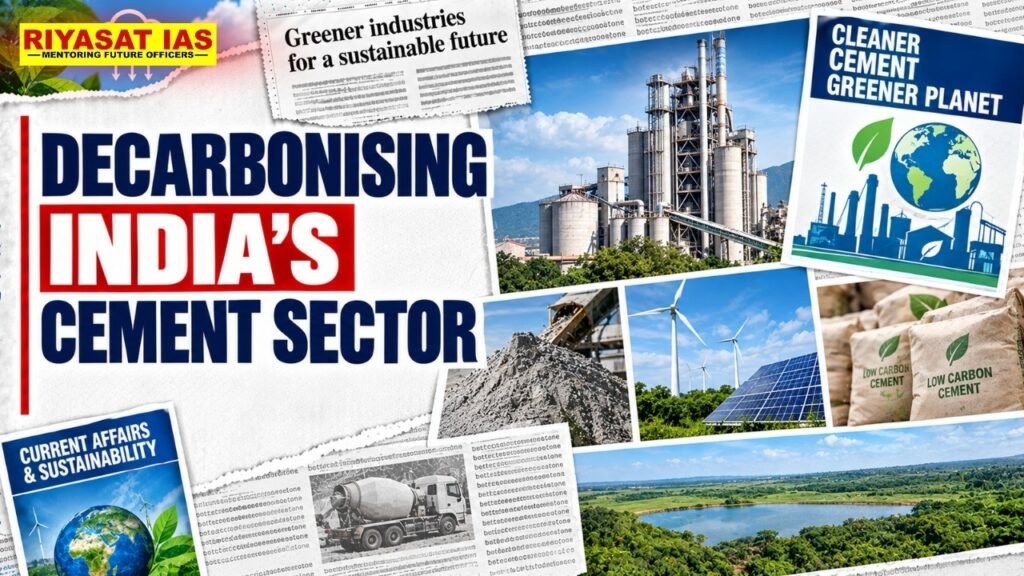
GS-III | Environment | Climate Change | Decarbonisation of Cement Sector
Why Cement Matters
- Targets of India Till 2047: India intends to transform into a financially evolved country by 2047; a net-zero discharges economy by 2070.
- Construction: It accounts for 35–40% of global GHG emissions, with steel and cement playing significant roles.
- Cement: Cement is responsible for 7–11% of global emissions and is among the hardest to abate sectors related to energy-intensive production as well as limestone calcination.
Traditional Alternatives
- Portland Cement: The binder of choice by the 19th century when Portland cement was produced in Britain from the 1820s.
- Conventional Binders: India used lime, lime-surkhi or mud/clay, gypsum and natural pozzolanic materials traditionally.
- E.g. Lime Mortar: The Taj Mahal, Roman buildings and lava pozzolanic binders.
Science of Cement
- Raw Material: The main raw material used in cement is limestone.
- Heating: We take the limestone, combine it with some clay and heat it up to about 1,450°C.
- Emissions: It produces around 35–40% of the emissions linked to making cement; the remainder comes from the chemical reaction that occurs when limestone decomposes.
- Clinker: The cement is made by crushing, combined with gypsum and fly ash. The calciners release CO₂ during the clinker process.
- Cement Emissions: India solves the problem by emitting 0.62 tonnes of CO₂ per tonne of cement.
- Goal: Emission rate drop of 0.56 tonne by 2030 and 0.51 tonnes by 2047.
- Cement Production: It is expected that cement production will increase from 334 million tonnes in the current year (2019-20) to 1,546 million tonnes in the year of potential peak emissions (2070).
- Other Pollutants: Cement production also releases nitrogen oxides, sulphur dioxide and particulate materials.
- Unforeseen Costs: Limestone mining, loss of vegetation, transportation and the loss of carbon sequestration are unforeseen costs as well.



Decarbonisation Solutions
- RDF: As a substitution of coal in cement kilns, use refuse-derived fuel (RDF) from municipal solid waste.
- Ambition: NITI Aayog recommends 20% thermal substitution level for 2030, up to 80 million tonnes CO₂-equivalent emissions reduction.
- Source Segregation of Waste: It is needed to have better source segregation of waste for utilizing RDF effectively.
- Clinker Reduction: Use waste/by-products (slag, fly ash, etc.) to replace clinker.
- Natural Clinker Replacement: Replacing 1 tonne of clinker avoids the emission of 0.83 tonnes of CO₂.
- Carbon Capture: In the journey to net-zero, carbon capture is fundamental since cement is one of those sectors which cannot be fully decarbonised.
- Types of Cement: More than 95% clinker in OPC; Portland pozzolana cement carries 65–80%; Portland slag cement carries 35–64%.
- Green Cement: One way to increase demand for green cement is through large-scale government procurement efforts.
- Clinker to Cement Ratio: At ~67.5%, India is only slightly below global average of 77% but this can be reduced further.
Looking Beyond Cement
- Soil, Sand and Cement or Lime in Small Proportions: The 2 types are Compressed Earth & Rammed Earth: Southern India.
- Natural Binders: Cactus juice with lime and mud, marble powder can be the binders.
- Kath Kuni: A style of construction that utilizes dry masonry and uses alternating wooden beams without cement.
- Wood & Bamboo: Widespread in Northern and Northeastern India, using these materials to make structures more water- and earthquake-resilient.
- Limitations: Old materials tend to be location-specific and require some customization to meet modern needs.
- Progressive Realism: You cannot actually eliminate cement and concrete from modern building practice — the practical approach is to limit its use wherever possible, and design buildings (and urban areas) to reduce heat gain, and heat storage.
UPSC Mains Practice Question
Q. Reducing emissions from the construction sector is critical to achieving India’s development and net-zero targets. Discuss the environmental impact of cement and the solutions for reducing its carbon footprint.
UPSC की तैयारी शुरू करें सही Guidance के साथ
अगर आप हिंदी माध्यम से UPSC की तैयारी कर रहे हैं, तो structured GS preparation, study material, current affairs, answer writing और mentor guidance के साथ अपनी तैयारी को सही दिशा दें।
👉 हिंदी GS Foundation से जुड़ें | Free Counselling लें | Mentor से बात करें




 Ravi Raaz
 Hassan Khan
 Shadab Ali