
GS – III Economy | Digital Payments | Cybersecurity and Financial Inclusion
Why in News?
- Scale of Digital Payments: Over 24,000 crore UPI transactions with transaction values crossing ₹314 lakh crore in FY 2025-26.
- Internet Penetration: Over 70% of its population is connected to the internet. India is one of the most desired global markets for Internet Services and Digital Platforms.
- SPIR 2026: Status of Policing in India Report (SPIR) 2026 explains internet use by India and how modern cybercriminals stay ahead of a single step against the users.
Digital Payments: A Daily Habit
- Usage: Nearly half (49%) of the respondents use UPI apps on a daily basis, and another quarter (24%) once or twice a week.
- Most Popular: UPI was the number one online payment method, with 48% of respondents saying they use it “many times”.
- UPI–Trust: UPI received the highest level of trust among all other payment methods as one-third (34%) of respondents rated UPI payment as “very safe”, while two in five (41%) feel it is “somewhat safe”: A total of three-in-four people consider it safe.
- Card Payments: Card payments were in the second place, 65% believe that it is safe.
- Overall Trust: A majority of the respondents find all types of online banking modes safe, with about one-fourth gaining them on the category of “very safe,” and two in five falling in between the categories of “very somewhat-safe.”
The Trust Paradox
- Unsafe Practices: SPIR also surveyed participants regarding behaviour, which together with the knowledge assess peoples’ vulnerability to unsafe online practices.
- Examples: Would they click on a link from an unknown sender? A random photo / video / file shared by a stranger? What do you share OTP with a random caller?
- Vulnerability and Confidence at the Same Time: The people least likely to engage in safe banking online were actually the most confident about their capabilities of using internet banking.
- Highly Vulnerable: Among the highly vulnerable, around half (49%) labelled online banking approaches as “very safe” and another 39% regarded them as “fairly secure”.
- Moderate to No Vulnerability: Of those people with moderate and no vulnerability, on average only one in five thought online banking was ‘very safe.’



Trust and Cybercrime Victimisation
- Victimization: People who perceived online banking modes to be “very safe” were more than likely victims of cybercrimes in last 2–3 years.
- Victims: 28% of victims thought that online banking methods constituted very safe, while only 14% considered online banking methods to be very unsafe.
- Because Perception of Safety: When you feel less secure, then the risk of victimization decreases.
- UPI Usage: Over the last 2–3 years, frequent UPI users have been more affected by cybercrime than people who never use UPI.
Organised and Inventive Cybercriminals
- Cybercrime Ecosystem: Your adversary is an organization with creativity in harmony with high trust and use of people via online banking methods.
- Fraud Kits: Exploit kit ($10), which is a fake web page that used to install malware (to steal data) on the target device; Microsoft fraud kit, Apple Fraud Kit, and more.
- Little Investment, Big Scam: With an initial investment of just ₹10,000–20,000 on these kits, fraudsters can make away with someone’s entire life savings running into tens to hundreds of lakhs or crores and remain virtually free from detection.
- In the Most Advanced Schemes: The fraudsters develop full sweep investment/betting apps, convincingly detain victims virtually on their phones for days and simply tricks the victim into believing them and revealing personal information.
Users as the Replaceable Link
- Bank Accounts: Two interactions where they said they had given their bank accounts to someone who they did not realise was a fraud, and were thus involved in the crime about which they knew very little.
- Exploitation: Fraudsters are not only exploiting gaps in the financial system, but they are recruiting its users and leaving them to be apprehended by the police as the most replaceable link in the chain, while they themselves go untouched.
Core Paradox
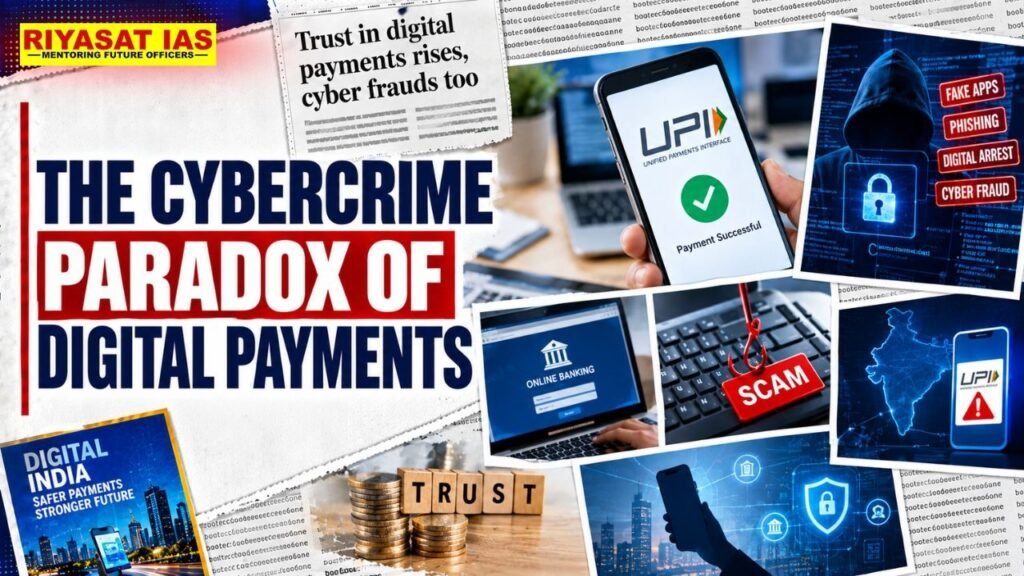
- Trust–Usage–Victimisation: Although this might sound like a contradiction in terms, the SPIR 2026 indicates that high levels of digital payments are accompanied by increasing trust and increased vulnerability to cybercrime.
- An Intelligent Opponent: The other end is an intelligent opponent utilizing all the proper instruments and preying upon the people confidence in their financial frameworks, and cunningly spiking with the human brain science to misuse it.
Conclusion
- Digital Payments: By itself, this is a success story. A system they use all of the time and a system that returns on delivery to a fair extent; people trust.
- Cybercrime Challenge: People widely place their faith in transactional methods on the Internet and use these services, confronting a progressively organised adversary: cybercrime challenge.
- Behavioural Challenge: Thus, the challenge here is not just technological but behavioural; since cybercriminals exploit trust, vulnerabilities and human psyche.
UPSC Mains Practice Question
Q. “The SPIR 2026 points to an almost paradoxical association: the more people use digital payments, the more they trust them, and the more likely they are to be victims of cybercrime.” Discuss.
→ UPSC 2027 Preparation: Get the latest UPSC notification, exam dates, syllabus, and preparation updates for Civil Services Examination 2027.
→ UPSC Prelims 2027: Strengthen your preparation with topic-wise revision, MCQ practice, previous year questions, and exam-oriented guidance.
→ UPSC Mains 2027: Improve your answer writing, content enrichment, revision strategy, and Mains-oriented preparation with expert guidance.




 Ravi Raaz
 Hassan Khan
 Shadab Ali