
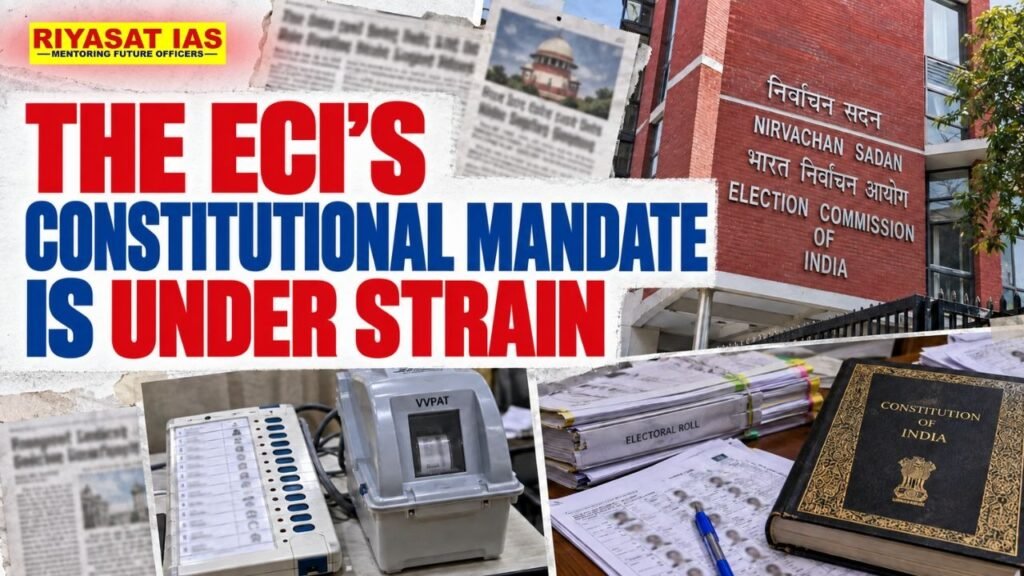
GS-II – Polity & Governance | Election Commission of India | Electoral Reforms
Why in News?
- Public Criticism of ECI: The Election Commission of India (ECI) has never been criticised publicly as much as it is today.
- Diminished Credibility: Historically, the ECI has garnered respect both within and outside India for its organisation, fairness and adherence to democratic values.
- Recent Concerns: It has hit the headlines for allegations of illegality, partisanship and procedural impropriety.
- Special Intensive Revision (SIR): The ECI methodology and procedural developments regarding SIR of electoral rolls in different States have raised issues of legal, procedural and constitutional propriety.
Constituent Assembly and Fear of Elections
- Outside Executive Control of ECI: The debate in the Constituent Assembly regarding the Election Commission reflected a consensus, including Dr. B.R. Ambedkar, against subjecting the election machinery to the control of the executive government.
- View of Dr. Ambedkar: He stressed that the basic principle that “the election machinery must be independent from the control of the executive government” was not in controversy.
- Original Proposal: A decentralised election machinery with a Governor behaving as Chief Election Commissioner of every province to conduct electoral rolls and elections to State legislatures was proposed in the Draft Constitution.
- Proposal on Centralised Election Machinery: A central Election Commission was provided for, which Dr. Ambedkar did not accept and instead moved in favour of it.
- Cause of Centralisation: The centralisation was due to State Chief Election Commissioners, mostly political appointees of the Chief Ministers, deleting voters seen as opponents of ruling parties in a massive manner.
- Central ECI: Thus, the new Article was inserted to provide for a Central Election Commission consisting of the CEC and other Election Commissioners, which would be responsible for:
- Preparation of electoral rolls.
- Elections to Parliament.
- Elections to State legislatures.
- Vote for the Presidency and Vice-Presidency.
- Ironic Twist: Almost 80 years later, similar complaints of mass purges without adherence to the law about voter removals have emerged.
- Concern of ECs: The other irony is that it was the Election Commissioners who complained of the CEC’s “illegal and unconstitutional acts.”
- Fear of Political Patronage: Shibban Lal Saxena’s apprehension was that a future regime could be headed by an inflexible party loyalist as CEC, who would use the electoral machinery at his/her disposal in furtherance of the ruling party.
- Safeguard Proposed: A person appointed by the President should be approved by Parliament with a two-thirds majority, similar to the US Senate.
- Constitution-Makers’ Concern: The Constitution-makers envisaged the danger of a CEC working against democracy and to the advantage of the party in power, leading to subversion of the constitutional scheme regulating elections.

Uncertain Legal Foundation of SIR
- Section 21 of the RP Act, 1950: Provides for preparation and updating of electoral rolls.
- Section 21(1): Electoral rolls in the prescribed manner with respect to the qualifying date shall be prepared and come into force after final publication.
- Section 21(2): Electoral rolls can be revised:
- Before every general election to the Lok Sabha or State Legislative Assembly.
- Before every by-election.
- At any time, if such revision is instructed by the ECI.
- Rule 25, Registration of Electors Rules, 1960: Revision under Section 21(2) may be:
- Intensive.
- Summary.
- Partly intensive and partly summary.
- Section 21(3): Another type of special revision is provided.
- Special Revision: The ECI may, for reasons recorded in writing, order a special revision of the electoral roll for any constituency or part thereof in such manner as it thinks fit.
- Narrow Field: By saying “any constituency or a part of a constituency”, it is clear that special revision is only meant for some constituencies where there are unique conditions.
- Different Types: Intensive revision and special revision are two kinds of difference in the way other circumstances.
- No “Special Intensive Revision”: The law does not include a special category called Special Intensive Revision (SIR).
- Article 324: The ECI cannot act contrary to law and the constitutional provision does not confer any power on the Commission to act fide. Insofar as statutory provisions are there, the ECI needs to act in accordance with the law.
The Cost of Unilateralism
- Removal of Voters: According to media reports quoted in the material, SIR operations have already led to the removal of 13 crore Indian voters from electoral rolls across the length and breadth of the country.
- Disenfranchisement Worry: This has been called the largest disenfranchisement effort in a democracy ever.
- Article 326: This entire exercise raises questions on the right of citizens under Article 326, which provides for universal adult franchise and that an eligible citizen can be registered as a voter unless he/she is disqualified by law.
- Article 326 – Purpose: Inclusion, not exclusion.
- SIR as an Issue: The aim of SIR seems to be to keep as many voters off the electoral rolls as possible.
- Unilateral Decision-Making: Within the ECI, this controversy has been associated with unilateral decision-making.
- Concern of Two ECs: Particularly, the two ECs have allegedly stated that they were not privy to some important decisions taken by the CEC.
- Legal Process: The structure of the ECI is constitutional and its decisional procedure is codified in law.
- Unilateral Decision: Unilateral decisions made by the CEC are illegal, which in turn renders measures taken later illegitimate.
- Potential Constitutional Crisis: This leaves one open to a little bit of a constitutional crisis.
Procedure and Protection of CEC
- Impeachment Motion: Opposition parties plan to bring an impeachment move against the alleged conduct of the CEC.
- Procedure of Removal: The CEC can be removed in the same manner as and on the same grounds as a Judge of the Supreme Court of India.
- Condition: Removal can happen only if there is proof of misbehaviour.
- Presiding Officers: Since both the Houses of Parliament have a Presiding Officer, he plays a vital role in impeachment because the Presiding Officers can reject an impeachment motion at the threshold.
- Potential Challenge: This clause can, instead, impede any attempts by Opposition MPs to take action against a judge or the CEC.
- Section 16 of the 2023 Act: The Chief Election Commissioner and Other Election Commissioners (Appointment, Conditions of Service and Term of Office) Act, 2023 establishes lifetime immunity from civil or criminal prosecution.
- Level of Immunity: The article reads that the President of India does not have such protection for a lifetime.
- Main Issue: The Election Commission is unlikely to be accountable due to excessive protection to the CEC and ECs.
Conclusion
- Constitutional Trust: The Election Commission, along with the legislature, was designed as a constitutional body insulated from executive control to protect elections.
- Current Challenge: Allegations of deleting votes, ambiguity about conduct of polls and unilateral decision-making have thrown up serious issues regarding its constitutional functioning and accountability.
- Constitutional Propriety: The integrity of the ECI ultimately rests on strict adherence to law, procedural correctness and democratic norms.
UPSC Mains Practice Question
Q. “An independent Election Commission is the foundation of electoral democracy.” Discuss in the context of the Special Intensive Revision (SIR) of electoral rolls.



 Ravi Raaz
 Hassan Khan
 Shadab Ali