
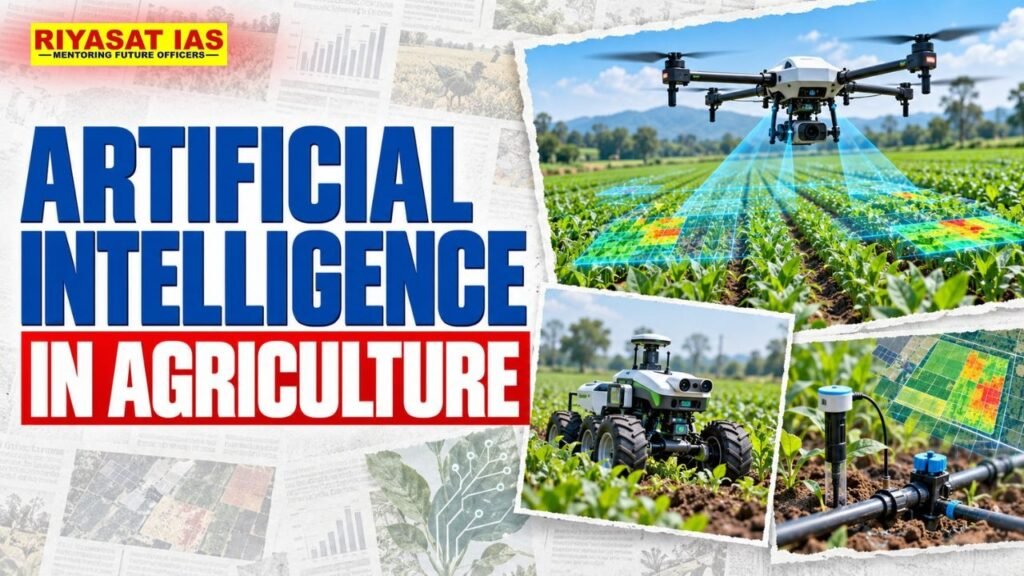
Artificial Intelligence in agriculture refers to the use of artificial intelligence (AI) and technologies such as machine learning, drones, and satellite imagery to support decision-making, improve farming practices and enhance productivity. The technologies can help farmers monitor and manage soil, water, crops, livestock, and the environment more efficiently.
Project Farm Vibes
- Project Farm Vibes is a suite of AI-driven technologies for agriculture that Microsoft Research has developed to improve the efficiency, productivity, and sustainability of farming. It uses satellite data, IoT sensors, drones and AI algorithms to provide useful insights to farmers.
- The project has incorporated the efforts of Microsoft Research, the Azure AI team, the Agricultural Development Trust in Baramati and Oxford University AI researchers.
AI-Based Agriculture in Baramati
The application of AI and digital technologies in farming in Baramati is an indication of how data from the farms can be leveraged to make agriculture more productive and efficient. Through the combination of various information sources, farmers can receive insights and recommendations that support decision-making at the farms.
- Sensor Fusion: The data collected from drones, satellite imagery, and soil moisture sensors can be fused to provide valuable information on the farm situation.
- AI-Based Farm Insights: Using AI, farmers can receive recommendations based on the data on soil, temperature, pH, and humidity levels.
- Vernacular AI Assistance: The use of AI to provide agricultural recommendations in local languages can boost the adoption of digital technologies in farming.
- Precision Farming:Through the use of AI, farmers can engage in precision farming to identify the spots that require fertilizing.
- Climate-Responsive Farming
- With the ability to analyze farm data, AI can recommend how best farmers can respond to the impacts of climate change.
- Based on the information provided in the source, the initiative has helped increase crop yield by 40%, reduce fertiliser costs by 25%, and conserve water by 50%. The source also highlights that the initiative has helped reduce the sugarcane crop cycle from 18 months to 12 months and reduced post-harvest losses by 12% due to improved logistics and storage.
Role of Artificial Intelligence in Agriculture
AI for Precision Agriculture
- AI, drones equipped with remote sensing devices, and computers can support precision agriculture by helping to monitor and collect data on the farm. Information such as crop health, soil, and weather conditions can be used to make informed decisions on water, fertilizer, or other inputs application.
- This technology can increase agricultural production while conserving water and reducing input costs.



AI for Data-Driven Farming
- AI can support data-driven agriculture by analyzing data to inform decisions on planting, harvesting, and crop rotation and to monitor and optimize irrigation.
- For instance, drones can be used to monitor crop health and detect nutrient deficiency or pests and diseases early in the growth period.
Hybrid Agricultural Intelligence (HAI)
- Hybrid Agricultural Intelligence combines farmers’ knowledge about farming in their localities with AI-driven recommendations.
- With the wide variation in the agro-ecological zones and farming systems in India, AI-driven recommendations based solely on algorithms may not be sufficient to support farming decisions.
- Farmers and local agricultural experts have knowledge about their farming practices and environmental conditions that they can contribute towards developing AI recommendations.
- The hybrid approach can help make AI more relevant and applicable in different localities and farm settings.
AI for Climate-Smart Agriculture
- AI can support climate-smart agriculture by analyzing weather patterns and providing early warning on extreme weather events and helping farmers respond to the effects of climate change by making recommendations on optimal water and fertiliser application.
AI-Powered Agriculture Solutions in India
Kisan e-Mitra Chatbot
- The Kisan e-Mitra chatbot is an AI-powered solution that provides information on the PM-Kisan Samman Nidhi scheme to farmers in various Indian languages.
- The chatbot is expected to provide information on other government programs and schemes related to agriculture.
National Pest Surveillance System
- The National Pest Surveillance System uses AI and machine learning to detect pests and diseases early in crops to support the timely application of appropriate control measures.
- This can help reduce pests and diseases damage and loss in agricultural production.
IoT-Based Irrigation
- ICAR has developed IoT-based systems for irrigation that have been tested on specific crops. The system uses information on the farm to help optimize water application and improve irrigation management.
AI-Based Crop Health Monitoring
- AI-based system can analyze photographs of the farm to monitor crop health and recommend actions where necessary.
- Data on weather conditions, including rainfall, can also be integrated into the system to support decision-making.
- Similarly, the system can provide soil moisture information for various crops such as rice and wheat to help support irrigation decisions.
Challenges of Using AI in Agriculture
- Small and Fragmented Landholdings: Most Indian farmers have small land holdings and fragmented farms compared to commercial farmers. Therefore, developing technologies that support precision agriculture at lower costs can be a challenge.
- High Cost and Infrastructure Requirements: AI-based agricultural technologies may be expensive and require specialized equipment and internet connectivity. These factors may make the technologies inaccessible, especially to small-scale farmers.
- Skill and Digital Literacy Gaps: Farmers and local agricultural institutions may need training and technological skills to adopt and effectively apply the new technologies.
Way Forward
- For AI to play a significant role in Indian agriculture, it is critical to invest in developing more affordable technologies, ensuring availability of local language information and digital infrastructure, and providing training to farmers.
- Similarly, AI solutions should be designed to support small-scale farmers.
- By combining farmers’ knowledge with AI, Indian farmers can benefit from using the technologies to transform agriculture.
FAQs
What is Artificial Intelligence in agriculture?
AI in agriculture refers to the use of machine learning, data analytics, drones, satellite imagery, IoT and other digital technologies to support decision-making, improve farming practices and increase productivity.
What is Project Farm Vibes?
Project Farm Vibes is a suite of AI-driven technologies for agriculture that Microsoft Research has developed to improve the efficiency, productivity, and sustainability of farming.
How is AI used in precision agriculture?
AI analyzes soil, crop and weather data to help farmers make more precise decisions on irrigation, fertiliser application, crop monitoring and pest management.
What is Hybrid Agricultural Intelligence (HAI)?
Hybrid Agricultural Intelligence combines farmers’ traditional agricultural knowledge with AI-based recommendations to support better farming decisions.
How can AI help farmers deal with climate change?
AI can analyze weather and field data to provide early warnings, optimize water and fertiliser use and support climate-responsive crop management.
What are the major challenges of AI adoption in agriculture?
The major challenges include small landholdings, high technology costs, inadequate digital infrastructure and limited technical skills and training among farmers.




 Ravi Raaz
 Hassan Khan
 Shadab Ali