
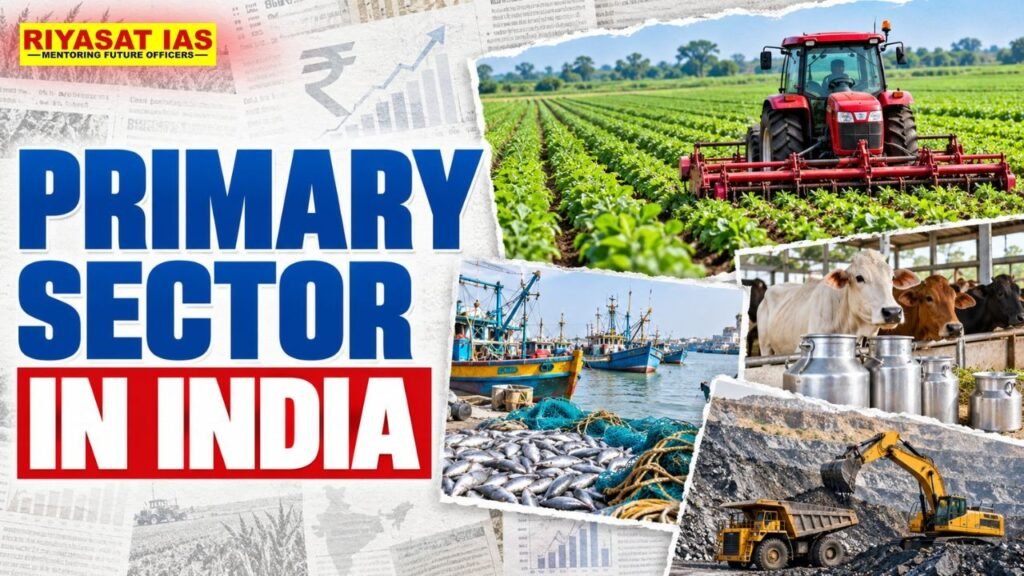
The primary sector is the backbone of the Indian economy. It includes all economic activities that are concerned with extracting natural resources and converting them into primary products. Farming, animal husbandry, forestry, fishing, and mining are some of the primary sector activities done in India. Although the share of the primary sector in India’s total output decreased over the years, its economic and social importance cannot be ignored. The primary sector continues to provide livelihoods to a large share of Indians, contribute to rural demand, and ensure the country’s food security.
What is the Primary Sector?
The primary sector of an economy is usually one of the three main sectors of economic activity, along with the secondary and tertiary sectors. Activities in the primary sector are directly related to the exploitation of natural resources.
While primary industries comprise a minuscule percentage of GDP in developed post-industrial countries like the US or Germany, they are significant sources of employment in emerging economies like India.
India’s Contribution from the Primary Sector
World Rank:
- In 2018, India ranked second in total agricultural produce with an output worth $1,400 billion in Purchasing Power Parity (PPP).
Economic Share:
- In 2024–25, the primary sector accounted for about 21.4% of India’s Gross Value Added (GVA) at current prices under the latest national accounts series with 2022–23 as the base year.
Workforce Participation:
- The primary sector remains one of the largest sources of employment in India, particularly in rural areas. While the output per worker is not high, it continues to employ a large share of the workforce.
Main Components of the Primary Sector
1. Agriculture and Allied Activities:
- Agriculture is the single largest component of the Indian economy. India is one of the world’s leading producers of rice, wheat, and commercial crops like sugarcane, cotton, and tea. In addition to staple food crops, allied activities like horticulture, floriculture, sericulture, apiculture, and organic farming also supplement the needs of the growing Indian population.
- Dairy farming and animal husbandry are vital allied activities in Indian agriculture. Animal husbandry provides an alternate source of income and food security, especially in the face of crop failure. India is the largest producer of milk in the world, contributing about 24% of the global milk supply.
2. Forestry and Logging:
- Forestry refers to cultivating woodlands and managing forests to yield timber, fuelwood, bamboo, industrial forest products, and non-timber forest products (NTFP). According to the India State of Forest Report (2023), India has 21.76% forest cover as a percentage of the total geographical area.
3. Fishing and Aquaculture:
- India has extensive coastlines, river systems, and freshwater ponds that contribute to its status as a global leader in fishing. The country is the second-largest fish producer in the world, and inland aquaculture contributes significantly to the livelihood of crores of fishers and fish farmers.
4. Mining and Quarrying:
- Mining is an essential activity for India’s industrial sector as it supplies steel, coal, and other minerals for the country’s steel plants, thermal power stations, and construction activities. India has vast reserves of coal, iron ore, bauxite, limestone, and mica. Mining and quarrying activities accounted for about 2% of India’s GVA in 2024–25 at current prices.
Role of the Primary Sector in India
Livelihood:
- Primary sector activities provide employment to a large share of the Indian workforce, particularly in rural areas.



Industrial Support:
- Many downstream industries are entirely dependent on the primary sector for their raw material supplies. For instance, sugar mills, textile mills, leather tanneries, paper mills, and agro-processing units are dependent on farm produce.
Food Security:
- With a population of over 1.4 billion people, India needs to ensure food production to meet the domestic demand for food grains, pulses, milk, and vegetables.
Foreign Exchange:
- India earns significant foreign exchange by exporting marine products, basmati, spices, raw cotton, tea, and iron ore.
Primary Sector: Global Comparison
The level of development of an economy can be judged by the proportion of GDP contributed by its primary sector. India’s primary sector employment as a percentage of total employment is high compared to developed countries.
| Country | Agricultural Output (2018, PPP) | Economic Character |
| China | $2,101 billion | Intensive state-supported consolidation, advanced agri-tech adoption |
| India | $1,400 billion | Small-holder dominated, high labor intensity, diverse agro-climatic zones |
| Indonesia | $486 billion | Tropical plantation focus (palm oil, rubber, cocoa) |
Government Policies on the Primary Sector
The Indian government has various schemes to support and strengthen the primary sector, including:
Agriculture and Rural Development
PM Krishi Sinchayee Yojana (PMKSY):
- This scheme focuses on “Har Khet Ko Pani” (water for every field) and “More Crop Per Drop” micro-irrigation to improve water-use efficiency and reduce dependence on erratic monsoons.
PM-Kisan Samman Nidhi:
- This scheme provides income support of ₹6,000 per year directly to eligible landholding farmer families in three installments.
PM Fasal Bima Yojana (PMFBY):
- Farmers are covered against crop losses due to specified non-preventable risks, including certain natural calamities, pests, and diseases, subject to scheme provisions.
National Mission on Sustainable Agriculture (NMSA):
- The mission promotes sustainable agricultural practices, moisture conservation, and climate-resilient cropping patterns.
Soil Health Card Scheme:
- This program conducts soil tests for 12 soil parameters and provides recommendations regarding fertilizer use and soil amendments to improve soil health.
Fisheries and Livestock
PM Matsya Sampada Yojana (PMMSY):
- This scheme aims to modernize cold chains at harbors, improve fish seed production, and develop deep-sea fishing infrastructure.
National Livestock Mission:
- The mission focuses on improving genetic traits of domestic animals, poultry, and small ruminants and expanding commercial livestock feed production.
Forestry and Mining
Green India Mission:
- As a National Action Plan on Climate Change (NAPCC) program, Green India Mission focuses on improving forest cover and quality.
National Mineral Policy, 2019:
- This policy promotes transparent mineral allocation, including auction-based allocation of mineral blocks, and responsible mining practices.
Challenges of the Primary Sector
India’s primary sector faces the following roadblocks:
Fragmented Land Holdings: India has a large number of small and marginal farmers, which can constrain access to and adoption of modern technologies.
Monsoon Dependence: A substantial proportion of cultivated land in India remains dependent on rainfall and is vulnerable to monsoon variability.
Low Productivity: Yield per hectare of several major crops, including pulses and oilseeds, remains lower than that of many major producing countries.
Degraded Soils: Imbalanced fertilizer use and inefficient irrigation practices have contributed to poor soil health and groundwater depletion in several regions.
Middleman Exploitation: Multiple layers of intermediaries and weak bargaining power can sometimes result in lower farm-gate prices for farmers.
Climate Shocks: Heatwaves during the crop-growth period, hailstorms, and coastal rainfall during the cyclonic season damage standing crops and marine produce.
Credit and Institutional Deficits: Sharecroppers, tenants, and marginal farmers may face difficulties in accessing formal bank loans and may therefore depend on private lenders.
Post-Harvest Losses: The lack of cold storage and warehouses at the village level causes significant wastage of perishable goods like milk, vegetables, and other agricultural products.
Youth Diversion: High input costs and low price realization have discouraged some younger people from farming, contributing to migration to urban areas for better employment opportunities.
Way Forward
India must focus on revitalizing its primary sector with farmer-centric profitability and sustainability at the core:
Aggregate Small Farmers: Encourage formation of Farmer Producer Organisations (FPOs) and land pooling to help small farmers gain bargaining power.
Drought-proof Farmland: Promote micro-irrigation and efficient water management alongside existing irrigation systems, as advocated under PMKSY, to improve the use of groundwater and surface water.
Adopt Modern Farm Practices: Promote mechanization that’s suitable for small holdings, use of drones for appropriate agricultural applications, including precision spraying where permitted, and use of high-yielding seeds.
Revive Soil Health: Promote balanced and efficient fertilizer use, neem-coated urea, green manure, and crop rotation with legumes.
Ease Market Access: Expand the reach of e-National Agriculture Market (e-NAM) to enable buyers and sellers to trade across states and improve market access, transparency, competition, and price discovery.
Climate Resilience: Develop and promote climate-resilient crops and cropping patterns.
Ensure Institutional Credit Flow: Facilitate Kisan Credit Card (KCC) limits for eligible fisheries, animal husbandry, tenant farmers, and sharecroppers to meet their credit needs, with collateral-free provisions as applicable under the relevant guidelines.
Post Harvest Cold Chain Infrastructure: Make investments in cold storage infrastructure at farm gates as well as in warehouses at the village level.
Promote Rural Processing: Set up rural agro-processing units to add value to farm produce and create employment in villages.
FAQs
What is the primary sector?
The primary sector comprises all economic activities that are directly concerned with the extraction of natural resources and their conversion into primary products.
What are the main components of the primary sector in India?
The four main components of the primary sector in India are: i) agriculture and allied activities, ii) forestry and logging, iii) fisheries and aquaculture, and iv) mining and quarrying.
Why is the primary sector important for the Indian economy?
The primary sector is important for the Indian economy because it provides livelihoods to a large share of the Indian workforce, ensures food security for 1.4 billion people, supplies raw materials to downstream industries, and earns valuable foreign exchange.
What are the major challenges of the primary sector?
Fragmented land holdings, dependence on monsoon, poor soil, lack of cold storage, middleman exploitation, climate change, and low prices are some of the major challenges of the primary sector.
What is the way forward for India’s primary sector?
The way forward for India’s primary sector is to focus on aggregation of small farmers, micro-irrigation, adoption of modern farm practices, restoration of soil health, ease of market access, cold chain infrastructure and rural processing infrastructure.


 Ravi Raaz
 Hassan Khan
 Shadab Ali