
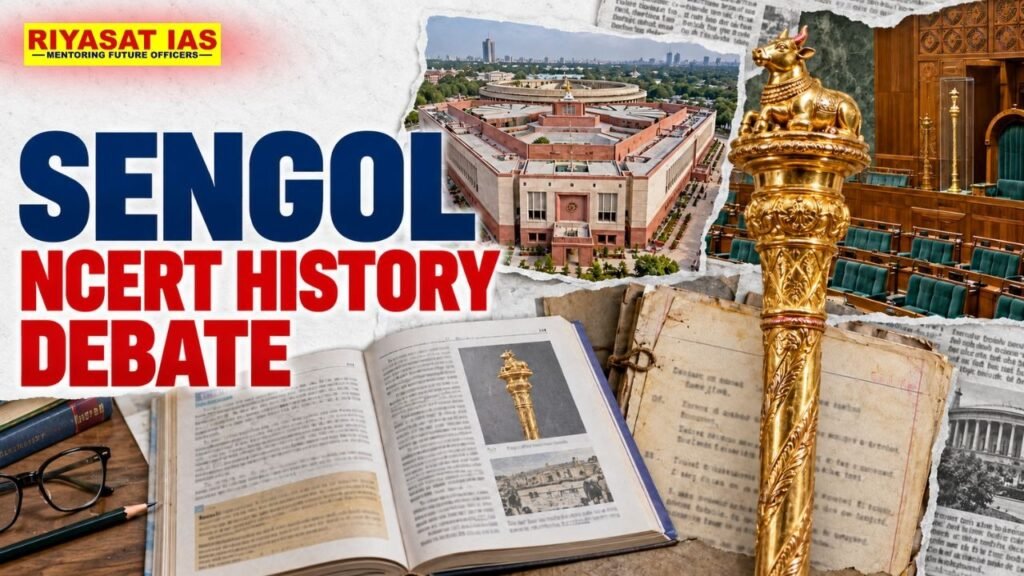
- Meaning: It is profound in meaning, derived from the Tamil word “Semmai”, meaning “Righteousness”.
- Form: It was made of gold or silver and was often decorated with precious stones.
- Ceremonial significance: A Sengol sceptre was carried by emperors on ceremonial occasions and used to represent their authority.
Sengol and Chola Tradition
- Association: It is associated with the Chola Empire, one of the longest-ruling and most influential dynasties in South India.
- Chola rule: The Cholas ruled over parts of Tamil Nadu, Kerala, Karnataka, Andhra Pradesh, Telangana, Odisha and Sri Lanka from the 9th to 13th century CE.
- Chola features: They were known for their military prowess, maritime trade, administrative efficiency, cultural patronage and temple architecture.
- Succession: The Cholas had a tradition of handing over the Sengol sceptre from one king to another as a mark of succession and legitimacy.
- Ceremony: The ceremony was usually performed by a high priest or a guru, who blessed the new king and conferred him with the Sengol.
Sengol and India’s Independence
- Transfer of power: Before independence from British rule in 1947, Lord Mountbatten asked Jawaharlal Nehru what ceremony should symbolise the transfer of power from British to Indian hands.
- C. Rajagopalachari: Nehru consulted C. Rajagopalachari (Rajaji), who later became the last Governor-General of India.
- Chola model: Rajaji suggested adopting the Chola model of handing over the Sengol sceptre as a suitable ceremony for India’s independence.
- Significance: He said it would reflect India’s ancient civilisation and culture, as well as its unity in diversity.
- Presentation: The Sengol was presented to Jawaharlal Nehru by Thiruvavaduthurai Adheenam, a 500-year-old Saivaite monastery, on August 14, 1947.
- Crafting: A golden sceptre was crafted by Vummidi Bangaru Chetty, a famous jeweller in Madras (now Chennai).
- Nandi: The Nandi, with its unyielding gaze as the beholder of “Nyaya”, is hand-carved at the top.



Prelims Question
Q. With reference to the Sengol, consider the following statements:
- The Sengol is associated with the Chola tradition of succession and legitimacy.
- It was presented to Jawaharlal Nehru by Thiruvavaduthurai Adheenam on August 14, 1947.
- The Sengol was crafted by Vummidi Bangaru Chetty.
- The Nandi is hand-carved at the top of the Sengol.
Which of the statements given above are correct?
(a) 1, 2 and 3 only
(b) 1, 3 and 4 only
(c) 2 and 4 only
(d) 1, 2, 3 and 4
Answer: (d) 1, 2, 3 and 4
Explanation: All four statements are correct. The Sengol is associated with the Chola tradition, was presented to Jawaharlal Nehru on August 14, 1947, was crafted by Vummidi Bangaru Chetty, and has a hand-carved Nandi at the top.





 Ravi Raaz
 Hassan Khan
 Shadab Ali