
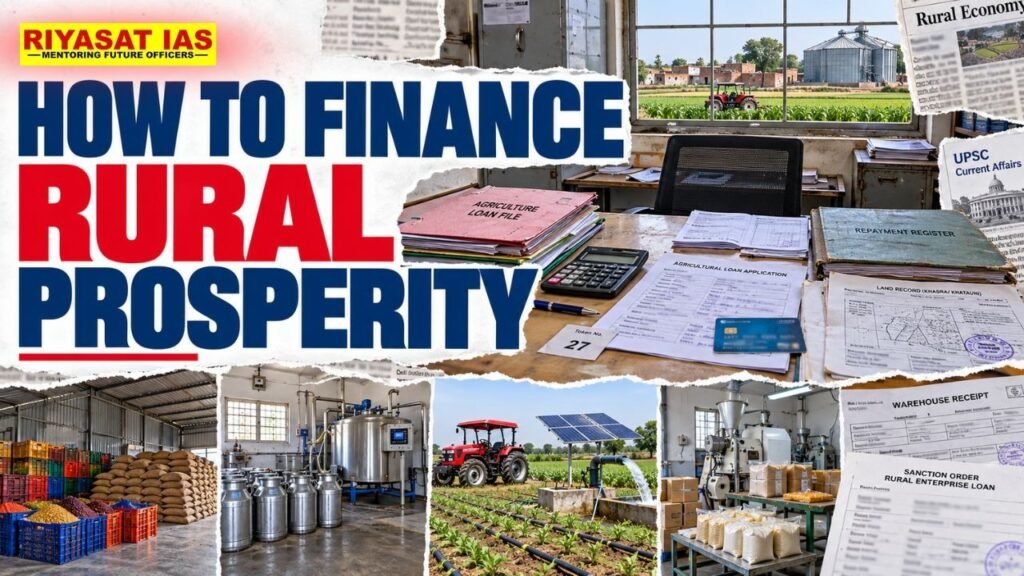
GS-III – Agriculture | Agricultural Finance | Rural Economy
India’s Agricultural Transformation
- Transforming agriculture: One of independent India’s greatest successes in the last six decades has been to make India one of the largest producers of cereals, milk, fruits, vegetables and fisheries products in the world.
- Key: Ground-breaking public policy, scientific innovation, water & irrigation, institutional credit & the enterprise of millions of Indian farmers.
- First agricultural transformation: Delivered food security.
- Next Agri revolution: Need to ensure rural prosperity by empowering rural India to get a larger percentage of post-harvest value.
Agricultural Value Chain
- The entire value chain: Every agricultural commodity goes through the value chain of production → aggregation → storage → logistics → processing → branding → markets.
- Value creation: Enterprises emerge, employment is created and prosperity is born in this chain.
- Diversity of financing need: Moving away from production credit to funding the entire agricultural value chain.
Diverse Financial Landscape Across Agricultural Sectors
- Dairy, poultry and fisheries: Work on a continuous procurement–marketing merchandising system, thereby leading to predictable cash flows, lesser inventory risk and regular working-capital turnover.
- Seasonal commodities: They have a completely different financial reality to play in.
- Processors: Must buy most of the annual raw material supply during a narrow harvest period, and finance inventory to feed them for the rest of the year.
- Processing Facility: For a company investing ₹500 crore in an ultramodern processing facility, it will need another ₹700–₹800 crore just to source, warehouse and transport seasonal inventory.
- Working capital: Even the most efficient of firms can struggle to become commercially sustainable without properly structured working capital.
- Sugar sector: It again proves that inventory finance and warehouse-backed lending can get such sectors growing.
- Sector Growth: Here too, the distinction is not in potential production but rather how the chain is financed.



Need for New Mechanisms
- Reform Successive: For almost five decades, various reforms regarding bank nationalisation, rural banks, cooperative institutions & Kisan Credit Card proliferated production credit.
- When national food security was prioritized: India has built strong institutions for financing agricultural production.
- Must: Establish resilient means of financing any commercially feasible task that together generates value between farm and end consumer.
Emerging Financing Ecosystem
- Banks: Launched a range of products including warehouse receipt financing, receivables financing and financing for food processing and agricultural infrastructure.
- Agri-focused NBFCs: Have already pioneered innovative value-chain models.
- Limitation: These are still siloed initiatives and not part of a broader agricultural value chain financing ecosystem.
Financing Opportunity
- Indicative estimate: As a reference, the GVA of agriculture and allied sectors (₹48.8 lakh crore) exceeded institutional credit flow (₹20 lakh crore) in 2023-24 by more than ₹28.8 lakh crore. This means India’s agricultural value chains can expect an annual financing opportunity greater than ₹14 lakh crore.
- Processing Level: Only 10–12% of the agricultural produce in India is processed.
- Comparison: The same rate is estimated at 35–45% for East, South and Southeast Asia, frequently above 60% in many developed economies.
- Financing systems: In these economies, agricultural transformation is driven by financing systems tailored toward commodity-specific value chains rather than production.
Agricultural Value Chain Financing Framework
- Financial instruments: The comprehensive framework should include a mix of:
- Product finance
- Receivables finance
- Warehouse receipt finance
- Risk mitigation solutions
- Credit enhancement mechanisms
- Financing flow: These instruments can provide financing for the flow of goods, services and capital along the value chain.
- Financing decisions: More increasingly, capital should be allocated based on commodity-value-chain tracking and cash-flow analysis instead of merely traditional collateral.
Expected Outcomes
- Access to capital: Making resources reach farmers, agribusiness firms (input suppliers, aggregators, warehouse operators) and logistics actors (processors from the farm gate through post-harvest handling, transporters, exporters and retailers).
- Private investment: Unlock private investment.
- Employment: Create rural jobs.
- Farmer incomes: Improve farmer incomes.
- Rural industrialisation: Accelerate rural industrialisation.
- Mahatma Gandhi said: “The future depends on what you do today.”
- Viksit Bharat 2047: Building a robust agricultural value chain finance architecture is one of the most prominent reforms that can help realise Viksit Bharat 2047.
Conclusion
- The first green revolution in India achieved food security; the second must achieve rural prosperity by enabling rural India to capture a larger share of the post-harvest value added.
- Good agricultural value chain finance architecture can help enable long-term rural jobs, private investments, farmer incomes and rural industrialisation.
UPSC Mains Practice Question
Q.“The first agricultural transformation in India provided food security; the next should provide rural prosperity. Financing the value chain, not just production.” Discuss.





 Ravi Raaz
 Hassan Khan
 Shadab Ali