
GS-II – Governance | Health | Drugs Price Control System | Public Health
Why in News?
- Supreme Court Worry: The Supreme Court also expressed concern over the wide gap between what is charged to the retailers and what is charged to consumers for various essential medicines, which include cancer drugs.
- Prohibitive Mark-ups: The Court found certain mark-ups left taxpayers with a heavy lift — what the Court referred to as “carnage.”
- DPCO, 2013: Bench of Justices Vikram Nath and Sandeep Mehta asked the Centre why a 16% retailer margin specified under Drugs (Prices Control) Order (DPCO), 2013 should not be uniformly applicable to essential drugs.
- Price to Retailer (PTR):
- The worry was steep mark-ups over PTR.
Supreme Court’s Observations
- Retailer Margin of 16% on MRP: The Bench asked why the 16% margin being claimed (and prescribed under DPCO) should not be made applicable to all.
- Taxpayer: Bench noted that ultimately it is the loser – taxpayer.
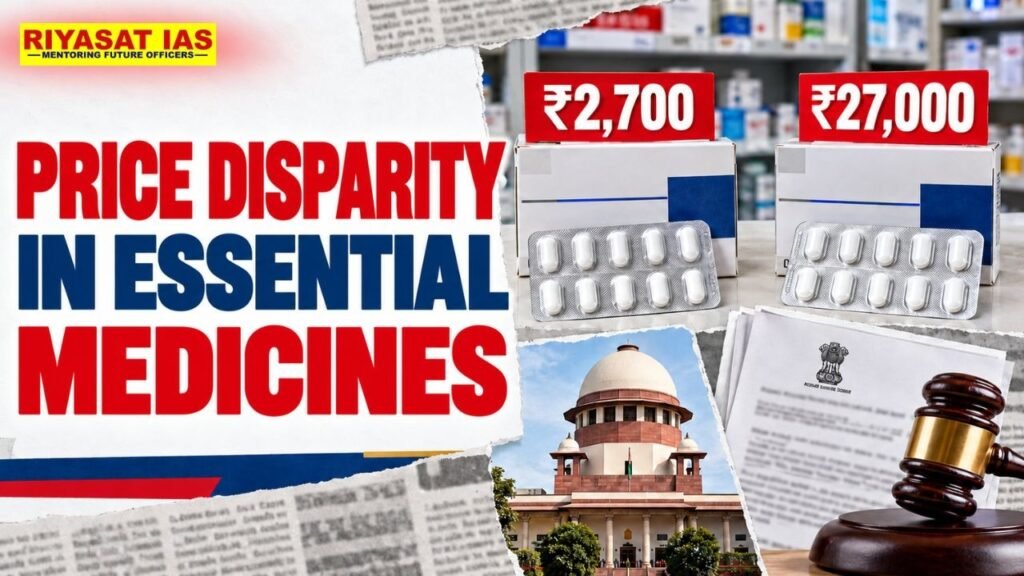
- Cancer Drug: Justice Mehta highlighted the almost 10X mark-up on a basic cancer drug:
o Delivered to retailers at approximately ₹3,000.
o Sold to consumers for ₹27,000.
o Difference of nearly ₹24,000.
- Who Benefitted: The Bench asked who was the ultimate beneficiary of the difference of nearly ₹24,000.
‘Private Gainers’
- Private Hospitals: The Solicitor-General Tushar Mehta said private hospitals, rather than pharmaceutical companies, benefited from the steep mark-ups.
- Big Pharma: “Big pharma does not profit? Your gain is the private hospital, the law officer finally argued.”
- In-House Pharmacies: The Bench flagged the practice of private hospitals insisting that patients purchase medicines from their in-house pharmacies.
- Restricted Options: This gives patients virtually no option to source the same drugs from other destinations at lower prices.



Impact on Public Finances
- The Bench highlighted the effect of overpricing essential medicines on public finance because a lot of health schemes which are funded by government.
- Ayushman Bharat:
- When treatment is provided through government-funded health schemes like Ayushman Bharat ultimately, the cost is paid for by taxpayers.
- Affecting Bigger Section of Society: The Bench noted that this has effect on larger section of society.
- Taxpayer: “The government pays nothing, the taxpayer does.”
Way Forward
- Provision for Uniform Retailer Margin: The 16% retailer margin provided for considering under the DPCO, 2013 needs to be factored-in while taking a call on exorbitant mark-ups over the PTR.
- More Strict Enforcements: There is need to stricter enforcement of price controls under the DPCO, 2013.
- Prohibit Excessive Prices: Overpricing of important medicines cannot be tolerated, and drug formulations should be made extra inexpensive.
- Preventing Unjustifiable Profit Margins: Prevention of violations in the pricing mechanism for drugs so that unjustified profit margin along the drug value chain stays avoided.
- Existing Mechanisms: Existing mechanisms governing drug pricing need to be presented before the Court.
- Equities Would Have to Be Balanced: Way forward for the government to strike a path ahead while “balancing equities”.
- Patient Choice: Private hospitals need to do battle over insisting that patients buy medicines from the hospital pharmacy rather than give patients more choices for sourcing the same drugs cheaply elsewhere.
- Public Finances: Higher prices for essential drugs must be tackled because it can affect public finances if treatment is compensated by health programs funded by the State.
Conclusion
- Low-cost Medications: Drug formulations must be low cost (gun-sights stated they overprice fundamental medicinal drugs).
- Price Control: Price controls under the Drug Price Control Order (DPCO), 2013, should be adequately enforced to curb deviation from prescribed pricing mechanism and unacceptable margins.
- Taxpayer: When treatment is covered under government-funded health schemes, it is the taxpayers who end up paying for inflated prices of essential drugs impacting public finances.
- Balancing Equities: The government has to find an “equitable path forward” and it should not come at the expense of provinces.
UPSC Mains Practice Question
Q. The abnormal gap between what essential medicines cost retailers and consumers makes it harder for patients as well as taxpayers both at the same time. Investigate the issues raised by the Supreme Court and provide solutions.




 Ravi Raaz
 Hassan Khan
 Shadab Ali