
Across India’s agricultural landscape, there is an ongoing shift: after decades of the Green Revolution, in which agrochemicals were enthusiastically adopted to produce the food needed to satiate the country’s needs, the environmental consequences of this approach – notably the loss of biodiversity, damage to the water ecosystem, and the burden on the economy from purchasing inputs – have returned farming to nature’s wisdom. India currently leads the world in the number of organic producers and is among the world leaders in farmland under organic agriculture.
Instead of using chemical fertilizers and pesticides, organic farming uses agro-ecological, waste recycling, crop rotation, and pest control methods to improve soil quality, encourage biodiversity, and manage pests. With the help of central organic farming programs such as Paramparagat Krishi Vikas Yojana and state organic farming initiatives in the North East, organic farming has emerged as an important agricultural activity.
The Status of Organic Farming in India
The status of organic farming in India should be considered in the context of already implemented and ongoing projects. The area of farmland under organic farming can be broken down into four categories:
- Organic farms that have received certificate confirmation.
- Organic farms that are currently in transition.
- Wild harvest collection areas.
- Organic farms located in special schemes.
Under the National Program for Organic Production (NPOP), there are 39.68 lakh hectares of farmland under certification in India for the 2024–25 agricultural year. Of these, 22.54 lakh hectares are organic farms, while 17.14 lakh hectares are in transition. At the same time, the country has 22.59 lakh hectares under certification for the sustainable collection of wild harvests in the forests.
Thus, according to the latest data of the National Program for Organic Production, the state of organic farming in India can be considered as follows:
Organic Farming Indicators 2024–25
During 2024–25:
| Organic Farming Indicator | 2024–25 |
| Certified Organic Farm Area | 22.54 lakh hectares (2.25 million hectares) |
| Farm Area Under Conversion | 17.14 lakh hectares (1.71 million hectares) |
| Total Farm Area Under NPOP Certification | 39.68 lakh hectares (3.97 million hectares) |
| Wild Harvest Collection Area | 22.59 lakh hectares (2.26 million hectares) |
| Organic Farm Production | 43.91 lakh tonnes (4.39 million tonnes) |
| Production Including In-Conversion Farms | 46.99 lakh tonnes (4.70 million tonnes) |
| Organic Export Volume | 3.68 lakh tonnes (0.368 million tonnes) |
| Value of Organic Exports | ₹5,394.32 crore |
The Organic Farming Leaders in India
The organic farming development in India is led by central and state-level initiatives. Most of the certified organic farmland area is located in Madhya Pradesh (about 10.13 lakh hectares). Maharashtra is in the second place with a large share of organic farmers’ cooperatives at the forefront of the organic farming movement.
Rajasthan, Gujarat, and Odisha are the third, fourth, and fifth in line, with vast tribal and rainfed dryland regions turned into organic farms.
Sikkim: India’s First Organic State
- In 2016, Sikkim became India’s first and the world’s first 100% organic state. By banning the use and sale of chemical pesticides and fertilizers, the government of Sikkim managed to make all 76,000 hectares of organic farms meet the standard of organic farming.
- This success was facilitated by a strong policy commitment from the state government, supported by training farmers in organic cultivation methods and local certification, and the development of processing infrastructure for high-value crops such as large cardamom, ginger, and buckwheat.
The Opportunities and Benefits of Organic Farming
Organic farming benefits from shifting away from petrochemical-intensive farming.
Higher Prices for Organic Farm Products
- Due to their popularity among progressive and environmentally conscious customers, organic farm products can command higher prices in the market. This is especially the case when it comes to the collection and aggregation of organic farm produce for resale.
Increased Level of Soil Quality
- By introducing organic farming methods and the active use of farmyard manure, vermicompost, leguminous green manure, compost, and bio-fertilizers to enrich the soil, organic farming allows for the improvement of the land’s quality.
- Over several years of organic farming, the number of earthworms in the soil can increase, contributing to improved soil biological activity and soil health.
Reduction in the Use of Chemical Inputs
- Organic farming allows reducing the use of chemical fertilizers, pesticides, and herbicides. This not only reduces the financial burden on the farmer but also helps protect water sources from chemical contamination.
Job Creation Through Resource-Intensive Organic Farming
- Compost preparation, mechanical weeding, multi-cropping, and harvesting of herbs and other organic farming methods contribute to increased employment rates.
Improved Water Retention Capacity of Soils
- High-quality organic farming results in high levels of organic matter in the soil. Such soil is capable of holding water for extended periods.
- This is beneficial both during droughts and after heavy rains when the soil does not turn to mud.
Biodiversity and Conservation of Natural Ecosystems
- The organic farming methods replace chemical pesticides with bio-pesticides, neem extracts, and the use of predatory and parasitic insects to control field pests.
- This can reduce the impact of farming on the local ecosystem, allowing it to recover.
The Potential for Rural Enterprise Development
- Organic farming opens the way for additional rural enterprise development, from farm stays to mechanized processing of natural food products. The creation of value-added products in rural areas offers significant opportunities for enterprise development.



Government Organic Farm Subsidies in India
National Program for Organic Production (NPOP)
- NPOP, under the aegis of the Agricultural and Processed Food Products Export Development Authority (APEDA), Ministry of Commerce and Industry, is India’s main organic farming program.
- It details the rules, regulations, and standards for organic production and lays down the procedures for accreditation of certification bodies.
- Moreover, it standardizes the requirements for certification of organic products, their packaging, processing, and export.
- NPOP’s organic farming guidelines secure the trade of organic products from India to other countries by establishing agreements with foreign regulatory authorities.
Participatory Guarantee System (PGS-India)
Small-scale organic farmers who want to sell their organic products in local markets, however, do not always have the resources to deal with the elaborate procedures and paperwork required for third-party certification.
The Participatory Guarantee System (PGS-India), a peer-review organic certification system, was developed by the Ministry of Agriculture and Farmers Welfare to address this issue.
National Program for Organic Production (NPOP) Versus Participatory Guarantee System (PGS-India)
| Basis | NPOP | PGS-India |
| Emphasis | Commercial certification | Accessible to small-scale farmers |
| Approach | Third-party audits | Farmer-to-farmer |
| Regulatory authority | Ministry of Commerce and Industry | Ministry of Agriculture and Farmers Welfare |
| Main goal | Organic farming export certification | Affordable organic certification |
Jaivik Bharat Logo
- Under the Organic Foods Regulations of 2017, the Food Safety and Standards Authority of India (FSSAI) launched the Jaivik Bharat logo to help consumers identify organic products.
- According to the regulations, any packaged food product sold as organic in India must have the Jaivik Bharat logo indicating compliance with either NPOP or PGS-India organic farming standards.
Paramparagat Krishi Vikas Yojana (PKVY)
- Paramparagat Krishi Vikas Yojana is the government’s main program that promotes cluster-based organic farming.
- Farmers are encouraged to organize themselves into organic farming cooperatives and transition their farmland to organic produce with the help of agricultural training and financial assistance.
- PKVY’s organic farming guidelines suggest allocating ₹31,500 per hectare during the three-year transition period to cover expenses related to certification, processing, packing, and marketing. Of this amount, ₹15,000 per hectare is directly paid to the farmer in the form of DBT (Direct Benefit Transfer).
- As of 30 June 2026, in India, PKVY covered 18.93 lakh hectares of farmland and provided subsidies to 33.63 lakh farmers.
- The total amount of central assistance released under PKVY since inception, as of 30 June 2026, was ₹2,811.36 crore.
Mission Organic Value Chain Development for North Eastern Region (MOVCDNER)
- Announced in 2015–16, Mission Organic Value Chain Development for North Eastern Region (MOVCDNER) is a special program to promote organic farming in the North Eastern states of India.
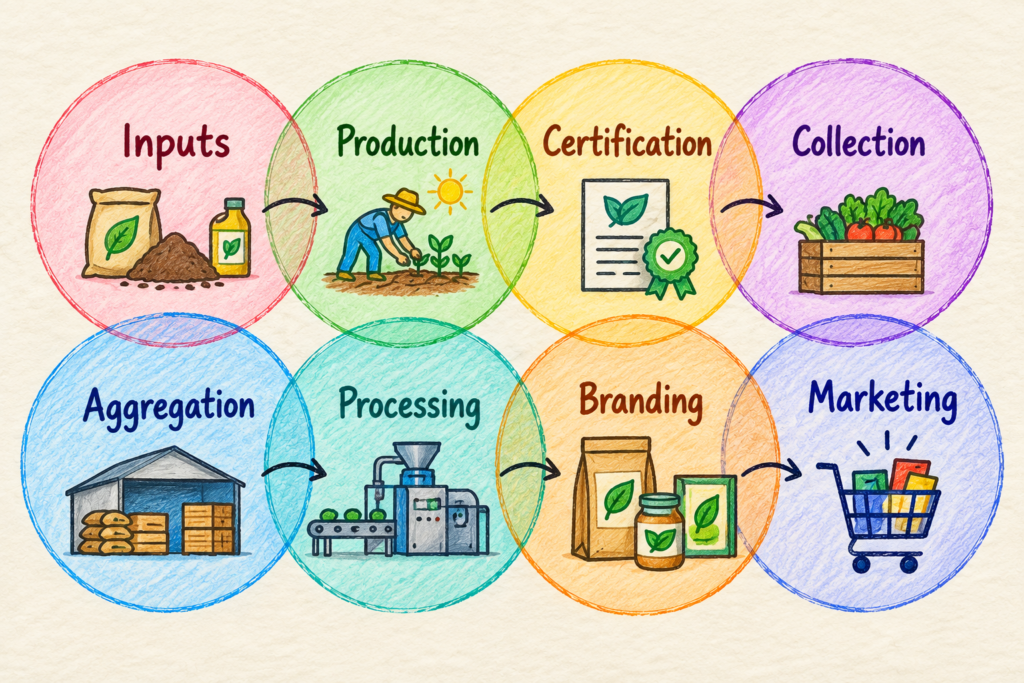
- It covers all stages of organic farming, from inputs to processing and marketing.
- MOVCDNER focuses on promoting organic farming in the North East by developing special infrastructure, such as processing units and cold storage facilities.
- Financial assistance under MOVCDNER is provided to Farmer Producer Organizations (FPOs) for the development and maintenance of organic farming clusters.
- As of 30 June 2026, 2.36 lakh hectares of farmland and 2.74 lakh farmers are covered by MOVCDNER.
- The total amount of central assistance released under MOVCDNER since inception, as of 30 June 2026, was ₹1,548.62 crore.
The State of Organic Farm Production in India
- India’s organic production and exports are developing. While India’s organic farming sector continues to develop, with more and more farmers adopting organic methods, the country has achieved significant results in terms of the volume of organic farmland and exports of organic farm products.
- During the 2024–25 agricultural year, organic farms covered by NPOP yielded 43.91 lakh tonnes of organic food.
- At the same time, taking into account farms in transition, organic farming produced 46.99 lakh tonnes of organic food.
- In terms of exports, India exported 3.68 lakh tonnes of organic products, generating ₹5,394.32 crore in export revenue.
- The main organic farming exports of India are organic oilseeds, tea, basmati, spices, and herbs.
- The main destinations for India’s organic exports are the U.S., the EU, Great Britain, Canada, Australia, Switzerland, the UAE, New Zealand, and Japan.
Challenges of Organic Farming in India
Despite the many benefits of organic farming and the efforts of the government and NGOs to promote it, organic farming in India faces several challenges that hinder its development:
Lack of Knowledge and Awareness about Organic Farming Methods
- Many potential organic farmers are not familiar with organic farming methods.
- Moreover, farmers switching to organic farming need to learn how to prepare their own bio-fertilizers and pest controllers, manage soil, and combat plant diseases.
The Limited Availability of Organic Inputs and Biomass
- One of the challenges of organic farming in India is the insufficient supply of organic inputs.
- Farmers’ reliance on biomass as a fertilizer and compost substrate often exceeds local availability.
High Labor Requirements and Additional Costs
- The use of traditional weeding techniques, preparation of herbal pest controllers, and composting requires additional labor and time.
- Such resource-intensive organic farming methods are not always accessible to small-scale farmers due to high labor costs.
Yield Losses During the Transition Period
- Switching to organic farming often requires a transition period, which can vary according to the crop and applicable certification standards.
- During this time, yields may be lower due to changes in nutrient management and soil conditions, which can be challenging for small-scale farmers.
Certification Challenges
- Obtaining third-party organic farming certification can be complicated, time-consuming, and expensive.
- Additionally, for small-scale farmers, organic farming certification often involves significant additional costs without sufficient benefits.
Inadequate Infrastructure for Organic Farm Products
- At the moment, organic farm production in India lacks the necessary infrastructure, such as cold storage and processing plants.
- Moreover, organic farming requires measures to prevent contamination from conventional farms, as chemical drift or other forms of contamination can affect organic production during cultivation and harvesting.
- Until such infrastructure and safeguards are available, organic farming can remain capital-intensive and competitive with conventional farming mainly in niche domestic and international markets.
Export Challenges
- Most international buyers of India’s organic farm products have strict requirements for chemical residues in food.
- Therefore, even minor chemical contamination of organic farms by conventional ones can lead to entire exports being returned.
Limited Domestic Market
- Currently, organic food products have a small domestic market in India.
- Organic farming exports are capital-intensive due to the need for cold chain infrastructure during transportation.
- Moreover, organic farm products often have a much higher price than comparable conventional products, which can make organic food less accessible to lower-income consumers.
The Future of Organic Farming in India
- Organic farming can be a solution to many problems in India’s agricultural sector, ranging from poor soil health to the burden of chemical fertilizers and pesticides on the environment and people’s health.
- However, for organic farming to realize its potential, farmers need more support, and the market needs to change to make organic farm products more accessible.
The Future of Organic Farming in India
Promoting Organic Nutrient Management
- Organic nutrient management can be promoted by establishing centers for preparing organic bio-fertilizers and compost at the village level.
- Moreover, farmers can grow green manure and other organic farming inputs locally.
- The widespread use of integrated organic farming methods will allow maintaining and improving soil fertility and provide farmers with a source of organic livestock feed.
Encouraging Crop Diversification and Multi-Cropping
- To avoid the loss of productivity associated with growing crops of the same type on the same plot, organic farmers should turn to crop diversification and multi-cropping methods.
- Moreover, it is necessary to develop systematic approaches to growing legumes and rotational cropping to restore nitrogen in the soil and control weeds and pests.
Developing Biological Pest and Weed Control
- A priority direction in organic farming will be the development and use of biological pest control agents – Trichoderma fungus, neem preparations, and pheromone traps.
- The widespread use of bio-pesticides and natural weed killers will reduce the burden of pests and diseases on organic crops.
Improving Organic Farm Certification Procedures
- Simplifying and digitizing the certification procedure, especially for small-scale farmers, and establishing group certification norms will reduce the cost and time of the certification process itself.
Developing Organic Farm Value Chains
- Organic farming value chains should be localized as much as possible to provide farmers with better prices and value-added processing of organic farm products.
- Farmer Producer Organizations (FPOs) and cooperatives need to develop their processing, grading, cold storage, and packaging capacities at the village level to capture more value.
Organizing Domestic and International Markets for Organic Farm Products
- It is necessary to develop a concept of domestic organic farming to promote the use of organic farm products among the Indian population.
- Moreover, it is necessary to develop the infrastructure for storing and transporting organic farm products and conducting quality tests at the local level to ensure the quality of organic farm products and gain the trust of foreign buyers.
FAQs
What is the status of organic farming in India?
As of 2024–25, India accounts for 39.68 lakh hectares of farmland under NPOP certification and 22.59 lakh hectares under certified areas for the collection of wild harvests.
Of the 39.68 lakh hectares under NPOP certification, 22.54 lakh hectares are currently under organic farming, while 17.14 lakh hectares are in transition.
Which state leads India in organic farming?
In terms of area under NPOP certification, Madhya Pradesh leads India with about 10.13 lakh hectares, followed by Maharashtra, Rajasthan, Gujarat, and Odisha.
Which is India’s first fully organic state?
In 2016, Sikkim became India’s first fully organic state and the world’s first 100% organic state. Sikkim’s organic farming covers 76,000 hectares.
What are the organic farming certification systems in India?
There are two organic farming certification systems in India: National Program for Organic Production (NPOP) and Participatory Guarantee System (PGS-India).
What is PKVY?
PKVY (Paramparagat Krishi Vikas Yojana) is a central scheme that promotes organic farming by providing financial assistance to farmers’ cooperatives for transitioning to organic farming methods and certifying organic farm products.
What is MOVCDNER?
MOVCDNER (Mission Organic Value Chain Development for North Eastern Region) is a central program that promotes organic farming in the North Eastern states of India by developing the entire value chain from farming to processing and marketing.
What is the area covered by PKVY and MOVCDNER?
PKVY covers 18.93 lakh hectares of farmland and 33.63 lakh farmers, while MOVCDNER covers 2.36 lakh hectares and 2.74 lakh farmers, as of 30 June 2026.
How much does India export in organic products?
India exported 3.68 lakh tonnes of organic farm products worth ₹5,394.32 crore in 2024–25.
The main destinations of India’s organic farming exports are the U.S., the EU, Great Britain, Canada, Australia, New Zealand, Switzerland, the UAE, and Japan.
What are the advantages of organic farming?
Organic farming has numerous advantages over conventional farming, including higher prices for organic farm products, improved soil quality through the use of compost and green manure, reduced use of chemical pesticides, job creation through resource-intensive organic farming methods, and conservation of natural ecosystems.


 Ravi Raaz
 Hassan Khan
 Shadab Ali