
GS-II – Child Rights | Digital Governance | Judiciary | Contract Law
Why in News?
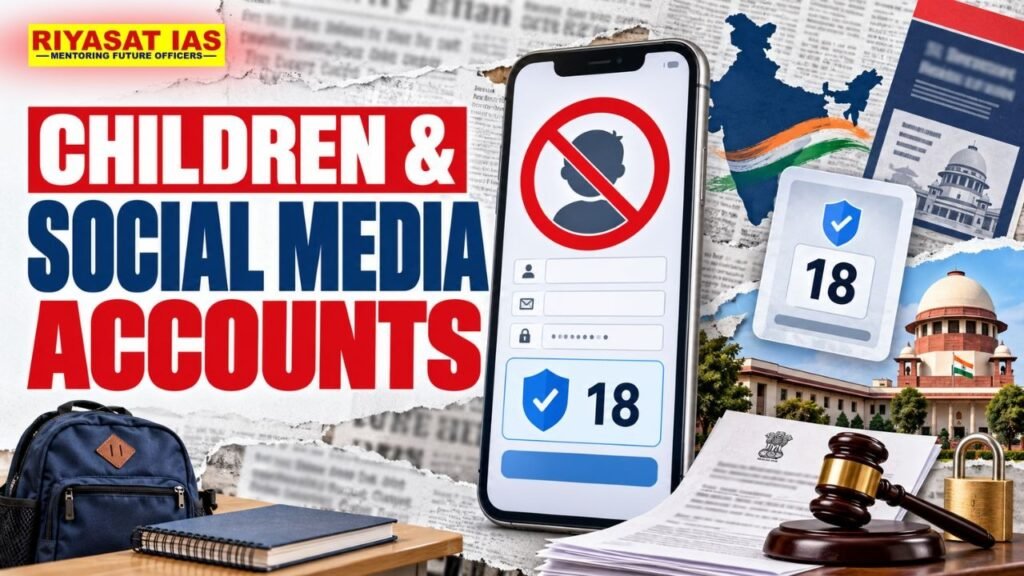
- Social Media Accounts of Children: Children create social media accounts, which are null and void from the outset since a contract is created when the terms of service of a platform is accepted but children being minors have no capacity to carry on with a seat within Section 11 Indian Contract Act,1872
Key Legal Provisions and Frameworks
- Section 11 of the Indian Contract Act, 1872: No person who is not of the age of majority i.e. an adult (18 years) can enter contracts. Therefore, any agreement with a minor is null and void ab inito (from the beginning).
- Information Technology Act, 2000: The Information Technology Act of 2000 does recognize electronic contracts by a clause under Section 10A, however the recognition of electronic formation does not in itself A and B can bind minors to enter into agreements as per section 11 of the Contract Act.
- Digital Personal Data Protection (DPDP) Act, 2023: Needs verifiable parental consent to process a minor’s personal data. But critics and petitioners say it does not specifically prohibit minor plaintiffs from being allowed to autonomously sign platform contracts.
- SHIELD Bill, 2025: A private member’s bill designed to prohibit child-initiated accounts without verified parental consent for kids under the age of 13 and restricts behavioral monitoring, limiting targeted advertising to older youth.
Recent Supreme Court Developments (2026)
- The PIL: Public Interest Litigation filed by the Just Rights for Children Alliance that the Supreme Court asked Central government to respond on.
- Court Hearing: A Bench head by Chief Justice Surya Kant and Justice Joymalya Bagchi sought to know how children between the ages of 12-15 can open social media accounts in their own right if the contract is unenforceable.
- Statutory Mandate: The Court over-emphasized that digital platforms must conform with Indian law by means of legislative power and insinuated that executive guidelines can never be satisfactory, but rules themselves ought to also have statutory authority through intermediary guidelines.



Challenges and Proposed Solutions
- The Problem: For Kids Apps, Platforms largely allow self-declaration of age (almost 13 years, based on foreign laws like COPPA in the US). There are no stringent checks on parent or identity verification
- The Solution Sought: Rather than a total internet ban, petitioners ask that business be “age-gated by design,” mandates for e-KYC/age-assured mechanisms, and parent-triggered education accounts.
- Implementation Challenges: How to comply with the child referral and reporting requirements of COPPA while ensuring privacy, data protection, and preventing a digital divide for marginalized youth?
Conclusion
- Child Protection and Digital Governance: In this case, protections need to be established similar to recent EU legislation around safeguarding children in their access to social media whilst maintaining privacy protocols from data protection policy to ensure a new form of digital divide does not emerge amongst at-risk children and youth
- Balanced Approach: Instead of immediate internet ban, petitioners seek business to be “age-gated by design”, e-KYC/ age assured mechanisms and parental control based education accounts.
UPSC Mains Practice Question
Q. Children creating social media accounts raises concerns relating to contract law, digital governance and child rights. Discuss the key legal provisions, recent Supreme Court developments, challenges and proposed solutions.




 Ravi Raaz
 Hassan Khan
 Shadab Ali