
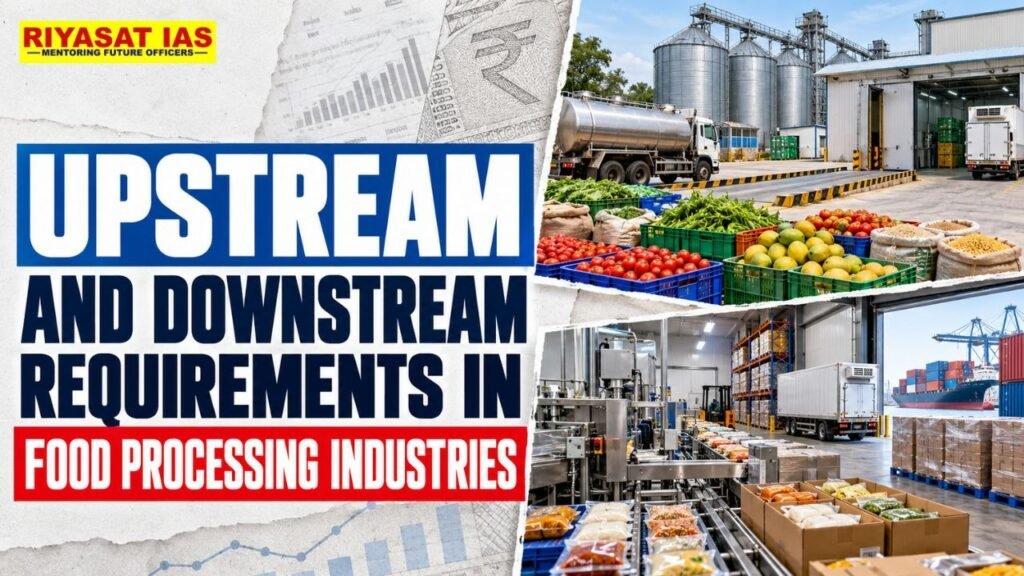
Whether it is a jar of mango pickle or a carton of pasteurized milk, every packaged food product has come a long way through the production chain before it reaches the end consumer. Like the flow of a river, the movement of goods takes place in one direction. Upstream activities comprise those happening prior to opening of factory gates while downstream activities include processing, packaging, and logistics of the goods to reach the consumer’s plate.
Having a fundamental insight into the two concepts helps understand how a bumper harvest has little bearing on the availability of affordable, quality assured, and high-end processed food on retail stores.
What are the Upstream and Downstream Activities?
Upstream Production
Upstream production activities entail procuring raw produce and production inputs. In the river system, these activities are compared to the headwaters. The focus of upstream production is on raw material aggregation and production of the agricultural and animal products to give processing units something to work on.
Downstream Production
Downstream production begins when the raw materials are put through the processing plant. The activities are concerned with processing, quality refinement, packaging, storage, commercializing and distribution of products to the retail stores and into the end consumer’s hands.
Upstream Production Requirements in Food Processing
The upstream production activities have several requirements to help make the business plan stand out and be able to endure in the market:
- Availability of raw materials
- Modern extraction and collection methods
- Farmer linkages
- Storage facilities
- Quality testing
- Transport infrastructure
- Labor force
Availability of Raw Materials for Upstream Production
This element focuses on the ongoing availability of agricultural, dairy, marine, or poultry produce for consistent manufacturing. If there is no readily available raw produce, manufacturing plants will be forced to sit idle.
Modern Extraction and Collection Methods
Modern agricultural and dairy production methods that minimize bruising during harvesting and prevent product contamination at the point of origin are a must.
Farmer Linkages
Partnership and collaboration with farmers ensures that the producer gets quality produce at reasonable prices.
Storage Facilities for Upstream Production
Farm gate pre-cooling facilities, silos, and grain elevators will help prevent rotting or infestation of the produce.



Quality Testing and Evaluation for Upstream Activities
Adequate laboratory facilities will enable test marketing of produce collected from farmers to ascertain qualities such as presence of pesticides, adulteration, and bacterial infection.
Transport Infrastructure for Upstream Activities
Refrigerated trucks and good road infrastructure will ensure that the crops reach the processing plants while still firm and not rotten.
Labor Force
Adequate staff to facilitate the procurement process as well as farm produce experts is required.
Downstream Production Requirements in Food Processing
The downstream activities require the following to take place:
- Processing facilities
- Distribution and marketing
- Customer interface
- Labor force
Processing Facilities in Downstream Production
Modern processing facilities that are capable of performing grading, cooking, pasteurizing, canning, and dehydrating to produce high-end food products are required. This requires a lot of investment in modern technology and equipment to ensure efficient production.
Distribution and Marketing of Downstream Activities
An extensive network of distributors, wholesalers, hypermarkets, and kirana stores will facilitate effective distribution and marketing of the finished products. The target customers should be well versed on the features of the products.
Customer Interface
Quality packaging, appropriate labeling, competitive pricing, and a favorable environment for feedback and complaints encourage customers to patronize the finished products.
Labor Force
Distributors, food technologists, marketing experts, and salespeople make up the workforce in downstream activities.
Upstream and Downstream Comparison in Food Processing
| Column 1 | Upstream Activities | Downstream Activities |
| Primary Focus | Raw materials, farm inputs, and procurement | Manufacturing, branding, consumer retail |
| Core Activities | Sourcing, harvesting, grading, and collection | Processing, formulation, packaging, and shipping |
| Key Partners | Farmers, cooperatives, FPOs, and input suppliers | Wholesalers, distributors, supermarket chains, and delivery apps |
| Storage Role | Farm gate pre-cooling, grain silos, and bulk chillers | Central finished goods warehouses and retail shelves |
| Quality Control | Testing raw crops for impurities | Enforcing shelf-life stability, nutritional content, and packaging regulations |
| Logistics | Farm to factory transport and bulk hauling | Factory to warehouse to consumer distribution networks |
| Workforce Needs | Harvesters, field procurement agents, and sorters | Food scientists, machine operators, sales teams, and marketers |
Importance of Upstream and Downstream Linkages in Food Processing
A strong upstream production in the absence of downstream production capabilities can lead to overproduction and downward pressure on prices. Meanwhile, downstream production capabilities in the absence of upstream production can lead to underutilized capacity at modern multi-crore processing facilities.
FAQs on Upstream and Downstream Requirements
What is upstream production?
Upstream production activities entail procuring raw produce and production inputs. The focus of upstream production is on raw material aggregation and production of the agricultural and animal products.
What is downstream production?
Downstream production begins when the raw materials are put through the processing plant. Activities are concerned with processing, quality refinement, packaging, storage, commercializing, and distribution of products to the retail stores and into the end consumer’s hands.
What are the main upstream requirements of food processing?
Key upstream requirements include availability of raw crop materials, farmer-procurement partnerships, farm-gate cold storage, quality inspection facilities, transport infrastructure, and labor force.
What are the main downstream requirements of food processing?
Key downstream requirements include modern processing facilities, secondary packaging, cold chain distribution, retail partnerships and marketing, and consumer interface.
Why are farmer linkages important for food processing?
Farmer linkages ensure that there is a constant supply of quality raw materials to the processing plants while also guaranteeing farmers against price volatility in the market.
What is the difference between upstream and downstream?
Upstream is supply-side production, while downstream is demand-side production. This means that upstream is more concerned with sourcing the raw materials from the farm or the ocean while downstream focuses on cooking, packaging, branding, and selling the finished products to the targeted customers.


 Ravi Raaz
 Hassan Khan
 Shadab Ali