
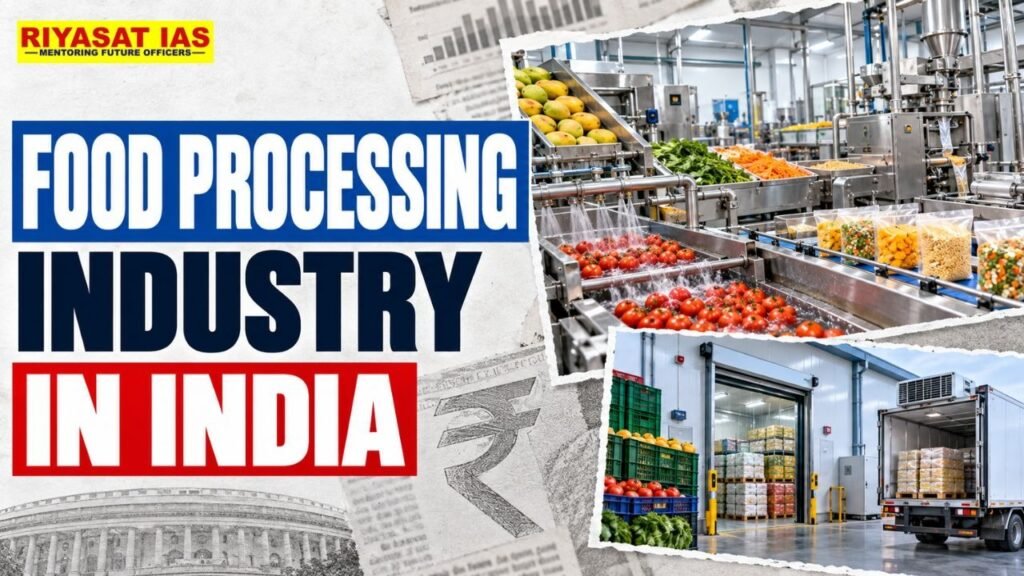
India’s food processing industry acts as a bridge between agriculture and manufacturing/markets by adding value to farm produce. It plays a crucial role in linking rural farm belts to the modern retail sector, thus creating employment opportunities, reducing post-harvest losses, and supporting agriculture exports.
What is Food Processing?
The processing of agricultural harvest and animal products into consumable, marketable forms through cleaning, grading, milling, preservation, processing, and packaging is referred to as food processing. It covers three levels:
- Primary Processing: Cleaning, grading, sorting, drying, milling of grains and basic packing.
- Secondary Processing: Processing primary produce into basic kitchen foods, including flour, edible oil, cheese, and dairy products.
- Tertiary Processing: Processing of tertiary items into more convenient foods such as canned soups, frozen meals, and ready-to-eat foods.
Status of India’s Food Processing Industry
India has a huge raw material base with the world’s largest milk production and second-highest yields of fruits and vegetables.
- Gross Value Added (GVA): India’s food-processing industry’s GVA grew from ₹1.34 lakh crore in 2014-15 to ₹2.24 lakh crore in 2023-24, representing 7.93% of the total manufacturing sector GVA. An average yearly increase of 6.55% was recorded between 2014-15 and 2023-24.
- Export: Processed foods accounted for 20.4% of India’s agri-food exports in FY2024-25, compared to 13.7% in 2014-15.
Importance of Food Processing
- Post-harvest Losses: Losses due to rotting, particularly fruits, vegetables, and milk, can be minimized by cold chain storage, preservation, canning, and freezing.
- Farmers’ Income: Processing provides an additional channel for off-take, ensuring that farmers get a reasonable price for their produce, saving them from distress sales.
- Employment Generation: In addition to creating jobs in the processing units, food processing also creates jobs in allied sectors such as warehousing, cold chain storage, transportation, and retail sales.
- Diversification of Agriculture: Processing provides a stable market for farmers’ surplus and encourages farmers to grow commercial crops such as fruits, vegetables, and millets.
- Export Promotion: Processed and branded items have a much higher margin and shelf-life than raw materials and are in great demand in international markets.
Major Growth Drivers
- Abundant Agricultural Produce: India is one of the world’s leading producers of milk, cereals, spices, fruits, and vegetables. A diverse range of high-quality raw materials is available for processing.
- Changing Consumption Pattern: There has been a rise in nuclear families and disposable income in urban areas and growing inclination for convenience foods.
- Organized Retailing and E-commerce: The rise of organized retailing and e-commerce channels has enabled consumers to have greater access to regional and niche processed foods.
- Technological Developments: Adoption of advanced cold chain storage and grading technologies by the processing sector has improved efficiency and quality.
- Investment: With rising private and government investment in food processing, large-scale processing units and food parks are being developed across the country.



Major Challenges
- Fragmentation of Supply Chain: India’s farm sector has witnessed fragmentation of farmland in recent decades, complicating bulk procurement by processors.
- Infrastructure: The country’s lack of cold storage, processing infrastructure, and efficient logistics causes enormous wastage of perishable goods.
- Low Processing Levels: Most of India’s agricultural produce is consumed in raw form or processed and exported in bulk. A large amount of value is lost when fruits and vegetables are not processed.
- Financial Accessibility: Many micro and small enterprises have faced challenges in accessing affordable credit from the formal banking system.
- Skill Gap: There is a severe shortage of skilled manpower in food processing, notably in food microbiology, food engineering, cold chain management, and quality management.
- Quality and Standards: Some Indian food-processing companies are denied exports due to the strict testing procedures that must be followed in overseas markets.
Government Initiatives
- PM Kisan SAMPADA Yojana: The Pradhan Mantri Kisan SAMPADA Yojana (PMKSY) is a centrally-sponsored scheme that provides financial assistance for creating integrated cold chains, mega food parks, agro-processing clusters, and farm-to-retail value chains. As of 30 June 2026, 1,735 projects have been sanctioned, of which 1,256 projects have been completed.
- PM Formalisation of Micro Food Processing Enterprises: This scheme aids micro food processing enterprises, self-help groups (SHGs), and Farmer Producer Organizations (FPOs) in upgrading their technology, accessing credit, and creating an umbrella brand for their products. Around 1,72,707 loans were sanctioned under the Scheme as of 31 December 2025, with a total disbursement of ₹14,190 crore.
- Production Linked Incentive Scheme: The Production Linked Incentive (PLI) Scheme for Food Processing Industry has a budgetary allocation of ₹10,900 crore during FY2021–22 to FY2026–27. Under this scheme, businesses will get incentives based on their capital investment, increase in processing capacity, and level of value addition to their products.
- 100% FDI in Food Processing: India allows 100% FDI under the automatic route for manufacturing food products. This encourages global investors to set up manufacturing units in the country under the automatic route without any approval from the foreign investment review board.
Way Forward
- Establishing Food Clusters: Setting up food processing, cold storage, and testing labs in close proximity to farms will reduce the transit time for fresh and perishable agricultural commodities.
- Enhancing FPO-Industry Linkages: Strengthening FPOs will enable them to bargain for better prices and ensure standardized produce for the industry.
- Processing More Perishable Agricultural Products: Investing more in processing perishable agricultural products is important given the high wastage levels and value addition potential.
- MSME Finance: MSMEs should be able to access low-cost working capital and equipment finance to scale their operations.
- Adopting Advanced Technologies: Advanced cold storage, IoT-enabled grading, and auto-packing technologies can help the industry adhere to international quality standards.
- Upskilling and R&D: Industry-academia collaborations can boost innovation in the food processing sector, notably in indigenous packaging and energy-efficient processing technologies.
- Sustainable Processing: Adapting to clean technologies, energy recovery systems, and alternate waste management methods can make India’s food processing sector more environment-friendly.
Conclusion
India’s food processing industry serves as a link between farmers and domestic and international markets. The industry’s overall growth is hampered by a lack of cold storage infrastructure and credit access to MSMEs. India must invest in building an end-to-end cold chain and encourage credit flow to MSMEs to realize the industry’s potential. India’s vast potential in the global food processing market can be unlocked by building a strong value chain that connects farmers, FPOs, processors, and retailers.
FAQ
What is food processing?
It refers to the processes by which agricultural and animal products are transformed into consumable, marketable forms.
What is the size of India’s food processing sector?
India’s food processing sector has a GVA of ₹2.24 lakh crore in 2023-24, accounting for 7.93% of the country’s total manufacturing sector GVA.
What is PMFME?
PM Formalisation of Micro Food Processing Enterprises is a scheme launched in 2020 that focuses on formalizing the unorganized micro food processing sector.
What is PMKSY?
PM Kisan SAMPADA Yojana is a centrally-sponsored scheme that focuses on building infrastructure, including mega food parks and cold storage facilities, to support the food processing sector.
What is PLISFPI?
The Production Linked Incentive Scheme for Food Processing Industry is a production-linked incentive scheme for the food processing sector.
Why is food processing important for farmers?
Processing adds value to farm products, cushioning farmers against price fluctuations, ensuring regular off-take, minimizing wastage of agricultural produce, and expanding market reach.
What are the challenges facing India’s food processing industry?
Fragmented farm holdings, inadequate cold storage, low processing levels, credit access issues for MSMEs, a shortage of skilled labor, and product quality and standards are some of the major challenges.


 Ravi Raaz
 Hassan Khan
 Shadab Ali