
GS-II – Governance, Polity and Social Justice | Police Reforms | Criminal Justice | Fundamental Rights
Why in News?
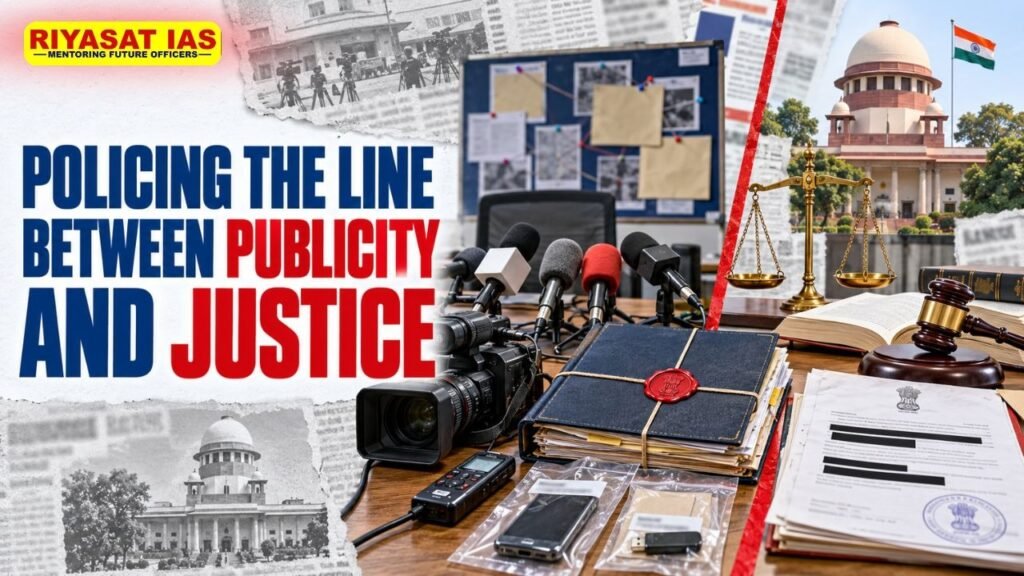
- Supreme Court PIL: A Supreme Court of India Public Interest Litigation (PIL) has questioned the law guiding police publishing images of accused persons, seeking national media protocols/police media briefings.
- Social Media: Photographs of alleged offenders often flood social media even before the accused appears before a magistrate within minutes of an arrest.
- Previous Stories Displaying Wanted: Reward notices, photos of wanted persons have aided in solving crimes, finding missing children and catching fugitives.
- Legal Void: Many reasons to publicise photos, but the law still lags.
Current Law and Practice
- No One Law: There is no one law that specifically allows or prohibits the police from publishing photographs of accused persons.
- Section 84, BNSS, 2023: Section 84 of the Bharatiya Nagarik Suraksha Sanhita (BNSS), 2023 (Section 82 of the Code of Criminal Procedure or CrPC) allows courts to proclaim absconders and publish proclamations in newspapers.
- Photographs: The Section 84 does not mention photographs, but attaching one has become a matter of settled practice as it is helpful to ensure appearance before the person.
- Investigation Stage: This is never a matter of public record until proven in courts, therefore the first component required for such publicity cannot be fulfilled at the investigation stage itself as it presupposes that a magistrate has given his/her new approval with respect to this particular warrant.
- Publication at the Investigation Stage: Publication at the investigation stage is governed by the general powers of an investigating officer (IO).
- Hue and Cry Notice: The practice of posting the photographs on social media to seek identification, trace absconders or witnesses is an internet-age extension of the “Hue and Cry Notice” in State Police Manuals.
- Reward Announcements: Reward announcements fall in a clearer, narrower space and in general are regulated under State Police Regulations pursuant to the Police Act, 1861.
- Criminal Procedure (Identification) Act, 2022: Relates to acquisition, collection and processing of measurements i.e., photographs for purposes of identification but does not provide for publication.


Constitutional Limits
- Article 21: Jurisprudence under Article 21 has honed constitutional issues concerning the notoriety of accused persons.
- Presumption of Innocence: Continues to be fundamental to criminal justice.
- Pre-Trial Publicity: The media flashing the face of an arrested person as a proven criminal, without framing any formal charge, is real and irreparable damage.
- Institutional Humiliation: Categorizing such practice as an “institutional humiliation”, Rajasthan High Court.
- Digital Circulation: Digital circulation is also permanent, searchable and unconcerned by acquittal in future.
- BPR&D Manual: Drafted by the Bureau of Police Research and Development, it is a manual on media briefings by police personnel which was sent to the Home Ministry in July 2024.
- Supreme Court, January 2026: The Supreme Court stated that the amicus had formulated a Police Manual for Media Briefing and ordered States to formulate suitable policies in accordance with it within three months.
Absolute Red Lines
- Juveniles: A juvenile in conflict with law shall not be identified except by a name, which is necessary in the interest of the child and with permission of Juvenile Justice Board.
- Sexual Assault Survivors: A sexual assault survivor is a person whose identity, by law, is protected.
- Ordinary Adult: The debate centers around the ordinary adult who gets accused and arrested while not yet tried.
Making the Differentiation Between What is a Real Exposure and Police Branding
- Loyal Investigations: Publication may be necessary to prevention of crime, maintenance of public-order and a healthy justice.
- Public Assistance: Publicity may help identify, trace absconders, locate witnesses and resolve specific police published crimes.
- Police Optics: Photography released for the purpose of demonstrating arrests since this is good police optics and it makes a claim against an individual.
- Prejudice: This kind of publicity may cause a trial by media rather than using the legal system to determine the facts.
- US: “Wanted” notices done by the US are exceptions to privacy law as they are not public records, and agencies [are trained to] use terms like “alleged” and “wanted for questioning” in order to keep presumption of innocence.
- British Policing: How British policing is more cautiously withholding identities of arrested persons entirely.
Way Forward
- Implementing a Uniform National Protocol: Create a written, national uniform protocol that differentiates between proportionate need-based disclosures and prejudicial publicity.
- Mandatory Blackout Categories: These include juveniles and sexual-offence complainants.
- No Time-Limited Review: Require a time-bound review and takedown after the investigative purpose is exhausted, or an accused is discharged/acquitted.
- Common Application: Having the protocol applied uniformly across States.
- Necessity Test: Before seeking to publish any photo, think about whether the disclosure is necessary to the investigation or just helpful to the story.
Conclusion
- Balance: The public must assist in investigating crime while considering the presumption of innocence and constitutional protections.
- Legal Basis: You have a well defined legal basis and not just precedential practice.
- Proportionate Intent: The intent should be proportional, based on need not stigmatizing circumstances.
UPSC Mains Practice Question
Q. The publication of photographs of arrested persons brings up a balance between investigative necessity, assistance to the public and the presumption of innocence. Examine the legal and constitutional issues involved.



 Ravi Raaz
 Hassan Khan
 Shadab Ali