
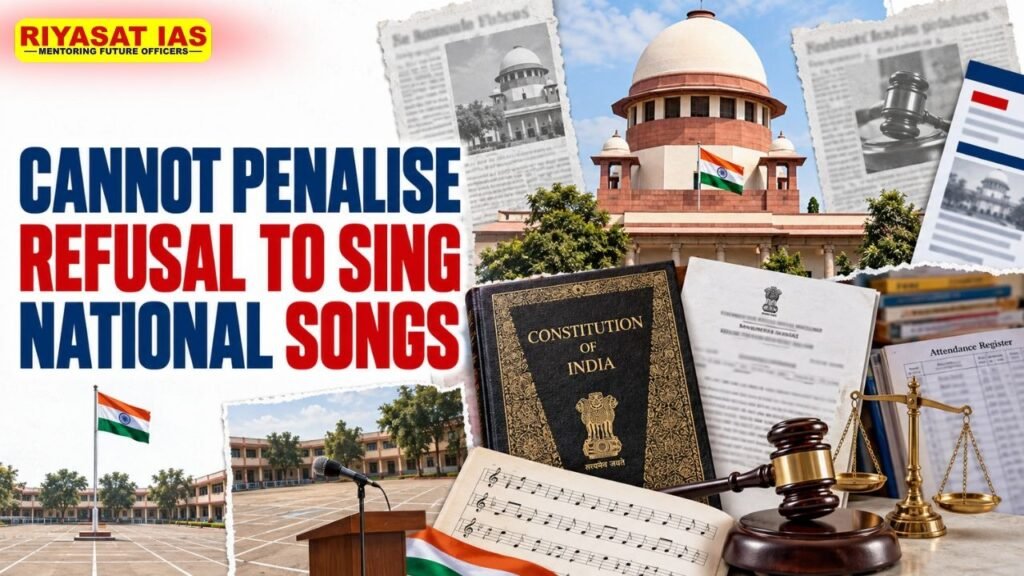
- On September 22, 2026, the Supreme Court agreed to examine whether a person can face penal consequences for refusing to sing Vande Mataram on grounds of conscience or religion. It declined to decide whether the National Song should comprise two or six stanzas.
- National Song: Vande Mataram.
- Constitutional Provisions:
- Article 25: Freedom of conscience and the right to freely profess, practise and propagate religion.
- Article 26: Freedom to manage religious affairs, subject to constitutional limitations.
- Supreme Court’s Observation: A conscientious objector should not be subjected to penal consequences for refusing to sing the National Song on grounds of conscience or religion.
- Judicial Precedent: Bijoe Emmanuel v. State of Kerala (1986) protected students who respectfully stood during the National Anthem but did not sing it due to their genuine religious beliefs.
- Prevention of Insults to National Honour Act, 1971: The Supreme Court is examining the penal consequences associated with the 2026 amendment concerning the National Song.
Prelims Practice Question
Q. With reference to Articles 25 and 26 of the Indian Constitution, consider the following statements:
- Article 25 protects freedom of conscience and the freedom to profess, practise and propagate religion.
- Article 26 deals with the freedom to manage religious affairs.
- Both Articles are absolute and are not subject to any restrictions.



Which of the statements given above is/are correct?
(a) 1 and 2 only
(b) 2 and 3 only
(c) 1 and 3 only
(d) 1, 2 and 3
Answer: (a) 1 and 2 only
Explanation:
- Statement 1 – Correct: Article 25 protects freedom of conscience and the freedom to profess, practise and propagate religion, subject to constitutional restrictions.
- Statement 2 – Correct: Article 26 protects specified rights relating to the management of religious affairs, subject to public order, morality and health.
- Statement 3 – Incorrect: These rights are subject to constitutional limitations.





 Ravi Raaz
 Hassan Khan
 Shadab Ali