
GS-II – Polity and Governance | Fundamental Rights
Why in News?
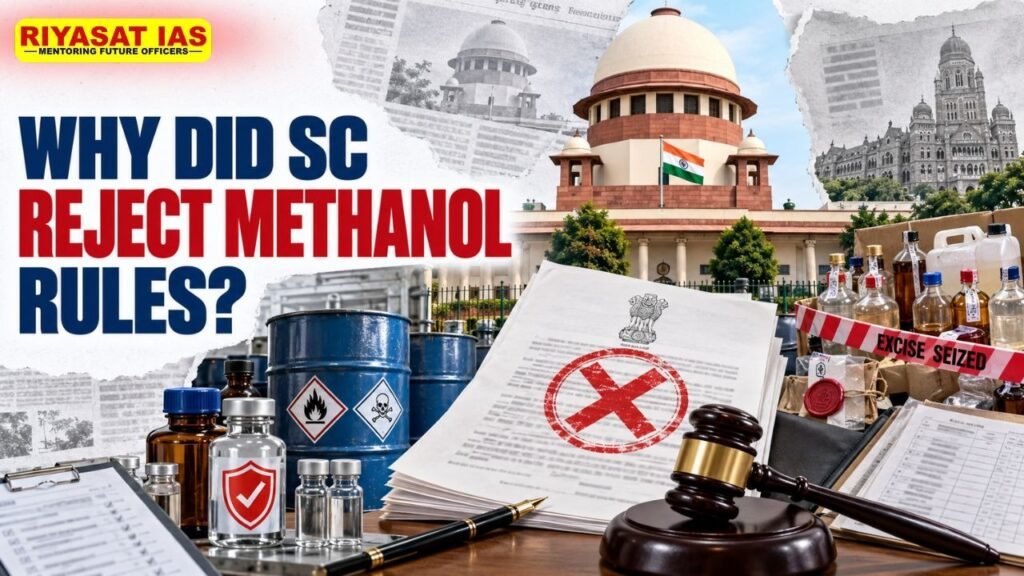
- The Supreme Court held on September 18 that the Maharashtra government rules requiring methanol to be denatured with a colourant and a bitterant prior to sale to non-drug manufacturers were disproportionate and had an insufficient nexus with the evil they were intended to solve.
What Was the Case About?
- Methanol: Methanol or Methyl alcohol is a very toxic substance.
- Industrial use: It is also widely used as an industrial raw material in products including formaldehyde, paraformaldehyde, paints, resins and other chemicals.
- Background: After 93 people perished in Mumbai after consuming spurious liquor mostly containing methanol in a hooch tragedy in 1991, the Maharashtra government imposed stringent controls on the use of the substance.
- Committee: A committee led by then Additional Director General of Police P.R. Parthasarthy was formed to study the reasons for the incident and recommend steps to avoid a repeat76.
- Amendments of 2011: The Poisons Rules were further amended by the Maharashtra Government in 2011 introducing Rule 18A and Rule 18B.
Petitioners’ Grievance
- Methanol Purchase: Petitioner aggrieved by operation of the impugned Rules 18A and 18B of the Maharashtra Poisons Rules, respectively, to ensure that methanol may not be sold purchase from a drug manufacturer without meeting statutory requirements other than as prescribed under provisions and proper procedure.
- Additionally, as per Rule 18 B, any possession of methanol is liable to be confiscated in the absence of a licence in Form A.
Industry Tells the Court
Colour contamination could make products unacceptable to paint and pharmaceutical companies, while the additives themselves could impact catalysts as well as laboratory and pharmaceutical applications, firms told the court.
State’s Argument
- The State contended that the rules must be implemented due to the possibility of methanol being blended with liquor which is deathly toxic.
- It also proposed the identification and bittering of methanol to deter its abuse.
What Did the Court Examine?
- Constitutional question: The main question that came up for consideration was as to whether Rules 18A and 18B in conflict with Articles 14 and 19(1)(g) of the Constitution.
- Article 14: The fundamental principle underlying Article-14 is that of fairness in action and non-arbitrariness.
- Article 19(1)(g): Freedom to practise any profession, or to carry on any occupation, trade or business.
- Regulatory Scope Of The State: Court held that state have power to regulate methanol.
- Poisons Act, 1919: Allows State governments to prescribe rules relating to possession and sale of poisons.
- Main Question: The validity set down in Rules 18A and 18B, respectively of the Maharashtra Poisons Rules was arbitrary, disproportionate and unreasonable.



What Was the Ruling?
- Violated the Constitution: The Supreme Court ruled that the challenged provisions of rules framed under Maharashtra Poisons Rules, 1972 were unconstitutional.
- Rule 18A(1)
o Before being sold to a purchaser, the seller had to verify that the purchaser’s Form A licence was valid.
o The court found that it placed an excessive limitation on genuine industrial consumers.
o Just confirming Form A licensing did not specify how a purchaser would utilize methanol.
- Rule 18A(2)
o Mandated that methanol for non-drug manufacturers be supplied with a colourant (2050) and bitterant.
o The court ruled that the condition did not have a rational and proximate nexus with controlling the diversion of methanol from legitimate use for unscrupulous liquor.
o The State did not prove that the additives would keep the alcohol from then being diverted or manufactured into fake liquor.
- Court’s Observation: From the above, what is discernible is that in practice the impugned rules provide a regime which are not even stopping to misuse of methanol in liquor taking place in unregulated field. Even in the best case of full compliance, misuse is possible and even addresses a mischief that it does not remedy while placing ongoing burden on the industries,” it observed.
- Rule 18B
o Penalised for possessing methanol without a Form A licence.
o The court also reasoned that it could be incompatible with the lawful holding of methanol under a Form B permit and would effictively invalidate such a permit.
o As a result, the provisioning also did not satisfy the proportionality test.
- Proportionality Test: Adopting the proportionality framework enunciated in K.S. Puttaswamy v. Union of India (2017), the court found that while there could be a legitimate aim behind preventing loss of lives due to methanol-adulterated liquor, the impugned restrictions were not rationally connected to the said objective nor were they necessary for achieving it.
What Were the Guidelines?
- Coordination: The court said States should coordinate and combine efforts through the prohibition, excise, police, transport, industries and health departments along with NGOs to prevent illegal liquor.
- Measures Taken For Enforcement: This covers manning of State borders, prevention of illegal transport, detection of locations where illicit liquor is distilled or kept and monitoring industrial units which may illegally supply ingredients for production of spurious liquor.
- Methanol: The court said, which prevents poisoning them due to accidental consumption or contamination, “needs to be stricter in [] States/UTs”.
- Licensing: Licences must be issued only after thorough verification and should be subject to periodic review.
- Industrial Users: The new regulations will require that industrial users return unused or surplus methanol returned to the suppliers and keep proper record of their stock and consumption — as well as penalties including suspension/cancellation of existing industry/business operator licences in case of violations.
- Transportation: Methanol must go in tankers dedicated only to its transport, under the supervision of excise officials and sealed from pilferage, diversion or tampering.
- Support measures: It also emphasised on the need for more de-addiction centres, support for the affected families and local counselling centres.
- Implementation: The court observed that it could always give directions, but implementation comes down to police and enforcement machinery.
Way Forward
- Liaison Between Departments: The prohibition, excise, police, transport, industries and health departments should coordinate with one another and also with NGOs to curb illegal liquor.
- Tightening Regulations: Methanol regulations should be tightened.
- Licensing: Ensure that licensing is done post verification and periodic review.
- Monitoring: Industrial users must return unused or surplus methanol, keep records of stock and consumption as per the government standards and defaulting firms will be suspended/ licenses cancelled.
- Safe Transport: Methanol must be transported in purpose-built / dedicated tankers monitored and sealed by excise authorities so it cannot be stolen, diverted or tampered with.
- Support Measures: Additional de-addiction centres as well as support for impactful family and local counselling centres.
Conclusion
- The court ruled, while the prevention of loss of life from methanol-contaminated liquor could be an aim of state action — as it would preclude a major public health issue arising by preventing deaths — what became important was whether the impugned restrictions were proportionate through suitability and necessity to achieve that objective.
- The police & enforcement machinery are what matters to effective implementation in the end.
UPSC Mains Practice Question
Q . Discuss the Supreme Court’s ruling on the Maharashtra Poisons Rules, 1972, in relation to Articles 14 and 19(1)(g) of the Constitution. Explain the proportionality test and the guidelines issued to prevent hooch tragedies.


 Ravi Raaz
 Hassan Khan
 Shadab Ali