
GS-III – Indigenisation of Technology (Science and Technology)
Why in News?
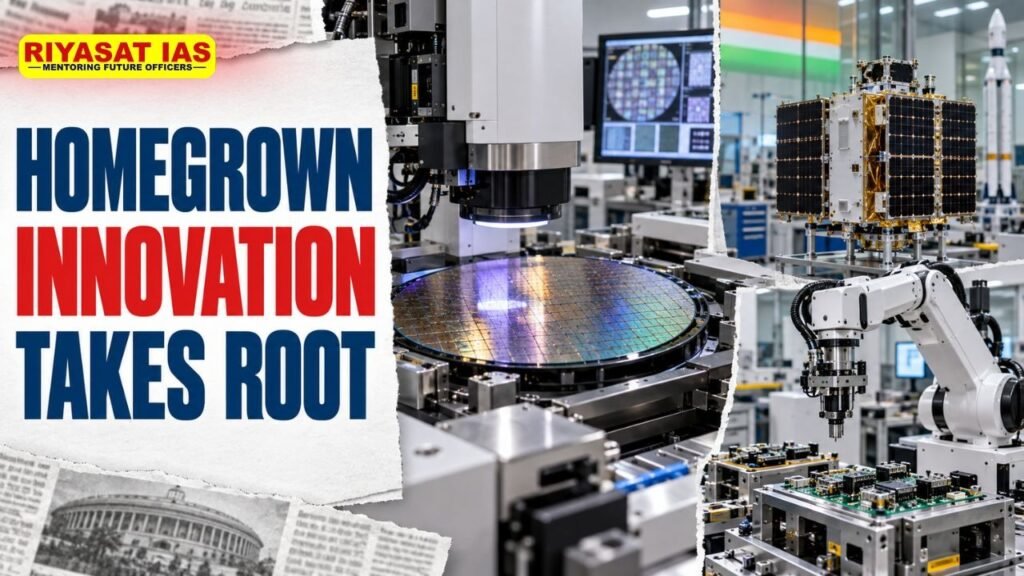
- Emerging Innovation Economy: India is beginning to produce technology locally through public research institutions, corporate R&D and deep-tech startups, thereby reducing dependence on imported technologies.
- Strategic Technologies: Indigenous Gallium Nitride (GaN) semiconductor technologies and affordable immunotherapies demonstrate the potential for domestic technological capabilities in defence, communications and biomedical innovation.
- Patent Growth: Patent filings are growing substantially, with domestic applicants accounting for almost seven out of ten filings.
- Persistent Gaps: India’s innovation transformation remains incomplete, as reflected in relatively low R&D expenditure, limited commercialisation and the low number of patents in force.
India’s Patent Landscape
- Patent Filings: Patent filings rose from a little over 1,10,000 in 2024–25 to more than 1,43,000 in 2025–26, registering an impressive 30.2% increase.
- Domestic Applicants: Domestic applicants account for nearly seven out of ten patent applications, indicating increasing engagement by Indian innovators.
- Patents in Force: At the end of 2025, India had just over 2,40,000 patents in force, compared with:
- China: 5.7 million (2024).
- United States: 3.5 million (2024).
- Japan: 2.1 million (2024).
- Patent Conversion Gap: The gap between patent applications and patents maintained suggests low grant rates, high abandonment rates, or both.
- Challenge of Commercialisation: Growing patent applications have not yet translated into sufficient commercialisation of research.
- Low R&D Expenditure: India spends less than 1% of GDP on R&D, compared with approximately 2.4% in China and 3.5% in the U.S.
- Key Concern: Increasing patent filings alone do not establish the strength of an innovation economy; the quality, commercial application and technological impact of research also matter.
India’s Innovation Economy and the Emergence of New Pillars
- Publicly Funded Research: Government-supported public institutions are generating breakthroughs in long-gestation research and strategic technologies.
- Corporate R&D: Private-sector R&D spending surpassed the combined spending of all levels of government for the first time in 2024.
- Increasing Share of Private Investment: With rising industry involvement in research, private R&D is expected to account for 55% during 2025–26.
- Industrial Innovation: Domestic industrial houses are beginning to reap the benefits of focused and sustained investment in R&D.
- Deep-Tech Startups: India’s startup ecosystem is moving beyond the service model and beginning to bridge gaps in deep technology and advanced manufacturing.
- Three Threads Converging: Public research, corporate R&D and deep-tech entrepreneurship can underpin India’s innovation economy in the years ahead.



Gallium Nitride (GaN) Semiconductor Technology
- Strategic Importance: GaN semiconductor technologies are essential for advanced radar, space systems and next-generation communications.
- A Major DRDO Breakthrough: In March 2023, scientists at the Defence Research and Development Organisation (DRDO), from the Solid State Physics Laboratory (SSPL), Delhi, and the Gallium Arsenide Enabling Technology Centre (GAETEC), Hyderabad, announced a breakthrough in manufacturing GaN Monolithic Microwave Integrated Circuits (MMICs).
- Technology Denial: According to various reports, the manufacturing know-how for these circuits had been denied to India as part of the offset obligations associated with the purchase of Rafale fighter jets from France.
- Technology Transfer: DRDO is transferring GaN High Electron Mobility Transistors (HEMTs)-based MMIC technology for applications such as:
- 5G and 6G wireless infrastructure.
- Electric vehicle onboard chargers.
- Renewable energy inverter systems.
- Global Capability: India is among the seven countries that have mastered this technology, alongside China, France, Germany, Russia, South Korea and the U.S.
- Commercialisation: AGNIT Semiconductors, a spin-off from the Centre for Nano Science and Engineering (CeNSE) at the Indian Institute of Science, Bengaluru, is taking its proprietary GaN technology towards commercial applications.
- Importance: Indigenous GaN technology can reduce reliance on foreign technology and enhance India’s strategic and industrial strength.
From Implementer to Innovator
- Bharat 6G Alliance (B6GA): The alliance aims to contribute 10% of global 6G patents by 2030.
- Over 7,700 Patent Filings: According to a review meeting by Union Minister for Communications Jyotiraditya Scindia, B6GA members have submitted more than 7,700 patent filings related to 5G and 6G technologies, including over 4,400 foreign filings.
- Patent Data Limitations: These figures represent applications, not patents actually granted or declared standard-essential; therefore, their true influence remains unproven.
- 3GPP Contributions: India contributed nearly 3,000 technical contributions to 3GPP last year, a 15-fold increase from 2020.
- International IPR Rankings: The 2025 Patent Cooperation Treaty rankings published by the World Intellectual Property Organization placed Jio Platforms Limited at 19th globally, marking its entry into the top 20 international patent filers and a rise of more than 300 places.
- Standards Participation: Intellectual property ownership and participation in standards-setting bodies increasingly determine who captures value from next-generation communications networks.
- The Transition: India is moving from its longstanding role as a standard-implementer towards becoming a standard-setting innovator, further strengthening its ownership of critical digital infrastructure.
Way Forward
- Increase Research and Development: Increase R&D expenditure through sustained public funding, greater private-sector participation and industry-academia collaboration.
- Enhance Commercialisation: Strengthen mechanisms for technology transfer, incubation and industry partnerships to convert research into products.
- Empower Deep-Tech Startups: Invest in emerging technologies such as semiconductors, advanced manufacturing, communications and other strategic domains.
- Develop Critical Technologies Domestically: Reduce import dependence and counter technology denial.
- Promote International Standards Participation: Encourage Indian researchers and companies to participate in global standardisation bodies and generate globally competitive intellectual property.
- Evaluate Innovation Through Outcomes: Assess innovation not only through patent filings but also through granted patents, commercial and technological adoption, and value creation.
Conclusion
- Innovation-Driven Growth: India is moving from being a technology buyer and implementer towards becoming a technology developer and standards-setting innovator.
- Institutional Convergence: Progress in public research, corporate R&D and deep-tech entrepreneurship is contributing to a stronger innovation ecosystem.
- Continuing Challenges: Low R&D expenditure, weak commercialisation of intellectual property and the gap between patent applications and patents in force remain major concerns.
- “Make in India” as Strategic Self-Reliance: Long-term sustained investment, sound technology transfer focused on production and design systems, enhanced enterprise capacity to absorb technology through IPR ownership, and stringent quality assurance mechanisms can create a more resilient, globally competitive and demand-driven innovation system for India.
UPSC Mains Practice Question
Q. India is gradually shifting from a net technology-importing country towards an innovation-driven economy, but numerous structural hurdles remain. Identify the emerging pillars of India’s innovation ecosystem and examine the reforms necessary to strengthen indigenous technological capabilities.





 Ravi Raaz
 Hassan Khan
 Shadab Ali