
GS-III – Science and Technology | Conservation of Environment | Sustainable Development
Why in News?
- New Priority: India is strengthening its position in deep-sea exploration and developing scientific and technological capabilities to access a largely unexplored region of the planet.
- The Central Question: The fundamental question is whether everything that can be technologically exploited should necessarily be exploited.
- Ecological Uncertainty: Since the deep ocean remains a poorly understood ecosystem, deep-sea exploration raises serious concerns about potentially irreversible ecological harm.
- Sustainable Development: India must balance the strategic importance of seabed minerals with biodiversity conservation, resource efficiency and reduced dependence on extraction.
India’s Growing Deep-Sea Footprint
- ISA Exploration Contracts: India holds three International Seabed Authority (ISA) exploration contracts covering approximately 95,000 square kilometres across the Central Indian Ocean Basin, Central Indian Ridge and Carlsberg Ridge in the international seabed area.
- Polymetallic Nodules: Exploration has identified an estimated 366 million tonnes of polymetallic nodules containing nickel, copper, cobalt and manganese, alongside extensive environmental and biodiversity studies.
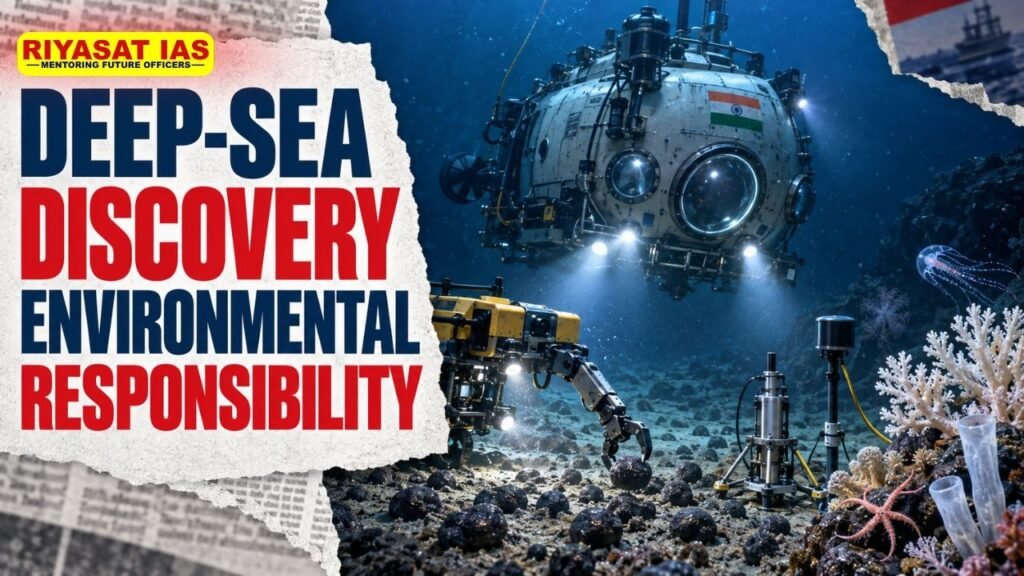
- Deep Ocean Mission: India is developing deep-sea mining technology, underwater robotics and the MATSYA-6000 human submersible.
- Mining Machine: An indigenously designed mining machine has been tested to a depth of approximately 5,270 metres by the National Institute of Ocean Technology.
- Biodiversity Surveys: Surveys across 19 seamounts have studied approximately 1,300 deep-sea organisms, including nearly 23 species reported as new to science.
- Scientific Responsibility: These achievements create an obligation to consider whether technological capabilities should ultimately lead to exploitation.
The Ecological Ramifications of Deep-Sea Mining
- Belief in Technology: Technological progress can create the assumption that if something can be exploited, it should be exploited.
- Fragile Ecosystems: The deep ocean contains ecosystems that have survived for millennia and remain poorly understood.
- Uncertainty in Biodiversity: India’s biodiversity research continues to discover previously unknown organisms, highlighting the limitations of existing ecological knowledge.
- Potential for Permanent Harm: Large-scale seabed disturbance may have consequences that cannot be fully predicted or reversed.
- More Science Before Intervention: The argument is not against science itself, but for more robust scientific research before potentially irreversible intervention is considered.



Strategic Importance Versus Ecological Permission
- Strategic Minerals: Deep-sea minerals could be important for India’s renewable-energy, electric-mobility and advanced-manufacturing sectors.
- Ecological Limit: Strategic importance does not automatically translate into ecological permission for extraction.
- Demonstrating Necessity: Before undertaking extraction, India must examine:
- Whether minerals are genuinely required at the proposed scale.
- Whether alternatives exist.
- Whether a circular economy can reduce demand through recycling, efficiency and substitution.
- Necessity Must Be Demonstrated, Not Assumed: The need for extraction must be established rather than taken for granted.
Exploration Is Not Exploitation
- Scientific Benefits: Investment in deep-ocean science can advance knowledge, biodiversity assessment, environmental baselines, technological development and characterisation without necessarily leading to exploitation.
- Exploration vs Mining: Exploration can improve scientific understanding, whereas mining would physically disturb the seabed.
- Limitations of Adaptive Management: Adaptive management alone cannot guarantee ecological protection, particularly where irreversible harm may occur.
- High Ecological Threshold: Since India’s ISA activities remain at the exploration stage, this is the appropriate time to establish a high ecological threshold for any future decision to mine.
- The Fundamental Question: The question should not simply be how to mine with the least harm, but whether mining is needed at all.
Science Must Also Teach Us to Say ‘No’
- Deep Ocean as an Economic Frontier: The deep ocean is emerging as a new economic frontier.
- Conflicting Expectations: The ocean is expected to regulate the climate and support biodiversity even as industrial activity expands into some of the least understood ecosystems.
- Environmental Cost Relocation: The ocean should not become a place where the environmental costs of human consumption are simply relocated.
- Meaning of Scientific Progress: Scientific progress should not merely expand the exploitation of nature and describe the activity as sustainable.
- Long-Term Sustainability: Dependence on extraction must be minimised through:
- Lower demand.
- Resource efficiency.
- Recycling.
- Substitution.
- Circular consumption.
- Mission LiFE: These principles are reflected in India’s Mission LiFE.
- Responsible Use of Resources: Science must help humanity use resources responsibly and determine when resources do not need to be used at all.
- Scientific and Civilisational Maturity: Recognising that not every frontier needs to be explored or exploited may represent greater scientific and civilisational maturity than merely demonstrating technological capability.
India Is Uniquely Positioned to Lead a Different Model
- Ecological Governance: India is positioned to play an important role in deep-sea ecological governance at the global level.
- Deep Ocean as an Ecological Asset: India could recognise the deep ocean not merely as a mineral reserve, but as a precious ecological asset whose value may exceed its mineral wealth.
- Precautionary Principle: Knowledge gained through the Deep Ocean Mission could enable India to decide that certain poorly understood ecosystems with potentially irreversible vulnerabilities are better left undisturbed.
- A Different Definition of Progress: Progress should be measured by how much of nature can be preserved while meeting human needs, rather than merely by how much can be converted into resources.
- Civilisational Tradition: Such an approach would reaffirm India’s ancient civilisational tradition of coexistence with nature.
Sustainable Development and Environmental Principles
- Nature-Based Solutions: Make explicit use of nature’s contribution in addressing environmental challenges.
- Sustainable Development Goals (SDGs): Achieve sustainable development while ensuring environmental protection.
- Circular Economy: Reduce resource consumption and dependence on continuous extraction through the circular use of resources.
- Mission LiFE: Promote sustainable consumption and resource conservation.
- Common Principle: These approaches recognise that nature is the capital on which development depends.
- Role of Science and Technology: Science must help determine not only how far humanity can go, but also where it must stop.
- Natural Capital: India’s future depends on protecting the natural capital that sustains development.
Conclusion
- Scientific Advancement and Conservation: Deep-sea exploration provides India with opportunities to advance scientific knowledge while engaging with fragile and poorly understood ecosystems.
- Responsible Innovation: Technological capability should not automatically translate into commercial exploitation, especially where ecological impacts may be irreversible.
- Ecological Governance: India can establish a model based on scientific evidence, demonstrated necessity and a high ecological threshold before seabed mining.
- Sustainable Future: True social progress lies in meeting human needs while reducing dependence on natural resources, protecting the physical environment and preserving space for other species in an accountable manner for future generations.
UPSC Mains Practice Question
Q. “Scientific progress should not merely expand the frontiers of exploitation; it should also help humanity determine where it must stop.” Discuss in the context of deep-sea mining in India and the need to safeguard ecological systems while meeting mineral requirements.





 Ravi Raaz
 Hassan Khan
 Shadab Ali