
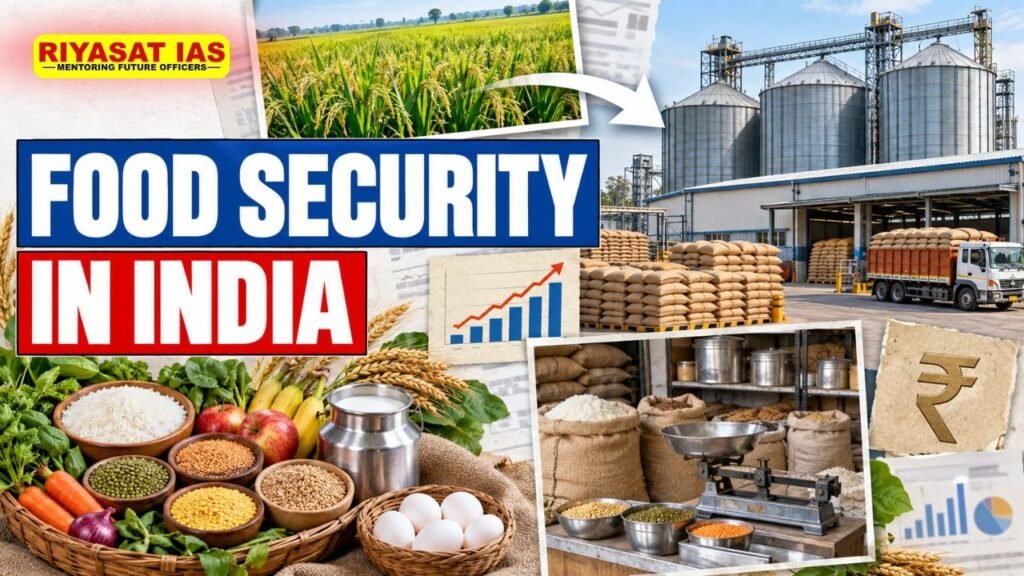
Food security in India means ensuring that everyone has regular access to sufficient, safe and nutritious food for a healthy and active life. India has strengthened food security through agricultural production, buffer stocks, MSP-based procurement, PDS and the National Food Security Act. However, malnutrition, food inflation, climate change, regional disparities and weaknesses in food distribution remain major concerns.
Dimensions of Food Security
- Food Availability: Ensuring the sufficient supply of food.
- Food Access: Making sure that people have enough money and means to buy available food.
- Food Utilisation: Ensuring that the food consumed provides adequate nutrition (besides the required calorie intake).
- Food Stability: Constant and uninterrupted availability of food despite economic, environmental and seasonal fluctuations.
Major Food Security Challenges in India
Food Availability
- Poor agricultural productivity due to inadequate irrigation, lack of improved practices and scarce access to modern inputs
- Small and fragmented land holdings that limit technology adoption
- Heavy losses due to poor storage and transportation
- Heavy reliance on imports, particularly edible oils and occasionally pulses
- Over emphasis on cereals (rice and wheat) which is a rich source of calories but not of protein, leading to the neglect of coarse grains, vegetables and pulses
- Regional imbalances
Food Access
- Poverty and inequality
- Gender inequality
- Poor access by vulnerable groups
- Poor market access
- Food inflation (especially for healthy food)
- Leaks and malfeasance in the Public Distribution System (PDS)
- Portability of ration cards and their poor implementation by migrants
Food Utilisation
- Malnutrition (even when there may be calorie sufficiency)
- Poor water, sanitation and healthcare resulting in low nutritional absorption
- Inequality in access to healthy food between genders
- The ignorance of the poor regarding the importance of good nutrition and a diet that comprises of a variety of food
- A PDS dominated by cereals and inadequate in terms of nutrition



Stability of Food Security
- Climate change impacting production and prices
- Water stress
- Disruptions in supply chains due to disasters, conflict and pandemics
- Unemployment and loss of livelihood that impact the capacity to buy food
- Fiscal burdens in terms of procurement, storage and PDS
- Poor convergence between various food, nutrition and welfare-related policies and programmes
Policy and Governance Challenges
- Implementation and Leakages: Poor convergence across sectors
- Lack of Data and Monitoring
- Technology-Induced Exclusion: Technology-induced exclusion due to biometric, connectivity and database problems
- Unpredictability of Trade Policy: Unpredictability of trade policy and its impact on prices and production
- Inappropriate Subsidisation: Inappropriate subsidisation of fertilizers, electricity and water
Way Forward for Food Security in India
- Shift from Food Security to Nutrition Security: Move from a narrow focus on cereals to nutrition-rich foods including pulses, millets, fruits, vegetables, milk, eggs, etc.
- Nutrition-Sensitive PDS: Diversify the food basket, wherever possible, to include millets, pulses, edible oils, etc.
- Improved PDS: Improve targeting, reduce leakages, strengthen monitoring and ensure transparency in the PDS.
- Protecting the Genuine Poor: Ensure fallback mechanisms in food security in case of technology failures and appropriate grievance redressal mechanisms.
- Strengthening of One Nation One Ration Card: Ensure convergence between employment, food, nutrition, social security and other sectors and promote technology-enabled targeting of the poor.
- Climate-Resilient Agriculture: Promote climate-smart agriculture to withstand the twin challenges of droughts and extreme weather conditions.
- Crop Diversification: Move from being over-dependent on rice and wheat to a more balanced production of coarse grains, millets and pulses as well as fruits and vegetables for improved nutrition.
- Improved Storage and Reducing Post-Harvest Losses: Improve storage capacity and infrastructure such as cold storage, road connectivity, transport, grading, packaging and processing.
- Improving Livelihood Security: Improve employment and livelihood opportunities, especially in rural areas, to improve purchasing capacity.
- Food Inflation: Ensure efficient supply chains as well as buffer stocking of essential items. Encourage domestic production of pulses and edible oils.
- Focus on Women and Children: Focus on nutrition security for women, children, pregnant and lactating mothers and adolescents.
- Convergence with Health, Water and Sanitation: Link food security with health, nutrition, water and sanitation to tackle the challenges of malnutrition, diarrhoea and poor hygiene.
- Focus on Urban Food Security: Ensure food security for the urban poor, the homeless, the ragpickers, the construction workers and the migrants.
Conclusion
India’s food security concerns are shifting from food availability to calorie and nutrition security and from that to livelihood security. To build sustainable food security, there is a need for crop diversification, improved PDS, climate-resilient agriculture, improved storage and lesser post-harvest losses and convergence between health, nutrition and sanitation.
FAQs on Food Security in India
What is food security?
Food security means availability of food for an active and healthy life.
What are the four dimensions of food security?
They are availability, access, utilisation and stability.
What are the major food security challenges in India?
Major challenges are malnutrition, poverty, food inflation, climate change, water stress, post-harvest losses, PDS leakages and livelihood insecurity.
Why is crop diversification important for food security?
Crop diversification is important in order to ensure nutritional security and reduce the burden on water resources.
What is the role of PDS in food security?
The PDS plays a huge role in ensuring that people are able to access food by providing food grains at subsidised prices.
How does climate change impact food security?
Climate change impacts food grain production due to extreme weather events like heat waves, floods, droughts, etc. and also makes food prices volatile.
What is One Nation One Ration Card?
It helps migrants in availing the benefits of the PDS in different states.



 Ravi Raaz
 Hassan Khan
 Shadab Ali