
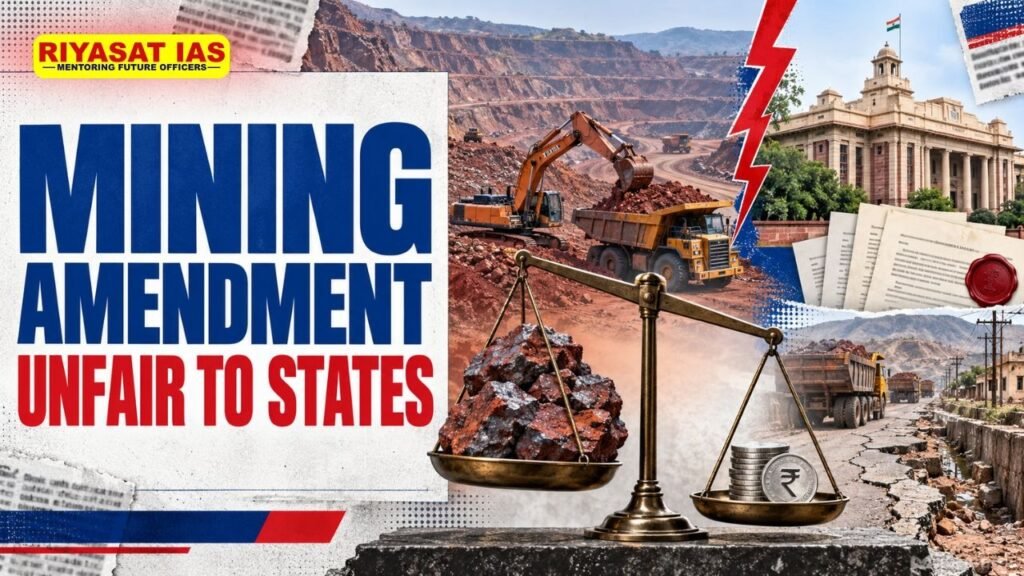
GS-II – Polity & Governance | Federalism
Uneven Distribution of Mineral Wealth
- Uneven Distribution of Minerals: Mineral wealth of India is not uniformly distributed across the country.
- Mineral-Rich States: Odisha, Jharkhand, Chhattisgarh and Karnataka have huge deposits of coal, iron ore and other minerals that supply industries all over India.
- Costs to the Host States: It also leaves the host State to contend with:
- Resettlement of displaced groups.
- Environmental damage.
- Pressure on public infrastructure.
- Extraction of minerals that can never be replaced, causing damage to the environment for decades.
MMDR Amendment, 2026
- Section 9D: No State Government will be able to charge tax, cess or any other levy on rights to mine minerals or land bearing minerals, except under conditions according to the rules framed by the Central Government.
- Centre: The measure is meant to:
- Create a predictable tax environment.
- Prevent excessive levies.
- Encourage long-term investment in mining.
- Economic Argument: Mining projects require massive investments and extend over many decades.
Concerns of the States
- Current Revenues: The question is far more subtle than simply whether States will continue to receive the royalty, auction premium and other revenues they derive from mineral production today.
- Centre’s Argument: The Centre contends that 90% of the mining sector revenue goes to States, and that this will remain.
- Future Income: The more serious concern is what States will no longer be able to earn in the future.
- Natural Economic Advantage: A mineral-rich State has a natural economic advantage, and one would generally expect that at least some of this advantage could be utilised to generate resources for its own development.
- Reduced Freedom: Section 9D curtails that independence by making the framework for future State levies connected with minerals dependent on the Centre.



Impact on Mineral-Rich States
- Mining-Dependent Budgets: This is immensely important for States with budgets that are very much tied to mining.
- NITI Aayog’s Fiscal Health Index: The Fiscal Health Index by NITI Aayog has noted that Odisha and Chhattisgarh were among the best-performing States on revenue mobilisation, which is partly due to their mining receipts.
- Odisha: A bigger share of the State’s non-tax revenue has come from mining.
- Mineral-Producing Districts: Such districts often need higher public spending because they are the ones who bear the cost of mining.
The Federal Problem
- Entry 50 – State List: States have the power to tax mineral rights; Parliament may limit that power through laws on mineral development.
- Entry 49 – State List: States also have a separate constitutional power to tax land and buildings.
- 2024 Supreme Court Judgment: The 2024 Supreme Court judgment in Mineral Area Development Authority vs. Steel Authority of India, involving a nine-judge Bench, addressed important issues, including that royalty payable on minerals is not a tax.
- State Taxes: It also recognised the States’ power to enact a tax on mineral rights.
- Mineral-Bearing Land: It held that mineral-bearing land is included within the States’ power to tax land.
2024 Judgment and Section 9D
- Impact: The 2026 Amendment threatens to make the impact of this judgment meaningless.
- Entry 50: Entry 50 of the State List allows Parliament, by law, to restrict a State from imposing any tax on the rights relating to minerals, but Section 9D not only restricts taxation of mineral rights but also extends to taxes or levies on mineral-bearing lands.
- Constitutional Debate: This raises a major constitutional debate: To what extent can Central legislation relating to mineral development encroach upon the exclusive power of a State to tax land?
Federalism and Fiscal Capacity
- Broader Question: This question is broader than just mining policy. It concerns the relationship between the Union and States.
- Financial Capacity: The federal system cannot work if responsibilities are imposed on States without also empowering them with financial capacity.
- Meaningful Stake: A State facing the social and infrastructural burdens imposed by mineral extraction should retain a meaningful stake in its own natural resource economy.
- Tax Predictability vs Fiscal Choices: Tax predictability may be guaranteed by uniformity, but it does not follow that fiscal choices available to States should be sacrificed in the pursuit of predictability.
Conclusion
- The debate over the MMDR Amendment is fundamentally about the constitutional balance of power between the Union and the States, rather than a simple choice between business investment and state taxation
- The minerals under a State may be in the interests of all citizens, but the people living above them pay for the consequences more than anyone.
UPSC Mains Practice Question
Q. “The MMDR Amendment, 2026 raises serious issues of State fiscal autonomy and federalism.” Analyse the taxation powers on mineral rights and mineral-bearing land.




 Ravi Raaz
 Hassan Khan
 Shadab Ali