
GS-II – International Relations
Local Currency Trade – Incremental Progress
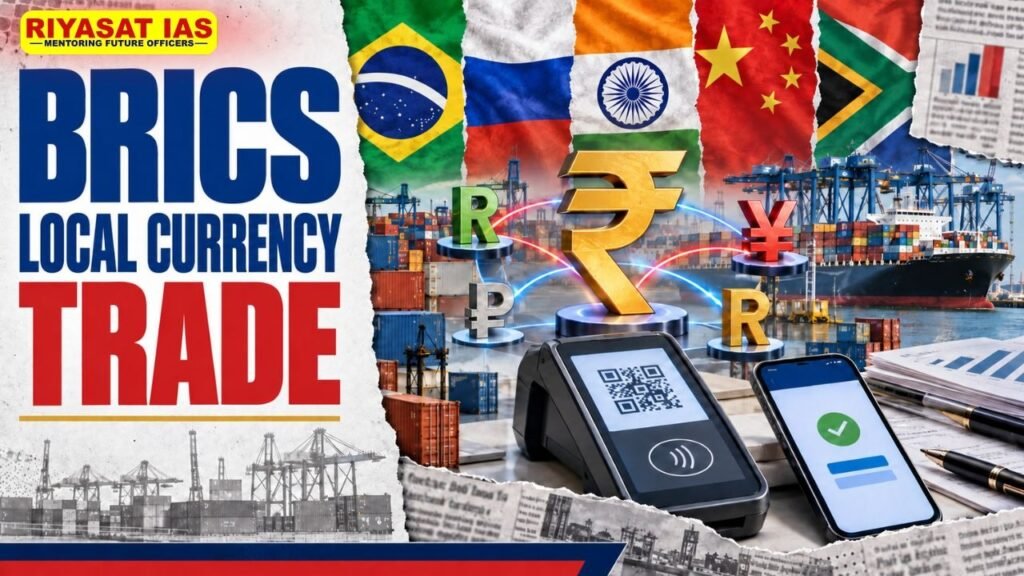
- New Delhi Declaration: It shows little progress in improving domestic currency trade; progress is incremental.
- No Clear Recommendations: The paragraph on local currency trade recognises the work of several task forces and committees, but provides no clear recommendations.
- India’s Rupee Trade: With only the UAE and Russia providing this option, India’s rupee trade with BRICS partners is still limited.
- Small Volumes: Even these countries offer relatively small trade volumes.
- Russia’s Rupee Issue: The Indian rupee is not a fully convertible currency globally, meaning non-residents face strict regulatory controls on capital flows and converting rupees into other foreign currencies.
- Petroleum Imports: Thanks to Ukraine’s assaults, Russia has started importing petroleum products from India. This is one avenue that can at least moderately use the rupees earned till now, but even so, this is merely a drop in the bucket.
India Willing to See Use of Local Currency for Trade
- BRICS Currency as Local: One possibility consists of considering any BRICS currency as local.
- UAE Dirham: The UAE Dirham is already being used by India to pay for Russian oil.
- National Priorities: The Declaration supports transactions in local currency with due respect for national priorities.
- Not One Size Fits All: It also acknowledges that not every approach can be the same.
- Intra-BRICS Issues: Some intra-BRICS issues must be settled.



India’s Strategic Considerations
- More Dollar: India would like to keep getting dollars for its exports.
- Depreciating Rupee: A depreciating rupee means that the value of the Indian Rupee (INR) has fallen relative to the US Dollar (USD).
- Export Benefit: A nation aspiring to increase exports, India would obviously not want to lose this benefit.
- Importer’s Point of View: India is also a major importing country and would like to pay in relatively cheaper local currencies.
- India’s Choice: India will have to take into account these options.
China and the Yuan
- China’s Share: Around two-thirds of BRICS exports come from China.
- Yuan Trade: Consequently, BRICS local currency trade will predominantly be yuan trade.
- India-China Relations: While relations with China may be improving, India would be loath to do business in yuan.
Trade in Local Currency vs Trade in a BRICS Currency
- Key Difference: Trade in local currencies and a BRICS currency are two different things.
- India’s Position: India is cautiously supportive of local currency trade.
- Against BRICS Currency: India has taken a public stance against a BRICS currency, as China is very likely to dominate this currency.
- U.S. Tariff Threat: U.S. President Donald Trump threatens 100% tariffs on any country that adopts a BRICS currency.
- India’s Approach: India is being sensible about Mr. Trump and will not invite such tariffs lightly.
Different Motivations within BRICS
- Iran and Russia: Countries such as Iran and Russia may have strong incentives to de-dollarise.
- India’s Case: So far, the Indian case for shifting away from the dollar has not been strong enough.
- India’s Practical Approach: The Declaration thus embodies India’s practical approach towards trade in local currency.
Conclusion
- BRICS local currency trade advances in small steps, with concrete proposals woefully lacking.
- India’s stance is a careful balancing act between its export interests, import needs, relations with China and fears over U.S. tariffs.
- The New Delhi Declaration reflects the different national priorities among BRICS countries, making a one-size-fits-all model difficult.
UPSC Mains Practice Question
Q. “The challenges to fostering local currency trade within BRICS are reflected in the New Delhi Declaration.” Discuss why India is shifting towards local currency trade and its position on a BRICS currency.




 Ravi Raaz
 Hassan Khan
 Shadab Ali