
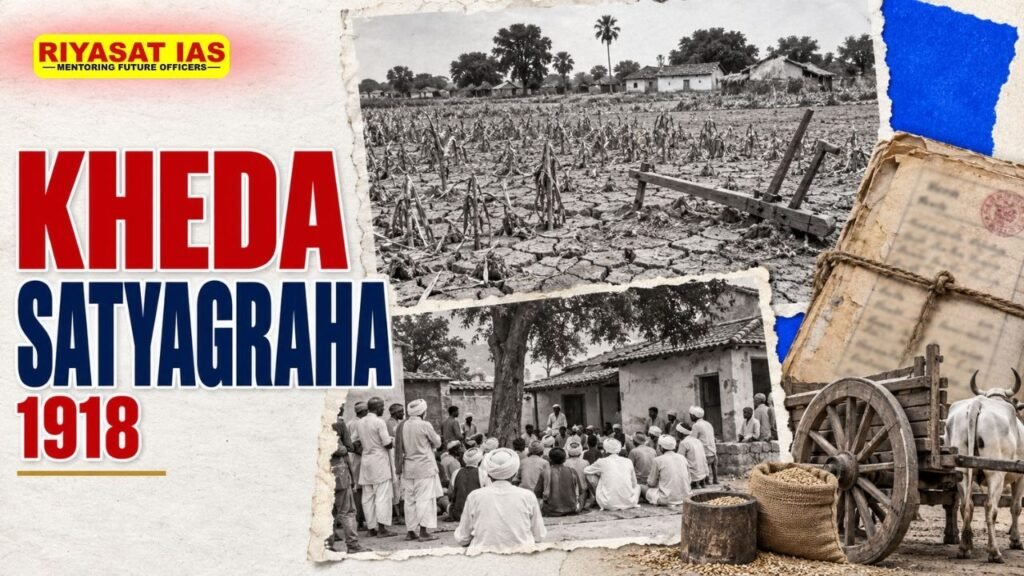
Kheda Satyagraha was Gandhi’s major peasant Satyagraha in Gujarat in 1918, coming soon after Champaran and the Ahmedabad Mill Strike. The immediate issue was simple: the crops had failed, but the government still insisted on collecting the full land revenue. Gandhi supported the peasants’ demand for suspension of revenue and turned the local dispute into a disciplined Satyagraha.
Background
· Kheda district, in present-day Gujarat and then part of the Bombay Presidency, was mainly inhabited by peasant communities, particularly the Kanbi-Patidars. During the late nineteenth and early twentieth centuries, the area had suffered from repeated famines and epidemics.
· The situation became particularly difficult in 1917–18, when a poor harvest was accompanied by rising prices and epidemics. Many peasants were already struggling to meet their basic needs, yet the colonial administration continued to demand land revenue.
· Under the revenue rules, a sufficiently severe crop failure could make cultivators eligible for remission or suspension of land revenue. According to the contemporary assessment, the crop yield in Kheda had fallen to about one-third of the normal yield, which strengthened the peasants’ claim for revenue relief.
Kheda Satyagraha causes
· The immediate cause was the failure of crops in 1917–18. Production had fallen sharply, leaving many cultivators without the income required to pay the full assessment.
· At the same time, prices of essential commodities had risen, increasing the pressure on rural households. The burden was particularly severe for poorer cultivators who had little capacity to absorb another financial demand.
· Peasants therefore requested the government to remit or suspend land revenue for the year. When their petitions and representations failed to produce relief, the issue gradually developed into an organised no-revenue campaign. Local leaders had already begun mobilising peasants before Gandhi formally took up the struggle.
Gandhi’s Role
· Gandhi first wanted to understand the actual condition of the cultivators rather than simply accepting the claims of either side. Crop conditions were investigated, and the evidence supported the peasants’ argument that the harvest had been exceptionally poor.



· Through the Gujarat Sabha, Gandhi and his associates organised the peasants and explained that they should withhold revenue peacefully if the government refused to provide relief.
· On 22 March 1918, at Nadiad, Gandhi asked the peasants to take a pledge that they would not pay the land revenue for the year, either wholly or partly, as long as the government refused their demand for remission.
· Gandhi repeatedly travelled through the villages and urged the cultivators to remain firm but strictly non-violent. He also insisted that better-off peasants should support the poorer cultivators so that individual families would not be forced to surrender under pressure.
Role of Vallabhbhai Patel and Other Leaders
· Gandhi was supported by several local workers who organised the villages and maintained communication with the cultivators. Vallabhbhai Patel emerged as the most important among them.
· Patel, along with Indulal Yajnik, Shankarlal Banker, Narhari Parikh and Mohanlal Pandya, travelled through the villages, explained the purpose of the Satyagraha and encouraged peasants to remain united.
· The movement therefore provided Patel with his first major experience of working closely with Gandhi and organising a large rural population.
Government Response
· The government refused the peasants’ demand and attempted to enforce revenue collection.
· As the Satyagraha continued, officials began using coercive measures. Cattle and household property were seized, standing crops were attached and properties of non-paying peasants were confiscated.
· Despite this pressure, the peasants largely maintained their pledge and avoided violence. Gandhi continued to emphasise discipline and non-violence.
· Gradually, the government began looking for a way out of the dispute. Instead of openly admitting that the entire revenue demand should be remitted, officials issued instructions that revenue should be recovered from those who were able to pay, while poorer peasants would be allowed relief. Confiscated property was also to be returned.
· Gandhi accepted this practical settlement and withdrew the Satyagraha, even though every demand of the peasants had not been formally accepted.
Result
· The Kheda Satyagraha ended with a partial settlement rather than a complete victory.
· The government remitted the revenue for one year, reduced the revenue rates in the following years, and returned the confiscated property of the peasants.
· Revenue collection was effectively relaxed for peasants who could not afford to pay, while those who were financially capable were expected to pay. Confiscated properties were returned to their owners.
· Gandhi’s decision to withdraw the movement despite the absence of a formal acceptance of all demands showed his willingness to accept a practical compromise when the main objective of protecting the poorer cultivators had been achieved.
Significance
· Kheda became an important step in Gandhi’s emergence as a mass leader in India. Unlike the earlier constitutional politics of petitions and representations, peasants themselves became active participants in a disciplined political struggle.
· The movement also gave Vallabhbhai Patel valuable experience in rural organisation and brought him into Gandhi’s close circle of political workers.
· Another important lesson was the use of non-payment of revenue as a form of non-cooperation. Peasants did not attack government officials or destroy property; instead, they collectively refused to cooperate with a revenue demand they considered unjust.
· Along with Champaran and the Ahmedabad Mill Strike, Kheda gave Gandhi the opportunity to test Satyagraha in three different settings—peasants, industrial workers and revenue-paying cultivators.
· This movement also strengthened the connection between Gandhian politics and rural India. Kheda subsequently became an important base for nationalist mobilisation in Gujarat.
Conclusion
· Kheda Satyagraha was a struggle over a very concrete issue—the inability of peasants to pay land revenue after crop failure. Gandhi turned it into an organised campaign based on non-payment, unity, discipline and non-violence. Although the settlement was only partial, the movement strengthened Gandhi’s position among peasants and gave Vallabhbhai Patel valuable experience in mass organisation.
FAQs
1. Why was the Kheda Satyagraha launched?
It was launched because of severe crop failure in 1917–18 and the government’s refusal to suspend or remit land revenue despite the peasants’ inability to pay.
2. What was the main demand of the Kheda peasants?
They demanded remission or suspension of land revenue for the year of crop failure.
3. Who were the important leaders of the Kheda Satyagraha?
Mahatma Gandhi and Vallabhbhai Patel were the principal leaders, supported by workers such as Mohanlal Pandya, Indulal Yajnik, Shankarlal Banker and Narhari Parikh.
4. How did the government finally respond?
Revenue was effectively collected only from those who could afford to pay, while poorer peasants received relief and confiscated properties were returned.



 Ravi Raaz
 Hassan Khan
 Shadab Ali