
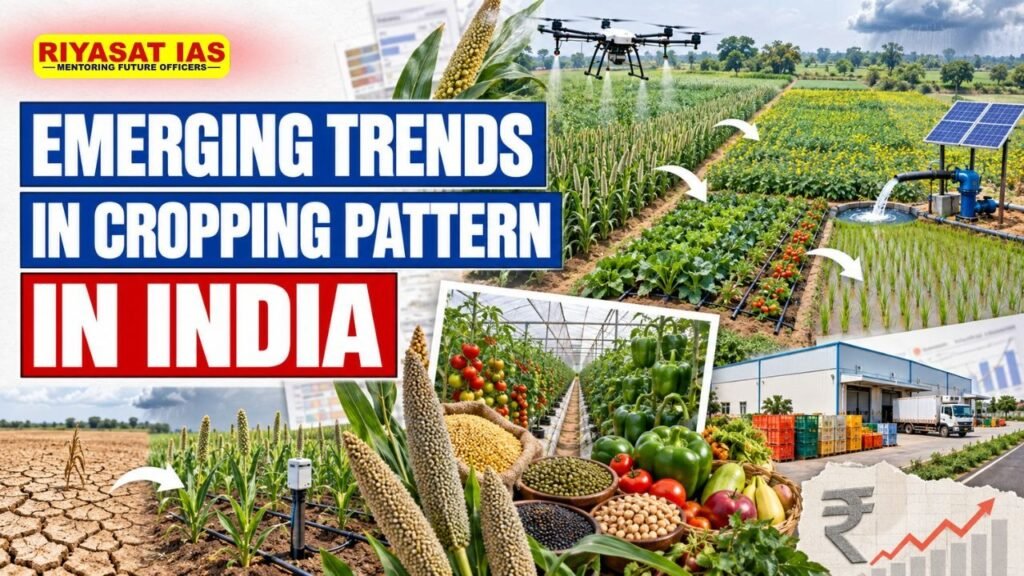
India’s farming community is witnessing a shift towards growing less basic foodstuff crops, and an increased inclination towards commercial farming due to changing market requirements, new agricultural technologies, horticulture, urbanization, availability of water and climatic factors.
Major Emerging Trends in Cropping Pattern of India
Shift From Subsistence Based Food Crops to Commercial Crops
While many farmers grow subsistence based crops like food grains, cereal, and pulses, the farmers are now looking towards commercial crops.
High agricultural productivity has enabled them to achieve higher yield levels which is quite better than the average level for several countries.
There is a decline in agricultural dependence and the proportion of agriculture in the overall economy has dropped as industry and services have expanded.
Increased Productivity Levels in Farming
Improved agricultural practices, better quality seeds, mechanization, irrigation, fertilizer use and increased level of education among farmers have led to an increase in agricultural productivity.
Still, Indian agricultural productivity remains lower than many other agricultural producing countries.
Increased Importance of Horticulture
India has witnessed an increase in the cultivation of fruits, vegetables, flowers and spices.
With the availability of improved planting material, techniques, irrigation facilities, knowledge, better price realization, domestic markets are growing to support this endeavor. Farmers are cultivating fruits, vegetables or spices as alternative crops with the available irrigation facility or in addition to traditional food crops.



India produces a large amount of major fruits like mango, banana, papaya, etc.
Impact of Urbanization on Cropping Patterns
The patterns of agricultural production are changing with the influence of urbanization which brings change in use of farm resources and production process.
The rapid rise in urban population leads to the shrinkage of cultivable land because of urban infrastructure and urban housing, but at the same time, it increases pressure on the remaining cultivable land to give more produce.
Changes in Food Grains Cropping Pattern
A steady growth in the production of food grains has been taking place since the last several years, but the increase in production needs to increase at a faster rate to meet the demand of growing population, increasing the rate of consumption and enhancing productivity.
Switch to Water Efficient Crops
There is an improvement in the cropping pattern and there is a move to cultivate crops like pulses, oilseeds, millets etc rather than water intensive crops like paddy, sugarcane.
The changing water scenario is a matter of concern and farmers need to adopt a new water efficient cropping pattern in place of existing crops.
Agro-Climatic Suitability Based Cropping Pattern
There is change from uniform cropping pattern to location specific or crop specific cropping pattern depending upon agro climatic conditions like availability of water, soil types, rainfall, temperature.
FAQs
What are the major emerging trends in cropping patterns in India?
The major trends are diversification of cropping patterns, increased focus on horticulture, commercialization of farming, water efficiency, enhanced agricultural productivity and awareness of agro-climatic suitability.
Why is horticulture gaining such significant ground in India?
Growing demand and supply, good price realization, availability of quality planting material, better technology, knowledge, and irrigation facilities encourages farmers to grow horticulture crops.
Why do farmers want to switch over to water efficient crops?
Depleting water table, water scarcity situation, and changing weather patterns encourage growing of less water demanding crops like millets, pulses by substituting water intensive crops like sugarcane and paddy.
How does urbanization impact cropping patterns?
Impacts of urbanization on cropping patterns are,
Land use pattern: As urbanization grows, agricultural land reduces as the urban infrastructure grows. This may lead to expansion of urban boundaries to encroach agricultural land.
Farmers, in the vicinity of newly urbanized areas may be motivated to change their cropping pattern to meet the new demands of the urban consumers. These consumers have a taste for varied products and services, like vegetables, eggs, milk, etc.
What is crop diversification?
Crop diversification means moving away from growing a single crop or set of crops to growing several kinds of crops.
Why is agro-climatic suitability important for selection of cropping pattern?
Selection of suitable crops on the basis of local suitability enhances production potential as well as productive use of available resources.




 Ravi Raaz
 Hassan Khan
 Shadab Ali