
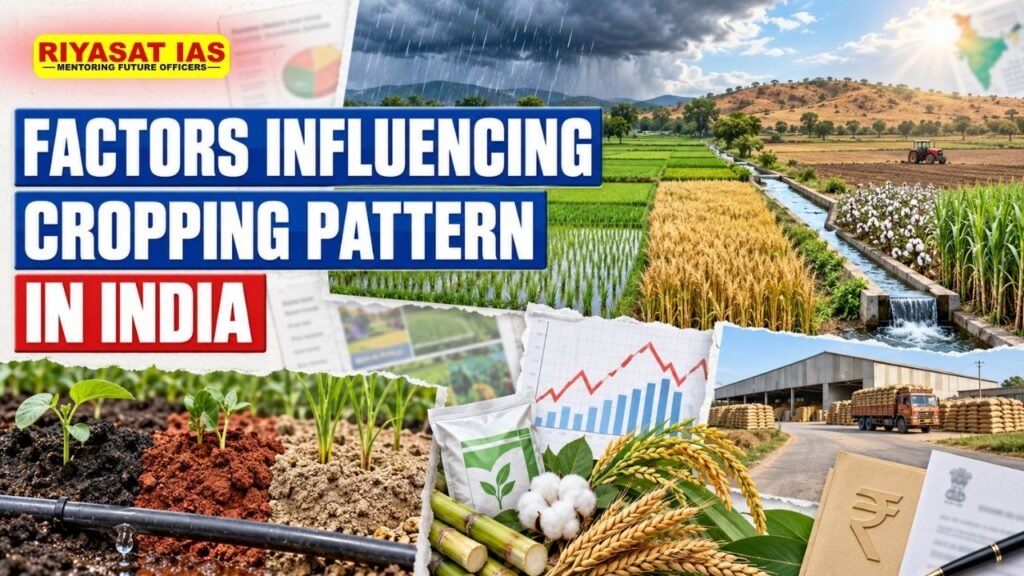
The cropping pattern in India is not static. Various factors like physical conditions, economic returns, infrastructure, government policies and social preferences affect the pattern of cropping in India. These factors are subject to change over time, and hence the pattern of cropping gets changed.
Physical Factors
Natural factors provide the basis for farmers to decide what crop to grow, where it can grow, and to a large extent, the amount of crop that can be grown.
Soil
Nature and properties of the soil determine the types of farming to be done. Selection of a crop is decided on the basis of the relationship of the crop with the soil. Crops like wheat are suitable for lighter soils whereas heavy soils such as clay are suitable for crops like jowar and bajra. Similarly, the texture of soil affects its capacity to hold water and hence affect crop growth. The relative share of different crops is determined also by their relationship with the climatic conditions in a region.
Climate
It is the most important natural factor, which governs the cropping pattern. The temperature and amount of rainfall determine which crops are likely to thrive in a region. Dry areas, which have less predictable rainfall, tend to grow coarse grains, whereas cultivation of crops like rice is favored in areas which have plenty of water with suitable temperature conditions. In general, crops that need less water are grown in areas with erratic rainfall.
Irrigation
The availability of irrigation facilities can greatly affect the cropping pattern. With assured water supply through irrigation works, it becomes possible to grow water-intensive crops on a large scale. Irrigation also makes multiple cropping possible in a year.
Economic Factors
The economic factors such as prices expected by the farmers, costs of inputs, and risks involved in different agricultural activities are important determinants of cropping pattern.
Price and Income Maximization
Farmers are likely to take decisions to maximize their incomes from their land by selecting the crop having better price competitiveness and minimizing the costs of cultivation.
Farm Size
Farmers’ share in total cropped area is governed to a large extent by farm size. Small farmers tend to devote more area to food grains for their own consumption whereas large farmers have more flexibility to choose between commercial and food crops.
Risk Management
The likelihood of crop failure acts as a deterrent to growing a single crop throughout the year. Hence, farmers are motivated to adopt crop diversification to minimize risks and stabilize output.



Availability of Inputs
The availability of seeds, fertilizers, irrigation, storage facilities, and transport facilities affect the cropping pattern.
Land Tenure
The ownership and leasehold holdings also have bearing on the cropping pattern. For instance, in case of crop-sharing arrangements, it is the master landlord who decides on the cropping pattern.
Infrastructure and Market Facilities
The level of infrastructure available in the region influences the cropping pattern. Facilities like irrigation, transport, storage, and processing play a significant role in deciding the cropping pattern.
Irrigation
Irrigation infrastructure provides water to the crops and reduces dependence of farmers on erratic and unpredictable monsoon.
Transport
Transportation facilities enable farmers to take their produce to markets efficiently.
Storage
Storage facilities help in reducing wastage due to decay and rotting of produce after harvest.
Trade and Marketing
Better trade and marketing facilities influence the cropping pattern according to demand in the market.
Post-Harvest Handling
The grading and packaging facilities provided after harvest help in making the produce attractive in the market.
Processing Facilities
Processing units help in making way for allied industries in the region, which in turn, decide the cropping pattern.
Government Policies
The government often influences the cropping pattern by implementing different government policies like minimum support price, subsidies, etc.
Agricultural Policies
The government can influence the cropping pattern through various agricultural policies and laws. Crop development programs formulated by the government can direct farmers towards crop cultivation.
Minimum Support Price (MSP)
Announced prices for certain crops provide assurance to the farmers regarding prices, which influence the cropping pattern.
Green Revolution
Introduction of high-yielding varieties of seeds along with extensive use of fertilizers and irrigation has led to replacement of coarse grains and pulses with wheat, especially in northern India.
Social Factors
The social factors like food habits and traditional practices influence the cropping pattern.
Food Habits
The staple diet is governed to a large extent by climatic conditions. Some people prefer eating wheat as their staple food while others prefer rice. This influences the cropping pattern to a great extent as there is always demand for staple diet. Generally, people living in eastern and southern part of the country prefer rice as their staple diet while people in northern part of the country prefer wheat as their staple diet.
Traditional Practices
Farmers, in general, follow traditional practices with regard to tillage and crop husbandry. Familiarity with a particular crop, local practices, and community customs also influence the cropping pattern.
FAQs on Factors Influencing Cropping Pattern
What are the main factors affecting cropping patterns in India?
The main factors are physical factors, economic factors, infrastructure and market facilities, government policies, and social factors.
How does soil influence cropping patterns?
Different crops require different levels of nutrients, water retention, and drainage. Hence, the nature of the soils determines the types of farming that can be undertaken.
Why is irrigation important for cropping patterns?
Irrigation facilities reduce dependence of farmers on rainfall, and enable them to cultivate water-intensive crops as well as to adopt multiple cropping.
How do crop prices determine cropping patterns?
The expected prices of a crop determine the extent of its cultivation. When the expected prices from a particular crop are higher, more and more farmers are motivated to cultivate that particular crop.
How does farm size determine crop selection?
Farmers having small land holdings have to give more importance to cultivating food grains for their own use, whereas medium and large farmers have more options in this regard.
How does MSP influence cropping patterns?
MSP provides price support to the farmers. It influences the cropping pattern as farmers consider expected returns when they decide which crops to cultivate.
How do food habits influence cropping patterns?
The demand for staple diet determines the cropping pattern. For instance, rice is traditionally more important in eastern and southern parts of the country, whereas wheat has greater significance in the northern part.




 Ravi Raaz
 Hassan Khan
 Shadab Ali