
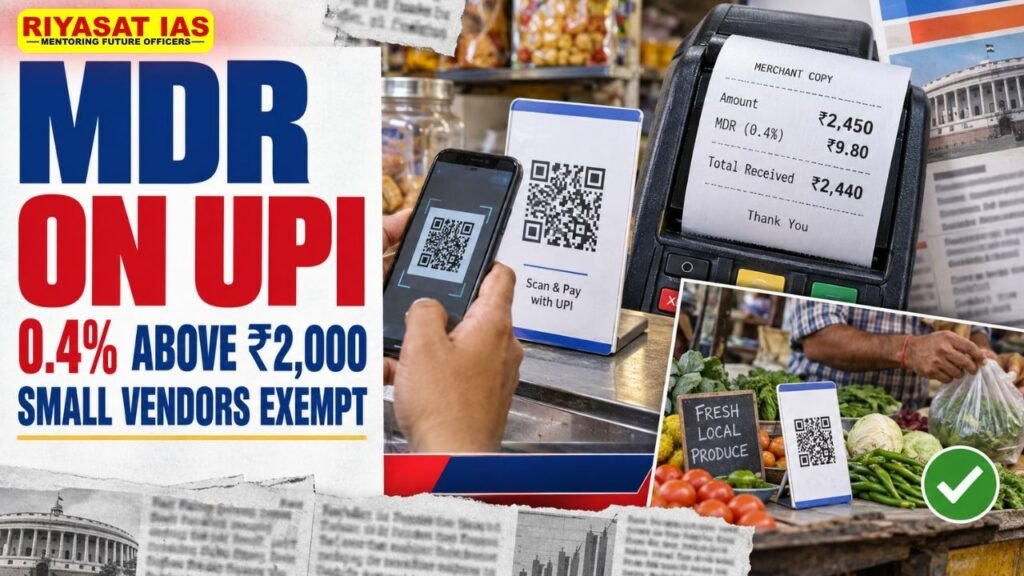
- MDR: Merchant Discount Rate — this is the commission paid in the payments market for a merchant payment transaction.
- New Rule: On Person-to-Merchant (P2M) UPI transactions of more than ₹2,000, an MDR of 0.4% will be levied from October 15, 2026.
- Who pays: Merchant (not consumer). Banks should ensure the charge is paid for subsequently and not billed to their clients.
- Maximum Cap: MDR is capped at an absolute maximum of ₹300 per transaction; hence, for a transaction of ₹75,000 or more, MDR can never be more than ₹300.
- P2P Transactions: No charge for person-to-person (P2P) UPI transactions, regardless of transaction value.
- Zero-MDR: UPI payments of up to ₹2,000.
- Special Categories: For transactions like railways, telecom, insurance and fuel that are above ₹2,000, the MDR is a flat ₹5 instead of 0.4%.
UPSC Prelims Question
Q. With respect to the new MDR framework for UPI, which of the following statements are correct?
1. Any UPI transaction exceeding ₹2,000 will attract a 0.4% MDR, which is the only charge that gets levied on a UPI transaction as well.



2. The amended MDR is applicable for Person-to-Merchant transactions.
3. Person-to-Person UPI transactions remain free.
4. The MDR is capped at ₹300 per transaction.
Which among the above statements is/are correct?
(a) 1 and 2 only
(b) 2, 3 and 4 only
(c) 1, 3 and 4 only
(d) 1, 2, 3 and 4
Answer: (b) 2, 3 and 4 only
Statement 1 is wrong: The 0.4% MDR (Merchant Discount Rate) is for P2M (P = Person, M = Merchant), not UPI transactions. MDR per transaction is capped at ₹300, and P2P transactions continue to be free.





 Ravi Raaz
 Hassan Khan
 Shadab Ali