
GS Paper III – Agriculture & Rural Development
- Global and Local Conflicts: Climate stress and food insecurity, insufficiently responding to entrenched poverty and fiscal pressure, only reinforce the limits of old development models.
- Evidence-Based Development: Any serious development must start with a realistic assessment of the facts — evidence, practical experience and results.
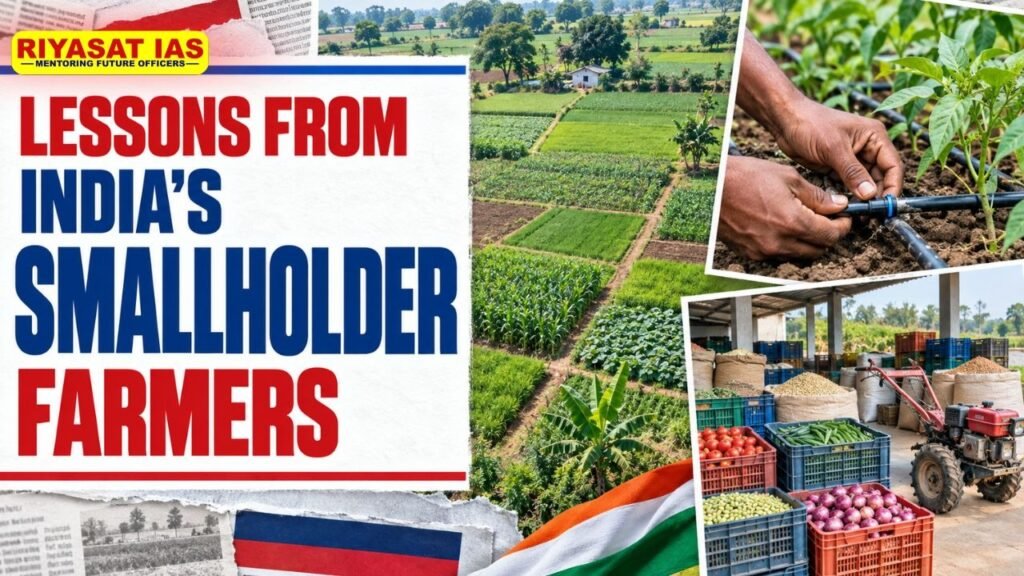
- Smallholders of India: The most significant takeaways for rural development strategies here in India are coming from smallholder farmers.
- Rural Transformation: Farmers, women’s groups, producer organisations and rural enterprises demonstrate that smallholder agriculture can be a path out of poverty and subsistence into profitable commercial opportunity at scale.
- Resource-Constrained Contexts: This disproves the concept that rural transformation cannot work in resource-constrained contexts.
- Bundled Services: India now blends infrastructure, enterprise development, skills, finance and market access in an increasingly commercial manner that can deliver large-scale results.
Challenges Faced by Smallholder Farmers
- Inequitable Access: Smallholder farmers persistently experience unequal access to finance, technology, markets, land, water and relevant infrastructure.
- Climate Change: Climate change is increasing the pressure through less predictable rainfall, rising temperatures and declining soils.
- Large-Scale Transformation: Rural transformation cannot be achieved based on isolated projects.
- Combination of Measures: Although roads, irrigation, power and digital connectivity are extremely important, they will change few lives unless farmers can band together to create collectives with bargaining power, access to finance and technology, reach markets and build viable food businesses.

Redefining Development
- IFAD Partnership: This can be seen in the programmes financed by IFAD, a specialised UN agency long associated with India.
- Maharashtra: Self-help groups access commercial credit to assist thousands of rural women.
- Meghalaya: A hub-and-spoke model of economic development is in place.
- Uttarakhand: Support for the formation of youth- and women-led farmer producer organisation enterprises.
- Mizoram: Climate-resilient Zau farming protects traditional communities and the environment.
- Jammu and Kashmir: Engaging youth by tapping into their entrepreneurial spirit to open up the agricultural potential in the region.
India’s Rural Development Ecosystem
- Official Ecosystem: The Government of India, NGOs, private sector entities, Agri Stack — an integrated digital public infrastructure — NABARD, self-help groups, farmer producer organisations, cooperatives, MSMEs and innovations combine to create an ecosystem that can connect farmers with opportunities.
- Access to Services: These institutions work together to provide smallholders with services, finance and markets.
- Digital Tools: Efficiency and accountability are improved by digital tools.
- IFAD–India Strategy: The new eight-year IFAD–India strategy, rolled out in May this year, complements India’s Viksit Bharat@2047 vision and is focused around constructing this architecture.
India and the Global South
- Global South Leadership: India is a key voice in the conversation on rural development and is taking on an increasingly broader leadership role.
- Vasudhaiva Kutumbakam: The rural experience in India is a common resource for the larger family of nations in line with the idea of Vasudhaiva Kutumbakam.
- IFAD: IFAD, the only international financial institution dedicated solely to rural transformation, works in 92 countries across the world and serves as a channel through which India can share its lessons beyond national borders.
- Transferable Principles: India’s models cannot be replicated, but its principles can travel:
- Build strong local institutions.
- Link them to markets and capital.
- Invest in rural enterprises.
- Use digital systems intelligently.
- Treat smallholders, including women and youth, as economic actors rather than passive recipients.
Conclusion
- These experiences from India serve us a set of keys to rural transformation: the commitment needed for organisation, commercial opportunity, adequate finance, infrastructure, technology and market access.
- There is a need for local institutions and treating smallholders as economic agents.
UPSC Mains Practice Question
Q. “Through organisation, commercial opportunity and resilience, smallholder farmers can make the leap from poverty and subsistence to prosperity.” For the Global South, what lessons stem from exploration into India’s experience of rural development?



 Ravi Raaz
 Hassan Khan
 Shadab Ali