
Introduction
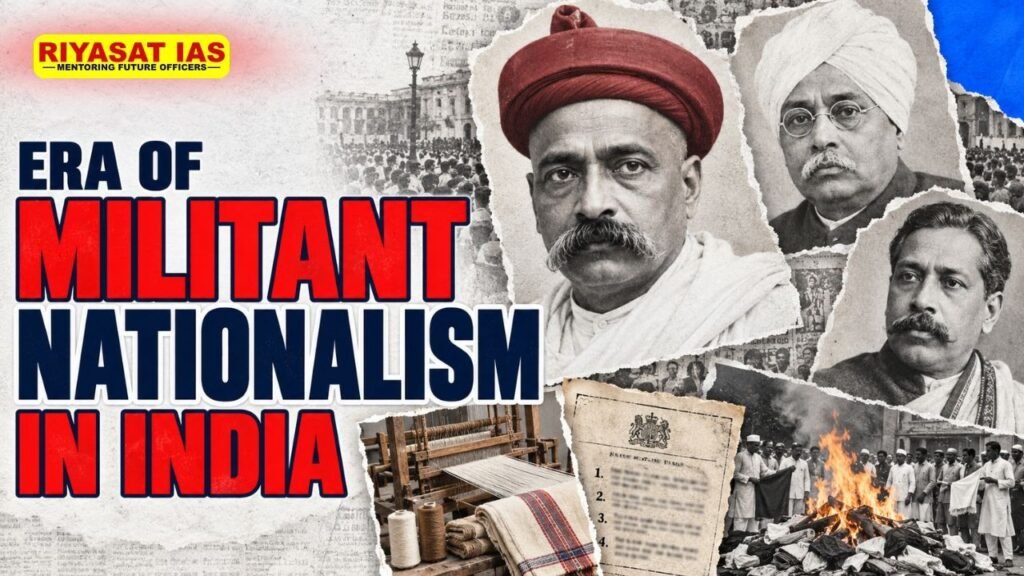
· The period between 1905 and 1917 witnessed the rise of a more assertive form of nationalism within the Indian National Congress. The new leaders, commonly called Extremists or Assertive Nationalists, criticised the Moderates for relying mainly on petitions and constitutional appeals.
· They demanded Swaraj, Swadeshi, Boycott and National Education and sought to involve ordinary people more directly in the national movement. The rise of this trend was closely connected with the Partition of Bengal, Curzon’s policies and the Swadeshi Movement.
Factors Behind the Rise of Militant Nationalism
· Political Radicalisation: By the beginning of the 20th century, a section of educated Indians had become dissatisfied with the limited results of Moderate politics. They increasingly felt that constitutional petitions and appeals to the British Parliament were insufficient to achieve meaningful political change. The younger generation wanted direct political action, self-reliance and Swaraj rather than continued dependence on British goodwill.
· Dissatisfaction with Moderate Methods: The Moderates mainly relied on petitions, prayers, resolutions and constitutional agitation. The Extremists regarded these methods as too slow and ineffective. They argued that political rights had to be secured through pressure, mass mobilisation, boycott and self-help, rather than simply through appeals to the colonial government.
· Economic Hardship and Famines: The late 19th and early 20th centuries witnessed famines, poverty and economic distress in different parts of India.
· Imperialist Policies of Lord Curzon: Lord Curzon’s Viceroyalty (1899–1905) became an important factor in the growth of militant nationalism. Measures such as the Indian Universities Act, 1904, restrictions on local self-government and his general attitude towards Indian political aspirations created widespread resentment.
· International Influences: The victory of Japan over Russia in 1905 demonstrated that an Asian power could defeat a major European imperial power. Similarly, nationalist and anti-imperialist movements in countries such as Ireland, Egypt and Turkey influenced Indian political thinking.
· Partition of Bengal, 1905: The Partition of Bengal was announced by Lord Curzon in 1905 and came into effect on 16 October 1905.
o The government presented it as an administrative measure, but Indian nationalists widely regarded it as an attempt to divide political opinion along communal lines and weaken the growing nationalist movement. The partition triggered the Swadeshi and Boycott Movements, which gave militant nationalism a powerful mass base.
Main Programme of the Extremists
· Swaraj: Swaraj or self-government became their central political objective. At the Calcutta Congress of 1906, under the presidency of Dadabhai Naoroji, Swaraj was accepted as the goal of the national movement.
· Swadeshi: Swadeshi encouraged Indians to use indigenous goods and promote Indian industries. It was intended both to strengthen the Indian economy and to weaken the economic foundations of British rule.
· Boycott: The boycott of foreign goods and, in some cases, colonial institutions and services was used as a means of putting economic and political pressure on the government.
· National Education: The Extremists promoted national educational institutions that could provide education free from excessive colonial influence.
· Passive Resistance: Leaders such as Aurobindo Ghosh and Tilak advocated forms of passive resistance and self-reliance. Tilak emphasised that Indians should develop the capacity to govern themselves rather than depend upon British concessions.



Prominent Leaders of Militant Nationalism
· Bal Gangadhar Tilak: He was one of the most influential leaders of the Extremist phase. Through Kesari and The Mahratta, he criticised colonial rule and popularised nationalist ideas. He used Ganapati festivals and Shivaji celebrations to bring political consciousness into wider society.
o His famous declaration, “Swaraj is my birthright and I shall have it,” reflected the assertive character of this new nationalism. Tilak supported Swadeshi, Boycott, national education and passive resistance and played a central role in the politics leading to the Surat Split.
· Lala Lajpat Rai: Lala Lajpat Rai became the leading Extremist voice in Punjab and was popularly known as the “Lion of Punjab.” He opposed colonial policies and promoted political mobilisation and national education. Along with Tilak and Bipin Chandra Pal, he became part of the famous Lal-Bal-Pal combination.
· Bipin Chandra Pal: Bipin Chandra Pal was one of the principal leaders of the Swadeshi Movement in Bengal. Through his speeches and writings, he advocated Swadeshi, Boycott, national education and self-reliance. He helped transform the anti-Partition agitation into a broader nationalist movement.
· Aurobindo Ghosh: Aurobindo Ghosh was one of the most radical intellectuals of the nationalist movement. Through journals such as Bande Mataram, he argued for Swaraj, Swadeshi, Boycott and National Education. He believed that Swaraj should not merely mean administrative reforms but genuine national self-government.
Moderates vs Extremists
| Basis | Moderates | Extremists / Assertive Nationalists |
| Period of dominance | Mainly 1885–1905 | Became prominent after 1905 |
| Main leaders | Dadabhai Naoroji, Gopal Krishna Gokhale, Pherozeshah Mehta | Tilak, Lala Lajpat Rai, Bipin Chandra Pal, Aurobindo Ghosh |
| Ultimate objective | Gradual expansion of self-government | Swaraj as the central political goal |
| Methods | Petitions, resolutions, constitutional agitation and appeals | Boycott, Swadeshi, passive resistance and mass mobilisation |
| Attitude towards British rule | Initially believed that British liberalism could be used to secure reforms | Increasingly viewed colonial rule as fundamentally exploitative and opposed dependence on British goodwill |
| Political participation | Mainly educated middle-class leadership | Sought wider participation through festivals, Swadeshi and popular mobilisation |
| Economic approach | Developed the economic critique of colonialism | Supported the Moderate economic critique but demanded more direct action against colonial economic interests |
| Education | Favoured modern education | Emphasised national education along with modern learning |
| Political strategy | Constitutional pressure | Self-reliance and political pressure from below |
Surat Split, 1907
Background
· The differences between the Moderates and Extremists became sharper during the Swadeshi Movement after 1905. The Calcutta Congress of 1906, presided over by Dadabhai Naoroji, adopted resolutions relating to Swaraj, Swadeshi, Boycott and National Education. The Extremists wanted these programmes to become the permanent basis of Congress politics, while the Moderates were more cautious about extending them beyond Bengal.
· The conflict intensified in 1907 when both groups attempted to influence the choice of the Congress president and the political programme of the session.
Why was the 1907 Session shifted to Surat?
· The Congress session was originally expected to be held at Nagpur, but it was shifted to Surat. Surat was considered more favourable to the Moderates, particularly because the Extremists had strong influence in Maharashtra and Bengal.
· Immediate Reason for the Split
o The election of the Congress President.
o The continuation of the Calcutta resolutions on Swadeshi, Boycott, National Education and Swaraj.
· The Extremists initially proposed Lala Lajpat Rai for the presidency, while the Moderates supported Rash Behari Ghosh. Lajpat Rai did not want the Congress to split and withdrew his name.
· The session nevertheless became highly confrontational. On 26 December 1907, disputes over the presidential election and Congress programme resulted in chaos and physical confrontation, and the session ended without completing its deliberations.
Consequences of the Surat Split
· Extremists were Isolated: The Extremists were effectively pushed out of the Congress organisation, while the Moderates gained control of its machinery.
· British Government Benefited: The division weakened the united nationalist challenge. The colonial government used the opportunity to repress the Extremists. Tilak was arrested in 1908 and sentenced to six years’ imprisonment in Mandalay. Aurobindo Ghosh was arrested in the Alipore Conspiracy Case and later withdrew from active politics.
· Decline of the Swadeshi Movement: The split weakened the organisational unity of the nationalist movement at a time when the Swadeshi Movement was already facing severe colonial repression.
· Rise of Revolutionary Nationalism: The repression of the Swadeshi movement and the frustration created by the Congress split contributed to the growth of revolutionary nationalism, particularly among younger nationalists in Bengal and Maharashtra.
· Later Reunion: The division was not permanent. The two groups eventually reunited at the Lucknow Congress in 1916, creating a broader nationalist platform.
Significance of the Era of Militant Nationalism
· Its greatest contribution was the transformation of nationalism from an appeal for administrative reform into a demand for Swaraj backed by Swadeshi, Boycott, National Education and self-reliance.
· The Swadeshi Movement also brought students, women and sections of the urban middle class into political activity and helped take nationalism beyond the earlier constitutional framework.
· At the same time, the movement had limitations. Its organisational reach remained uneven, it did not fully mobilise the peasantry, and the Surat Split weakened the national movement at a critical moment.
Conclusion
The era of militant nationalism marked a decisive shift in Indian politics from constitutional appeals to assertive mass-oriented nationalism. Despite its organisational limitations and the Surat Split, it popularised Swaraj, Swadeshi and Boycott, widened political participation and prepared the ground for the mass nationalist movements of the Gandhian era.
FAQs
1. What led to the rise of Extremism in the Congress?
The major factors included dissatisfaction with Moderate methods, economic hardship, Curzon’s policies, the Partition of Bengal, international nationalist movements and the radicalisation of Indian political opinion.
2. Who were the main Extremist leaders?
The principal leaders were Bal Gangadhar Tilak, Lala Lajpat Rai, Bipin Chandra Pal and Aurobindo Ghosh, popularly represented by the Lal-Bal-Pal trio in particular.
3. What were the four major programmes of the Extremists?
They were Swaraj, Swadeshi, Boycott and National Education.
4. Why did the Surat Split occur in 1907?
The immediate conflict concerned the Congress presidency and the continuation of the Swadeshi-era resolutions, but the deeper cause was the growing ideological and strategic conflict between the Moderates and Extremists.
5. When did the Moderates and Extremists reunite?
The two factions reunited at the Lucknow Congress in 1916, by which time the political circumstances had changed considerably.



 Ravi Raaz
 Hassan Khan
 Shadab Ali