
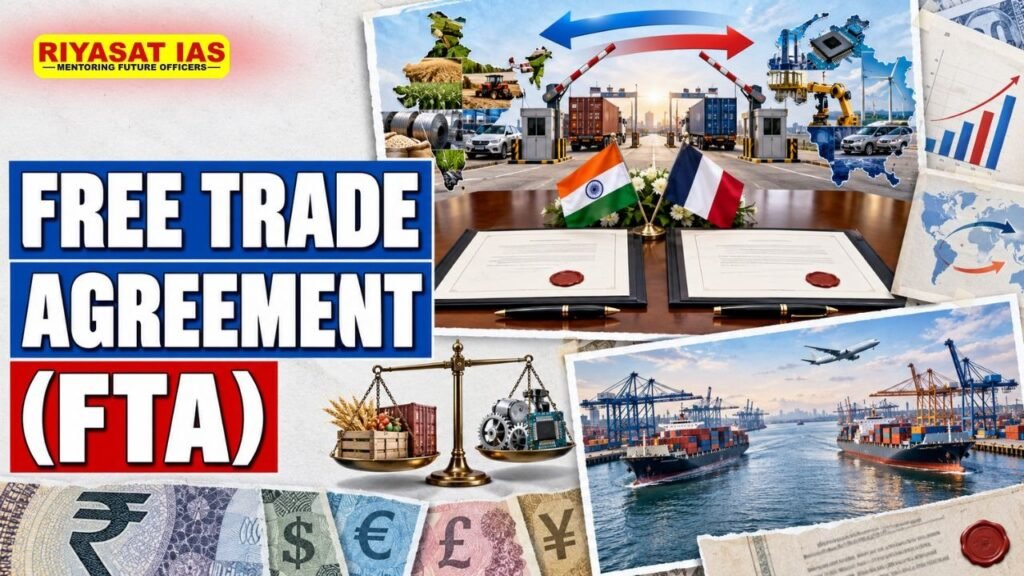
A Free Trade Agreement (FTA) is a trade arrangement between two or more countries or economic blocs to facilitate commerce by reducing the tariffs, quotas and other trade barriers on the goods and services of the parties concerned.
The underlying principle is simple: the member countries grant each other preferential access to their markets, which they may not normally have granted to any non-member country, while each continues to pursue its own trade policy (towards both goods and services) for countries that are not members of the agreement.
For example, India–Singapore CECA provides a platform for increased trade and economic cooperation between the two countries.
What Is a Free Trade Agreement?
An FTA provides for preferential treatment for its members in respect to goods, services, investment, intellectual property, digital commerce, among other.
An FTA does not imply an immediate removal of all trade barriers. Usually, countries will undertake tariff reductions through a phased approach and offer different concessions on different products.
Key Features of an FTA
1. Tariff Reduction or Elimination
The mutual reduction or elimination of customs duties by the contracting party or parties for goods traded between the member countries.
2. Trade in Services
An FTA can facilitate trade in services, such as information technology, banking, financial services, education, professional services, etc.
3. Rules of Origin
These are rules for determining the regional identity of a product that is eligible to receive preferential treatment under the FTA. They ensure that goods originating from a third country do not enter the FTA as if they were local products.
4. Trade Facilitation
These are measures that aim to speed up and simplify customs clearance, documentation and border procedures.
5. Investment Provisions
Modern FTAs also provide for investment-related provisions in an effort to promote investment and protect investments.
6. Dispute Settlement
The FTA will also provide for dispute settlement mechanisms for settling disputes between members regarding the interpretation or application of the agreement.
7. Independent External Trade Policy
Unlike a customs union, FTA members generally retain their own external tariff structures and trade policy vis-à-vis non-member countries.
Types of Trade Agreements
Trade agreements can vary significantly in the extent of economic integration that they entail, from a limited preferential arrangement to a complete economic union.



1. Partial Scope Agreement (PSA)
A Partial Scope Agreement (PSA) covers only certain products or sectors rather than all products traded by the participating countries.
It is a useful starting point for countries that wish to begin trade cooperation without taking on the full commitments of a comprehensive agreement.
Example: India–Chile Preferential Trade Agreement
2. Free Trade Agreement (FTA)
An FTA, on the other hand, provides for preferential market access by reducing or eliminating internal trade barriers (tariffs and non-tariff measures) between members. However, each member retains its own trade policy vis-à-vis non-members.
Example: India–Singapore Comprehensive Economic Cooperation Agreement (CECA)
3. Customs Union
A Customs Union goes one step beyond an FTA. In addition to eliminating internal trade barriers (tariffs and non-tariff measures) among members, all members agree to apply a Common External Tariff (CET) to imports from countries that are not members of the union.
Example: Southern African Customs Union (SACU)
4. Common Market
A Common Market removes barriers to both goods and services and allows for a free movement of capital, labour, goods and services between member countries.
Example: CARICOM Single Market and Economy (CSME)
5. Economic Union
An Economic Union represents the most integrated form of economic co-operation. It entails a common market with coordinated economic and macroeconomic policies; in addition, it also involves a common currency and monetary policy.
Example: European Union (EU)
FTA vs Other Trade Agreements
| Type | Main Feature | Level of Integration |
| Partial Scope Agreement | Preferential treatment for selected products | Limited |
| Free Trade Agreement | Reduced or eliminated internal trade barriers | Moderate |
| Customs Union | FTA + Common External Tariff | Higher |
| Common Market | Customs union + freer movement of capital and labour | Very high |
| Economic Union | Common market + coordinated economic policies | Highest |
Why Are FTAs Important?
1. Wider Market Access
An FTA facilitates a business’s access to wider markets.
2. Lower Trade Costs
Lower trade costs make imported and exported goods more competitive.
3. Export Opportunities
Domestic producers can enter into a larger customer base and diversify their export markets.
4. Investment
Predictability of trade rules can attract investment in production and supply chains.
5. Stronger Economic Cooperation
Modern FTAs can deepen cooperation in services, investment, technology and other economic areas.
6. Global Value Chains
FTAs can enable countries to become part of regional and global value chains by facilitating the free movement of inputs and outputs.
FTA and India
FTAs are particularly important for India because they can create new opportunities for manufacturing, services and merchandise exports. FTAs with major trading partners can also help Indian companies diversify their markets and participate in global value chains. However, an FTA can also expose domestic industries to stronger foreign competition. Therefore, it depends on the tariff negotiations, rules of origin, domestic competitiveness, standards and implementation.
Conclusion
An FTA provides for a broader framework for market access, trade facilitation and economic cooperation between member states. The different forms of trade agreements represent varying levels of economic integration. For India, the challenge is to negotiate FTAs that can help expand export opportunities while protecting sensitive sectors and ensuring that domestic businesses can compete effectively.
FAQs on Free Trade Agreements
What is a Free Trade Agreement?
An FTA is an agreement between two or more countries or economic blocs to reduce or eliminate trade barriers among them.
Does an FTA eliminate all tariffs?
Not necessarily. Tariff reductions may be partial, phased or limited to specific products, depending on the agreement.
What is the main difference between an FTA and a Customs Union?
An FTA allows members to maintain their own external trade policies, whereas a Customs Union adopts a Common External Tariff for non-members.
What are Rules of Origin in an FTA?
Rules of Origin determine whether goods qualify for preferential treatment under the FTA. They help prevent trade diversion through non-member countries.
Which trade agreement provides for free movement of labour and capital?
A Common Market generally provides for freer movement of goods, services, capital and labour among its members.
What is the highest level of economic integration?
An Economic Union represents a very deep level of integration; it combines a common market with coordination of economic policies and, in some cases, a common currency.




 Ravi Raaz
 Hassan Khan
 Shadab Ali