
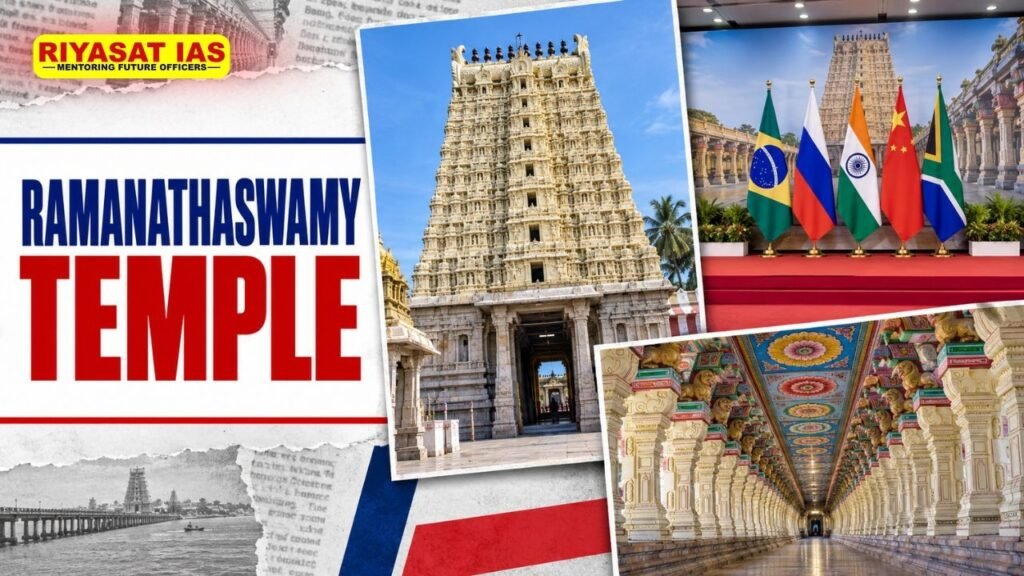
- Location: Rameswaram, Tamil Nadu.
- Diety : Lord Shiva in the guise of Ramanatha.
- Religious Importance: One of the 12 Jyotirlingas.
- Architecture: A major specimen of Dravidian temple architecture.
- Corridors: Notable for its long pillared corridors, with highly sculptured pillars.
- Construction: Built over centuries by different kings, mainly the Sethupathi rulers of Ramanathapuram.
- Sethupathis: Measured and directed the construction of the temple architectural wisdom.
- Ramayana Tradition: Associated with the tradition Lord Rama worships Shiva at Rameswaram after Lanka episode.
- Theerthams: The temple is noted for its many sacred water bodies (theerthams) that can be found in and around the temple complex.
- Historical Significance: An important centre of pilgrimage and South Indian temple architecture related to Shaivism.
- Art And Culture: Dravidian style of architecture + spacious columned corridors + Sethupathi kings + Jyotirlinga shrine + Rameshwar.
Q. Regarding the Ramanathaswamy Temple, which of the following statements are correct?



1. It is situated Tamilnadu’s Rameswaram.
2. This among one of the 12 Jyotirlingas.
3. It is a prime example of Dravidian temple architecture.
4. The whole temple was constructed by a single king.
How many of the above statements are correct?
A. 1, 2 and 3 only
B. 1 and 4 only
C. 2, 3 and 4 only
D. 1, 2, 3 and 4
Answer: A
Explanation:
Ramanathaswamy Temple at Rameswaram, Tamil Nadu.
It is one of the 12 jyotirlingas, sacred to Lord Shiva.
It is one of the great examples of Dravidian temple architecture, note worthy for its long pillared corridors.
The temple was constructed and has been expanded by the different rulers through centuries especially by Sethupathi rulers.





 Ravi Raaz
 Hassan Khan
 Shadab Ali