
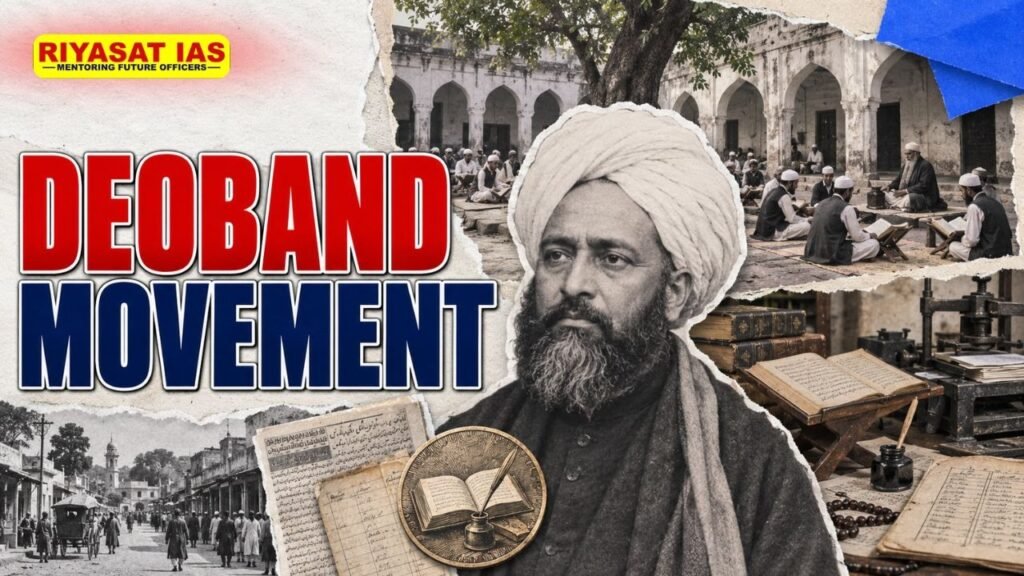
About the Deoband Movement
· The Deoband Movement was an important Islamic religious, educational and socio-political reform movement that emerged in North India in the second half of the 19th century. Its institutional centre was the Darul Uloom Deoband, established at Deoband, in present-day Uttar Pradesh, in 1866.
· The movement developed in the difficult political situation following the Revolt of 1857. Its leaders sought to preserve Islamic religious learning and identity while also responding to the political and social challenges created by British rule.
· The movement later produced several important Muslim scholars who participated in the anti-colonial struggle, particularly through the Silk Letter Movement, Khilafat Movement and Non-Cooperation Movement.
Background
· The Revolt of 1857 had serious consequences for Muslim religious scholars and institutions. British authorities viewed many sections of the traditional Muslim leadership with suspicion, while the decline of the old political order weakened established centres of Islamic learning.
· In this environment, Maulana Muhammad Qasim Nanautavi and Maulana Rashid Ahmad Gangohi, along with other scholars, established the Darul Uloom Deoband in 1866.
· The institution aimed to preserve traditional Islamic learning through an organised system of education. Over time, Deoband developed into an influential centre of Islamic scholarship and produced a large number of religious scholars.
· The movement was therefore not initially a political organisation. Religious education, preservation of Islamic learning and social reform were its principal early concerns.
Objectives and Ideology
· Preservation of Islamic Learning: The movement sought to preserve traditional Islamic scholarship at a time when colonial education and institutions were rapidly expanding. The Quran, Hadith, Islamic jurisprudence and Arabic and Persian learning remained central to its educational programme.
· Religious and Social Reform: The Deoband scholars attempted to remove practices that they considered contrary to Islamic teachings. They emphasised a disciplined religious life and greater adherence to Islamic principles.
· Education: Education was considered the main instrument for preserving the community’s religious and cultural identity. The Deoband model subsequently influenced the establishment of many other madrasas.
· Opposition to Colonial Rule: Although the institution itself was primarily educational, a significant section of its scholars gradually became involved in resistance to British colonial rule. This political strand became particularly visible under Maulana Mahmud Hasan, popularly known as Shaykh-ul-Hind.



Key Features and Beliefs
- Traditional Islamic scholarship remained central, particularly the study of the Quran, Hadith and Islamic jurisprudence.
- The movement preferred religious education based on Islamic sources rather than replacing traditional learning completely with Western education.
- Social and moral reform formed an important part of its programme, with emphasis on religious discipline and ethical conduct.
- British political domination was increasingly opposed by several leading Deobandi scholars. This eventually gave the movement an important place in the nationalist struggle.
- United nationalism became an important political position among major Deobandi leaders in the 20th century. The Jamiat Ulama-i-Hind, founded in 1919, advocated cooperation between Muslims and non-Muslims in the struggle against British rule.
Deoband Movement vs Aligarh Movement
| Basis | Deoband Movement | Aligarh Movement |
| Beginning | Darul Uloom Deoband was established in 1866. | Sir Syed’s educational movement developed during the 1860s–1870s, leading to MAO College. |
| Main figure | Muhammad Qasim Nanautavi, Rashid Ahmad Gangohi and later Mahmud Hasan and other scholars. | Sir Syed Ahmad Khan. |
| Main emphasis | Islamic religious education and preservation of traditional scholarship. | Modern education, particularly English, science and Western knowledge. |
| Approach to Western education | Remained cautious about Western intellectual influence and retained a traditional curriculum. | Actively promoted Western education and scientific knowledge among Muslims. |
| Political approach | Major Deobandi leaders later became strongly involved in the anti-British nationalist movement. | Sir Syed initially favoured cooperation with the British and remained cautious about representative politics. |
| Nationalism | Important Deobandi leaders such as Husain Ahmad Madani supported composite/territorial nationalism. | The early Aligarh leadership developed a distinct political approach and emphasised Muslim educational advancement. |
| Institutional centre | Darul Uloom Deoband. | MAO College, later Aligarh Muslim University. |
Role in India’s Freedom Struggle
· Silk Letter Movement: Maulana Mahmud Hasan attempted to organise an armed resistance against British rule during the First World War. This effort became known as the Silk Letter Movement (Reshmi Rumal Tehreek).
o The plan involved seeking external assistance and organising resistance against British rule. The movement was discovered by the British, and Mahmud Hasan was arrested and sent to Malta.
o The failure of this attempt encouraged a shift among several Deobandi leaders towards a broader and eventually non-violent mass struggle.
· Formation of Jamiat Ulama-i-Hind: The Jamiat Ulama-i-Hind was established in 1919. Many of its leading figures came from the Deobandi tradition.
o The organisation supported the anti-colonial struggle and Hindu-Muslim cooperation. Its political strategy shifted from earlier revolutionary efforts towards participation in mass movements.
· Khilafat and Non-Cooperation: Deobandi scholars participated actively in the Khilafat and Non-Cooperation Movements.: They supported cooperation with Mahatma Gandhi and regarded the combined mobilisation of Muslims and Hindus as an effective means of challenging British rule.
o The Jamiat’s 1920 session endorsed the Non-Cooperation Movement, and a fatwa supporting the movement was endorsed by hundreds of ulema.
· Composite Nationalism: One of the most important contributions of the later Deobandi political tradition was the argument that Indian Muslims and Hindus could constitute one political nation while retaining their distinct religious identities.
· Maulana Husain Ahmad Madani became a prominent advocate of this idea of composite nationalism. This position placed important Deobandi leaders in opposition to the idea that Muslims and Hindus necessarily constituted separate political nations.
Impact and Legacy
· Educational Legacy: The greatest institutional legacy of the movement was the development of Darul Uloom Deoband as a major centre of Islamic scholarship. Its educational model influenced the establishment of numerous religious institutions across India and beyond.
· Religious and Social Impact: The movement helped preserve and institutionalise traditional Islamic learning during a period of major political and cultural change. It also produced a large body of scholars who became influential in religious, educational and public life.
· Contribution to Nationalism: The participation of Deobandi scholars in anti-British activities gave the movement an important place in the history of Indian nationalism. The transition from the Silk Letter Movement to participation in Non-Cooperation and other mass movements is particularly significant because it shows the changing political strategy of the ulema.
· Long-term Political Influence: The Deobandi tradition was not politically uniform. Different scholars and organisations developed different political positions over time.
Conclusion
The Deoband Movement began primarily as an effort to preserve Islamic learning and reform Muslim society after the upheaval of 1857. Its later political evolution gave it an important place in India’s freedom struggle. Through institutions such as Darul Uloom Deoband and organisations such as Jamiat Ulama-i-Hind, it left a lasting educational, religious and nationalist legacy.
FAQs
1. When was the Deoband Movement started?
The movement is generally associated with the establishment of Darul Uloom Deoband in 1866.
2. Who founded Darul Uloom Deoband?
Maulana Muhammad Qasim Nanautavi and Maulana Rashid Ahmad Gangohi were among its principal founders.
3. What was the main objective of the Deoband Movement?
Its early objective was to preserve Islamic learning, promote religious and social reform, and maintain Muslim religious and cultural traditions.
4. How did Deoband contribute to the freedom struggle?
Deobandi scholars participated in the Silk Letter Movement, Jamiat Ulama-i-Hind, Khilafat Movement and Non-Cooperation Movement.
5. What is the main difference between Deoband and Aligarh?
Deoband primarily emphasised traditional Islamic education and religious reform, whereas Aligarh emphasised modern Western education, science and English learning. Their political approaches also differed considerably.



 Ravi Raaz
 Hassan Khan
 Shadab Ali