
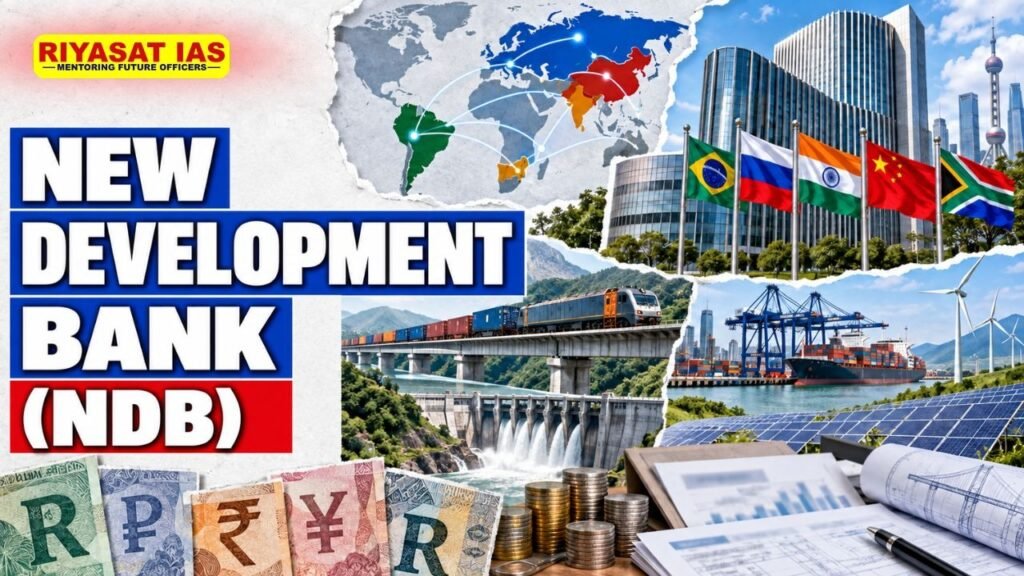
The New Development Bank (NDB) is a multilateral development bank, established by the BRICS countries, to provide alternate sources of financing for infrastructure and sustainable development in emerging market and developing countries (EMDCs).
NDB provides developing countries with an alternate forum for raising developmental assistance, as well as promoting South-South cooperation. Additionally, as the bank opens its doors to wider memberships, it also serves to extend the bank’s reach beyond the founding BRICS nations.
What Is the New Development Bank (NDB)?
The New Development Bank (NDB) is a BRICS-led multilateral development bank, established to finance infrastructure and sustainable development.
| Particulars | Details |
| Established | 2014 |
| Operational since | 2015 |
| Founding members | Brazil, Russia, India, China, and South Africa |
| Headquarters | Shanghai, China |
| Authorised capital | US$100 billion |
| Subscribed capital | US$50 billion |
| Focus | Infrastructure and sustainable development |
| Beneficiaries | BRICS and other EMDCs |
The bank was conceived as an alternate source of development financing for EMDCs, complementing the existing development banks.
How Was the NDB Established?
The NDB was approved at the 6th BRICS Summit, hosted by Brazil in 2014. It commenced its operations in 2015.
The five founding members subscribed to the bank’s initial authorized capital of US$50 billion of capital equally, while the authorised capital was fixed at US$100 billion.
Notably, the initial terms gave equal say to all the founding members, reflecting the BRICS nations’ desire to have greater representation in international financial institutions by virtue of being emerging-market economies.
Objectives of the New Development Bank
The New Development Bank focuses on mobilizing resources for infrastructure and sustainable development, with the following objectives:
- To finance infrastructure development
- To support sustainable development
- To mobilize development resources for BRICS and other EMDCs
- To promote South-South cooperation
- To facilitate greater use of national currencies in financing



How Is the New Development Bank Different from the World Bank?
While the NDB differs from the World Bank in a variety of ways, its governance model is significantly different, as demonstrated below:
| Basis | NDB | World Bank |
| Nature | BRICS-led multilateral development bank | Global development institution |
| Focus | Infrastructure and sustainable development | Broader set of development issues |
| Voting | Equal voting power | Voting power according to shareholding |
| Individual veto | Not applicable | No individual country has a veto power |
| Founding members’ safeguard | Founding members retain voting power of at least 55% | Not applicable |
The NDB, therefore, has a more equal governance framework as compared to other global financial institutions.
Voting System of NDB
The NDB follows a unique voting system, as demonstrated below:
- The bank’s governance framework operates on a one-member-one-vote basis.
- Additionally, no country has a veto power over the bank’s decisions.
- The founding members, however, have a safeguard in the system, which prevents their collective voting power from dropping below 55%.
Membership Expansion of NDB
The NDB began its journey with the five founding members, but it has since opened its doors to other nations. The following list highlights some of the significant developments in the NDB’s membership expansion:
| Joined NDB | Year | Remarks |
| Bangladesh and UAE | 2021 | The NDB’s first expansion |
| Egypt | 2023 | |
| Algeria | 2025 | |
| Uzbekistan | 2026 | Joined as the 10th member and the first nation from Central Asia |
Uzbekistan: Why Is Its NDB Membership Important?
Uzbekistan became the 10th member of the NDB and the first country from Central Asia to join the bank. This development is particularly significant for India, as Uzbekistan’s NDB membership helps to realise India’s own foreign policy objective – the Connect Central Asia Policy.
In other words, with the inclusion of Uzbekistan into the NDB, there is likely to be further growth and development of regional linkages and ties between India and the Central Asian region.
The other NDB members from the region that have joined the bank include Bangladesh and Pakistan. Additionally, per the source material, the NDB has accepted the applications for membership from Uruguay, Colombia, and Ethiopia. These nations are expected to formally join the bank after depositing their instruments of accession with the NDB.
According to the source material, NDB members represent:
- 42% of the world’s population
- 27% of the world’s surface area
- More than 20% of the world’s GDP
Significance of the New Development Bank
The NDB has great significance, particularly for EMDCs, given the following reasons:
- Alternate source of development financing: The NDB provides a much-needed additional source of financing for EMDCs.
- Voice for the Global South: The bank serves to give the Global South a bigger say in international financial markets.
- Local currency financing: The NDB’s push for greater use of local currencies can reduce the reliance of developing countries on any single currency, such as the US Dollar.
- Diversity of the global financial system: The NDB adds to the diversity of the international financial system, allowing greater choices for EMDCs.
- Outreach and impact: The NDB has the potential to scale its outreach and impact, particularly in the wake of its membership expansion.
India and the New Development Bank
India has a special relationship with the NDB, as it is not only a founding member of the BRICS bloc but also a founding member of the NDB.
The NDB serves to provide India with additional opportunities to promote its developmental and foreign policy objectives, including infrastructure development, sustainable development, and South-South cooperation. The inclusion of Uzbekistan in the NDB is particularly pertinent for India, as Uzbekistan is the first Central Asian nation to join the bank.
This development can be seen as an opportunity for India to further advance its Connect Central Asia Policy through the NDB platform, as well as promote regional development and cooperation.
FAQs on New Development Bank
What is the New Development Bank?
The NDB is a multilateral development bank, established by the BRICS nations, to finance infrastructure and sustainable development.
When was NDB established?
The NDB was established in 2014 at the 6th BRICS Summit in Brazil. It commenced its operations in 2015.
Who are the founding members of NDB?
The NDB was founded by the five BRICS nations – Brazil, Russia, India, China, and South Africa.
Where is the NDB headquarters?
The NDB is headquartered in Shanghai, China.
What is the voting system of NDB?
The NDB operates on an equal voting system. In other words, each member nation has an equal number of votes, and no nation has a veto power over the bank’s decisions.
Who became the 10th member of NDB?
Uzbekistan became the 10th member of the NDB and the first nation from Central Asia to join the bank.
Why is Uzbekistan important for India?
Uzbekistan’s NDB membership can serve as an additional platform for India to advance its Connect Central Asia Policy.
Why is the NDB important?
The NDB enhances South-South cooperation, provides alternate financing for EMDCs, promotes infrastructure and sustainable development, and facilitates greater use of local currencies in financing.




 Ravi Raaz
 Hassan Khan
 Shadab Ali