
Introduction
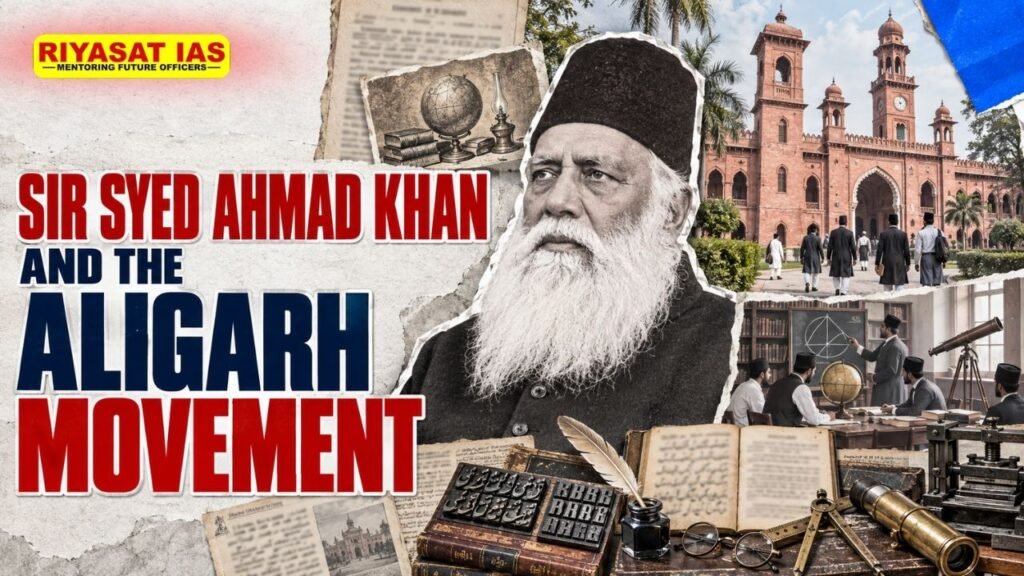
· The Aligarh Movement was a major Muslim social and educational reform movement of the late 19th century. It was led by Sir Syed Ahmad Khan, who believed that the social and economic advancement of Indian Muslims depended largely on modern education, scientific thinking and engagement with contemporary knowledge.
· The movement is closely associated with the establishment of the Muhammadan Anglo-Oriental (MAO) College at Aligarh, which later developed into Aligarh Muslim University (AMU) in 1920.
Background
- The replacement of Persian in government employment and courts in the 1840s created considerable anxiety among sections of the Muslim community.
- The Revolt of 1857 further changed the political and social position of Muslims. Sir Syed felt that Muslims needed to adapt to the new circumstances rather than remain isolated from the emerging system of modern education and administration.
- He considered English education and modern science essential if Muslims were to regain their social and economic position.
- At the same time, Sir Syed did not advocate abandoning Islamic traditions. His objective was to combine modern Western learning with Islamic cultural and religious values. AMU itself describes this as an attempt to create a bridge between the old and the new, and between Eastern and Western learning.
Sir Syed Ahmad Khan
· Sir Syed Ahmad Khan was born in Delhi on 17 October 1817. He initially worked in the judicial and administrative services of the East India Company.
· The experience of 1857 had a major influence on his thinking. He tried to understand the causes of the revolt and subsequently argued for better relations between the British and Indians.
· His central concern gradually became the educational and social advancement of Indian Muslims.
Important initiatives of Sir Syed
- He established schools at Moradabad in 1858 and Ghazipur in the early 1860s as part of his wider educational programme.
- He established the Scientific Society at Aligarh in 1864. It translated Western works into Indian languages and attempted to develop a scientific outlook among Muslims.
- He started the journal Tahzib-ul-Akhlaq in 1870, through which he discussed social and ethical reform.
- He founded Madarsatul Uloom at Aligarh in 1875, which developed into the Muhammadan Anglo-Oriental College. The foundation stone of the school was laid on 24 May 1875, while the college itself was formally established in 1877.
- The MAO College was modelled partly on Oxford and Cambridge, while retaining an Islamic cultural framework.



Objectives of the Aligarh Movement
· Modern Education: Sir Syed considered education the most effective means of improving the condition of Indian Muslims. He particularly encouraged the study of English, modern sciences and Western knowledge.
· Scientific Temper: The Scientific Society and its translations were intended to make modern knowledge accessible and encourage Muslims to develop a scientific and rational outlook.
· Social Reform: Sir Syed criticised social practices that contributed to backwardness within Muslim society. He also advocated improvements in women’s education and attempted to interpret religious questions through reason. NIOS notes his opposition to ignorance and fanaticism and his efforts towards social reform.
· Reconciliation of Tradition and Modernity: Sir Syed did not see modern education and Islam as necessarily contradictory. He sought to reconcile Islamic values with modern scientific and educational ideas.
· Political and Economic Advancement: The movement aimed to create an educated Muslim middle class capable of entering government services and public life. This was particularly important after the political changes following 1857.
Opposition to the Aligarh Movement
· The movement faced opposition from orthodox sections of Muslim society.
· Some religious conservatives were suspicious of English education and Western ideas because they feared that these would weaken traditional Islamic values.
· Sir Syed also faced criticism for his relatively liberal interpretation of religion. His attempt to interpret the Quran in the light of reason brought him into disagreement with orthodox scholars. NIOS specifically notes that he faced opposition from orthodox Muslims while promoting English education and social reform.
· There was also opposition to his advocacy of women’s education and social reform.
Impact of the Aligarh Movement
· Educational Impact: The most lasting achievement was the creation of a modern educational institution at Aligarh. The MAO College produced a new class of educated Indian Muslims who increasingly participated in government, administration, education and public life.
· Social Impact: The movement encouraged Muslims to move towards modern education, scientific thinking and social reform. It helped create greater awareness about the importance of education in overcoming social and economic backwardness.
· Intellectual Impact: Through the Scientific Society, Aligarh Institute Gazette and Tahzib-ul-Akhlaq, Sir Syed created channels through which modern ideas and debates could reach Muslim society.
· Political Impact: The movement produced an educated Muslim intelligentsia that became increasingly involved in the political life of British India.
o However, Sir Syed’s own political approach was different from later Muslim separatist politics. He initially emphasised cooperation with the British and was cautious about representative politics based on numerical majority.
· Institutional Legacy: The MAO College eventually developed into Aligarh Muslim University in 1920. The institution became one of the major centres of higher education and intellectual life in modern India.
Limitations
· The movement primarily addressed the problems of the educated and emerging Muslim middle class, particularly in northern India. Its reach among poorer and rural sections was comparatively limited.
· Sir Syed’s close cooperation with the colonial government and his political caution also attracted criticism from more nationalist sections.
· At the same time, his contribution should be understood in its historical context: his immediate concern was to prevent further educational and socio-economic backwardness among Indian Muslims.
Conclusion
The Aligarh Movement represented an important phase of Muslim social and educational awakening in colonial India. Sir Syed Ahmad Khan placed modern education, scientific thinking and social reform at the centre of his programme. The institutions created through his efforts produced a new educated class and left a lasting institutional legacy through Aligarh Muslim University.
FAQs
1. Who founded the Aligarh Movement?
The Aligarh Movement was led and founded by Sir Syed Ahmad Khan, with modern education as its principal instrument of social reform.
2. When was MAO College established?
Madarsatul Uloom was started at Aligarh in 1875, and the Muhammadan Anglo-Oriental College was formally established in 1877.
3. When did MAO College become Aligarh Muslim University?
The institution was transformed into Aligarh Muslim University in 1920.
4. What was the main objective of the Aligarh Movement?
Its primary objective was to promote modern education, scientific thinking and social reform among Indian Muslims.
5. Why was the Scientific Society important?
The Scientific Society translated Western works into Indian languages and sought to introduce modern knowledge and scientific thinking among Muslims.



 Ravi Raaz
 Hassan Khan
 Shadab Ali