
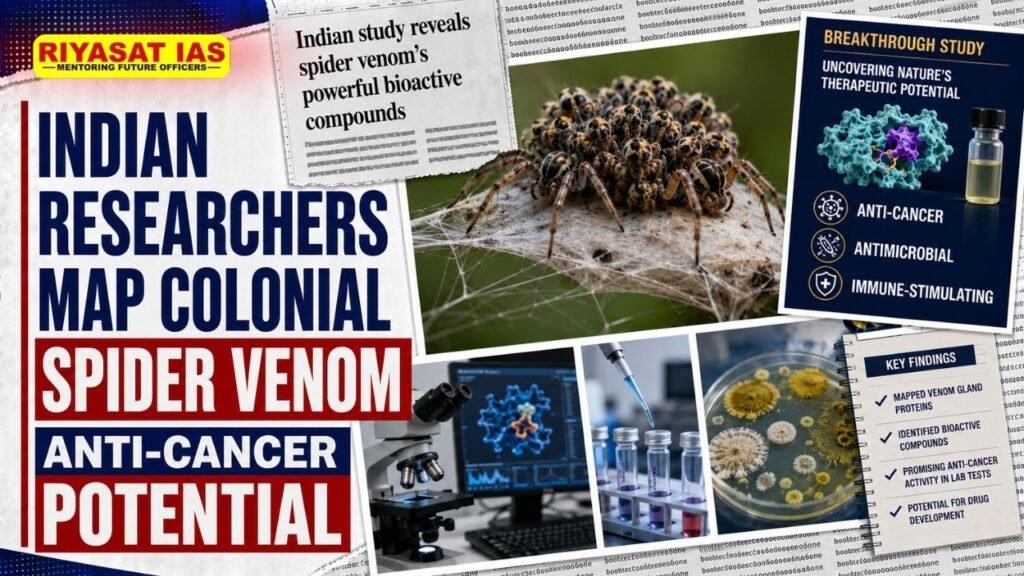
- Indian researchers have produced the first comprehensive molecular and functional profile of the venom gland of the colonial spider Stegodyphus sarasinorum.
- The study was published in Scientific Reports on 24 August 2026.
- Researchers found molecules showing cytotoxic activity against cancer cells in laboratory experiments, opening possibilities for future anti-cancer and antimicrobial drug research.
Key Findings
- Spider:Stegodyphus sarasinorum
- Commonly known as an Indian social/colonial spider.
- Unlike most solitary spiders, it lives in permanent colonies and exhibits cooperative behaviour.
- Multi-omics approach: Researchers combined:
- Transcriptomics → study of RNA/transcribed genes
- Proteomics → study of proteins
- Metabolomics → study of small-molecule metabolites
- Confocal Raman Spectroscopy → mapping/distribution of biomolecules
- Molecular inventory:
- 31 annotated protein components identified through transcriptomic analysis.
- 32 proteins identified through proteomic analysis.
- 81 metabolites detected using UHPLC-MS.
Anti-Cancer Potential
- Venom-gland extracts were tested against Dalton’s Lymphoma Ascites (DLA) cells.
- They showed dose-dependent cytotoxicity:
- Higher concentration → greater destruction of cancer cells.
- The venom gland also showed antioxidant/radical-scavenging activity in laboratory assays.
- Important molecules/protein families identified include:
- Hemocyanin proteins → associated with immune responses and studied for possible relevance to cancer immunotherapy.
- U12 and U20 lycotoxins → peptide molecules capable of disrupting cell membranes, making them potential templates for antimicrobial and anti-cancer research.



Prelims MCQ — English
Q. Consider the following statements regarding Stegodyphus sarasinorum:
- It is a colonial/social spider.
- Its venom gland has been studied using transcriptomics, proteomics and metabolomics.
- Its venom-gland extract has demonstrated dose-dependent cytotoxicity against Dalton’s Lymphoma Ascites cells.
- The study has already resulted in an approved anti-cancer drug.
Which of the statements given above is/are correct?
A. 1 and 2 only
B. 1, 2 and 3 only
C. 2, 3 and 4 only
D. 1, 2, 3 and 4
Answer: B
Explanation: Statement 4 is incorrect because the research only indicates potential and remains at the laboratory stage.





 Ravi Raaz
 Hassan Khan
 Shadab Ali