
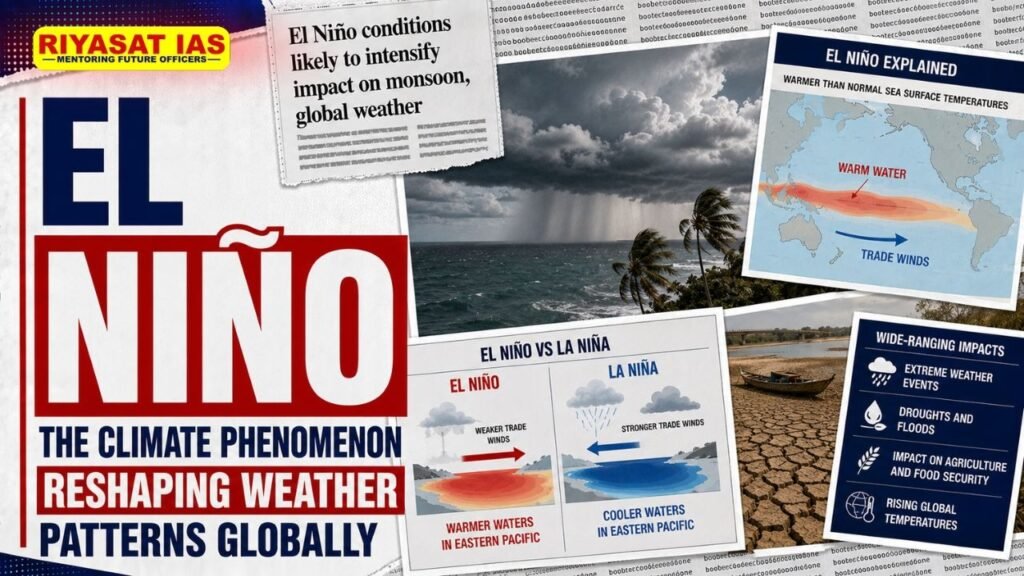
- Definition: El Niño is a periodic climate phenomenon involving unusual warming of sea-surface temperatures (SSTs) in the central and eastern equatorial Pacific Ocean.
- ENSO: El Niño is the warm phase of the El Niño–Southern Oscillation (ENSO).
- Trade Winds: During El Niño, the normally prevailing easterly trade winds weaken, allowing warm surface water to move eastward.
- Upwelling: Weakened trade winds reduce the upwelling of cold, nutrient-rich water along the western coast of South America.
- Atmospheric Circulation: El Niño modifies the Walker Circulation, thereby disturbing global atmospheric circulation and rainfall patterns.
- Global Impact: It can cause droughts in some regions, excessive rainfall/flooding in others, and widespread temperature anomalies.
India — Important Prelims Points
- Indian Monsoon: El Niño is generally associated with weaker Southwest Monsoon rainfall over India, although this relationship is not absolute.
- Agriculture: Weak monsoon can affect crop production, irrigation and food security.
- Temperature: El Niño can contribute to above-normal temperatures and heat stress in several regions.
- Indian Ocean Dipole (IOD): A positive IOD can partly offset the adverse influence of El Niño on the Indian monsoon.



Prelims MCQ
Q. With reference to El Niño, consider the following statements:
- It involves abnormal warming of the central and eastern equatorial Pacific Ocean.
- It is the warm phase of ENSO.
- It is generally associated with weakening of the trade winds.
- It always results in deficient monsoon rainfall over India.
Which of the statements given above are correct?
(a) 1, 2 and 3 only
(b) 1 and 2 only
(c) 2, 3 and 4 only
(d) 1, 2, 3 and 4
Answer: (a) 1, 2 and 3 only
Explanation: El Niño involves warming of the central/eastern equatorial Pacific and weakening of trade winds. It increases the probability of a weak Indian monsoon but does not always cause deficient rainfall.




 Ravi Raaz
 Hassan Khan
 Shadab Ali