
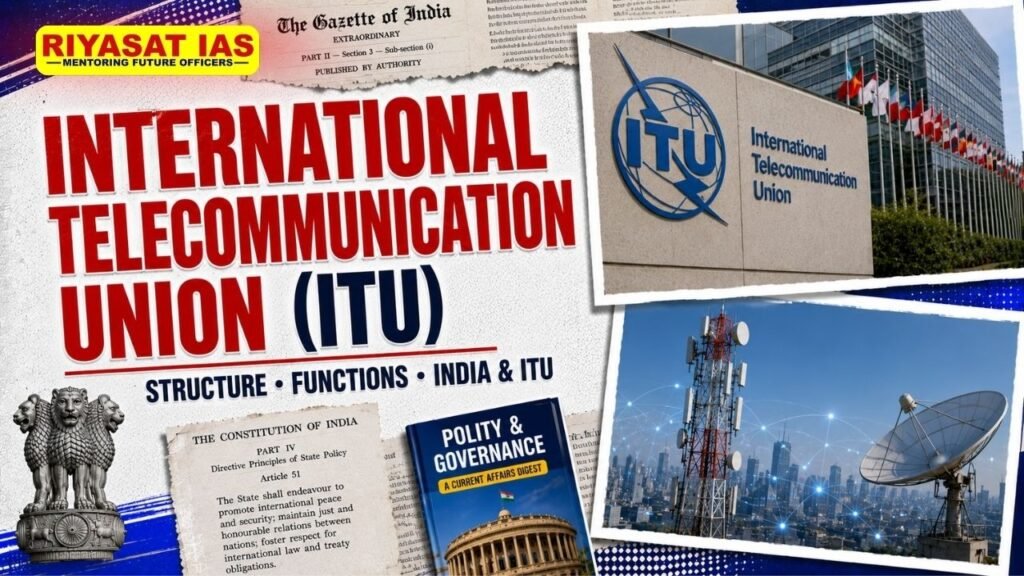
About ITU
The International Telecommunication Union is the specialised agency of the United Nations for information and communication technologies (ICTs). It works to promote global connectivity and coordinates international cooperation on telecommunication networks, radio-frequency spectrum, satellite orbits, technical standards and digital development.
The organisation has a unique historical significance because it is the oldest agency in the UN system, with its origins going back to the International Telegraph Union established in Paris in 1865. The first International Telegraph Convention was signed by 20 countries on 17 May 1865.
o Established: 1865 as the International Telegraph Union.
o Present name: International Telecommunication Union.
o UN specialised agency: Since 1947.
o Headquarters: Geneva, Switzerland.
o Member States: 194.
o Other members: More than 1,000 companies, universities, research institutions and international and regional organisations participate as Sector Members, Associates and other categories.
· The ITU’s present legal framework is based on the ITU Constitution and Convention, 1992, as amended by subsequent Plenipotentiary Conferences.
· Global Cybersecurity Index is published by ITU.
Structure :
· The Plenipotentiary Conference is the highest policy-making body of the ITU. It is held every four years and determines the Union’s overall direction, policies and activities.
· The Council acts as the governing body between Plenipotentiary Conferences and deals with policy, strategic planning, budgetary matters and the implementation of ITU decisions. For the current 2023–2026 period, the Council has 48 Member States.
Note- The ITU’s technical and development work is organised through three major sectors:
· ITU-R: Radiocommunication Sector: ITU-R coordinates the international use of radio-frequency spectrum and satellite orbital resources and develops technical standards for radiocommunication systems.
· ITU-T: Telecommunication Standardization Sector: ITU-T develops international technical standards, known as ITU-T Recommendations, that facilitate interoperability and compatibility between communication networks and technologies.
· ITU-D: Telecommunication Development Sector: ITU-D promotes the development of telecommunications and ICT infrastructure and works towards bridging the digital divide, particularly by supporting developing and least-developed countries.



Major Functions of ITU
· Radio-Frequency Spectrum Management: It coordinates the international allocation and use of the radio-frequency spectrum, which is essential for mobile communications, broadcasting, satellite communications, navigation and other wireless technologies.
· Satellite Orbital Coordination: It coordinates the equitable and efficient use of satellite orbital resources, including the geostationary-satellite orbit, to reduce harmful interference between satellite systems.
· Development of Global ICT Standards: ITU-T develops international standards that promote interoperability, compatibility, security and efficiency across global telecommunications networks.
· International Telecommunication Regulations: It provides an international framework for cooperation in telecommunications through instruments such as the International Telecommunication Regulations (ITRs) and the Radio Regulations.
· Digital Connectivity: The organisation works to expand meaningful connectivity and improve access to ICT infrastructure, particularly in developing countries and underserved communities.
· Bridging the Digital Divide: Through ITU-D and capacity-building programmes, the organisation assists countries in developing digital infrastructure, skills, institutions and regulatory capacity.
· Emerging Technologies: Provides a global platform for cooperation on emerging technologies such as artificial intelligence, 5G/6G, Internet of Things, cybersecurity and digital public infrastructure.
· Global Digital Cooperation: The ITU facilitates cooperation among governments, private-sector organisations, academia and other stakeholders to address global challenges associated with digital technologies.
Key Conventions and Legal Instruments
· International Telegraph Convention, 1865: The International Telegraph Convention of 1865 established the International Telegraph Union, the predecessor of today’s ITU. It introduced common arrangements for international telegraph services, including standardised procedures, tariffs and technical practices.
· International Telecommunication Convention: The International Telegraph Convention gradually evolved with technological developments and was renamed the International Telecommunication Convention. In 1932, the telegraph and radiotelegraph conventions were consolidated into a single International Telecommunication Convention covering telegraphy, telephony and radio.
Constitution and Convention, 1992: The 1992 Constitution and Convention constitute the present basic legal framework of the organisation. The Constitution establishes the purposes and structure of the Union, while the Convention deals with its functioning and the activities of its three sectors. Both instruments have treaty value.
Radio Regulations: The Radio Regulations are an international treaty-level instrument governing the use of the radio-frequency spectrum and satellite orbits. They are revised through World Radiocommunication Conferences.
International Telecommunication Regulations: The International Telecommunication Regulations (ITRs) establish general principles for the provision and operation of international telecommunication services and cooperation among countries.
India and ITU
India has a long association with the ITU and is currently one of the 194 Member States of the organisation. India is also a member of the Council for the 2023–2026 term, representing the Asia and Australasia region.
· India’s participation is important because the organisation deals with issues directly connected with India’s expanding digital economy, telecommunications infrastructure, satellite communication, 5G/6G technologies, cybersecurity and digital inclusion.
· India participates in ITU processes relating to spectrum management, international standards, telecommunications development and emerging digital technologies.
· India’s digital transformation initiatives, including Digital India, Aadhaar, Unified Payments Interface (UPI) and other digital public infrastructure, also provide important areas for international cooperation and knowledge sharing.
FAQs
1. When was the it established?
It originated in 1865 as the International Telegraph Union following the signing of the International Telegraph Convention in Paris.
2. How many Member States does the ITU have?
The ITU currently has 194 Member States.
3. Where is the headquartered?
The headquartered in Geneva, Switzerland.
4. What are the three sectors of the ITU?
The three sectors are ITU-R (Radiocommunication), ITU-T (Telecommunication Standardization) and ITU-D (Telecommunication Development).
5. What is the main role ?
The ITU promotes global ICT cooperation by coordinating radio spectrum and satellite orbits, developing international telecommunication standards and supporting digital connectivity and development.





 Ravi Raaz
 Hassan Khan
 Shadab Ali