
GS-III: Disaster Management | Geography | Environment | Climate Change | Infrastructure
Context
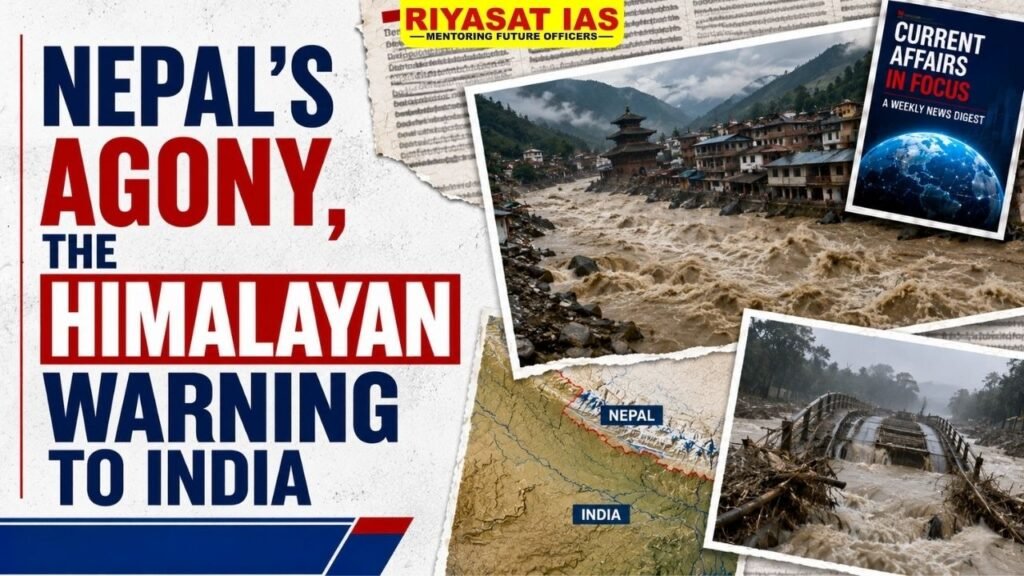
- Nepal as a Warning: The recent disaster in Nepal raises the question of whether India will learn from the agony of its Himalayan neighbour.
- One Himalayan System: The Himalaya are not a series of silos but one interconnected geological system spanning Afghanistan, Pakistan, India, Nepal, Tibet-China and Bhutan.
- Unpredictable Hazards: Seismic activity, glacial movements, GLOFs, rockfalls and landslides can trigger cascading disasters across borders.
- Historical Precedent: The Nepal-Bihar earthquake of 1934 and Assam earthquake of 1950 demonstrate the destructive potential of Himalayan earthquakes.
Question of Preparedness
- Seismic Threat: Seismologists have warned of an earthquake of enormous scale with potential for catastrophe across large parts of northern India.
- Preparedness Gap: Although India has undertaken disaster-management measures, the key question is whether existing preparedness can protect riverside habitations from instant death.
- GLOF Threat: Global warming has triggered the fearsome phenomenon of Glacial Lake Outburst Floods (GLOFs).
- Public Awareness Gap: People living in potential GLOF-affected areas need to be adequately warned and advised on how to respond.
- Knowledge–Action Gap: Earth scientists possess substantial knowledge, but it often remains confined within the scientific community as “acharya-mushti”—knowledge kept in the teacher’s fist.
Lessons India Must Learn
- Recognise Himalayan Danger: The Himalaya, though sacred, also “gestate ‘sure-shot’ danger” through seismic, glacial and geological processes.
- Move Beyond Technical Papers: Himalayan dangers can no longer remain confined to seminars and technical papers.
- War-Footing Risk Communication: Scientific warnings must reach potential victims quickly and clearly.
- Community Participation: Public awareness must go beyond information-sharing and make communities active participants in safeguarding.
- Medog Project Risk: Concerns have been raised regarding China’s Medog hydropower project near the great bend of the Brahmaputra and close to the Paizhen Fault, with the possibility of massive floodwater and debris reaching India’s Northeast following a major earthquake.
- Frank Engagement with China: India’s efforts for mature border relations should include frankness about the potential danger posed by Medog.
- Review Built Hazards: India must urgently review dams and reactors in high-risk zones and dismantle genuinely dangerous structures.
- Decongest Risk Zones: Undertake calibrated and time-bound decongestion of human agglomerations in high-risk areas.
- Disable Dangerous Infrastructure: Infrastructure that was intended for human well-being but has become a danger should be disabled with precision.



Progress and Danger
- Dams: Marjorie Sykes’ observation—“Dams are a damnation”—highlights the danger posed by dams depending on their location.
- Reactors: Some reactors can become “rakshasas” when located in vulnerable environments.
- Commercial Projects: Some commercial behemoths can also become predatory.
- Development–Risk Balance: Development must therefore be assessed against the danger it may create in fragile Himalayan environments.
Way Forward
- Convert Knowledge into Action: Scientific findings must be translated into early warnings, evacuation plans and local preparedness.
- Strengthen Public Safeguarding: Communities in vulnerable areas should become an integral part of disaster-risk reduction.
- Reassess High-Risk Infrastructure: Conduct urgent safety assessments of dams, reactors and other built infrastructure located in vulnerable zones.
- Regulate Human Agglomerations: Implement time-bound decongestion of settlements and commercial activity in high-risk areas.
- Address Transboundary Risks: India should maintain frank dialogue with China regarding the potential risks associated with projects such as Medog.
- Adopt Himalayan-Wide Thinking: Disaster preparedness should recognise that the Himalaya constitute one living geological system, rather than separate national silos.
- Balance Progress with Safety: Development projects must not be allowed to turn into sources of danger to human settlements and fragile ecosystems.
Conclusion
The Nepal experience demonstrates that the Himalaya cannot be treated as separate national or administrative compartments. Their seismic, glacial and geological processes are interconnected, and their consequences can travel far beyond the point of origin.
India must therefore move from merely knowing about Himalayan risks to making citizens part of safeguarding against them, while ensuring that development does not create new sources of catastrophe.
UPSC Mains Practice Question
Q. “The Himalaya are not a series of silos but one living rock.” In the light of recent events in Nepal, discuss the lessons India must learn regarding disaster preparedness and development in the Himalayan region. (250 words, 15 marks)





 Ravi Raaz
 Hassan Khan
 Shadab Ali