
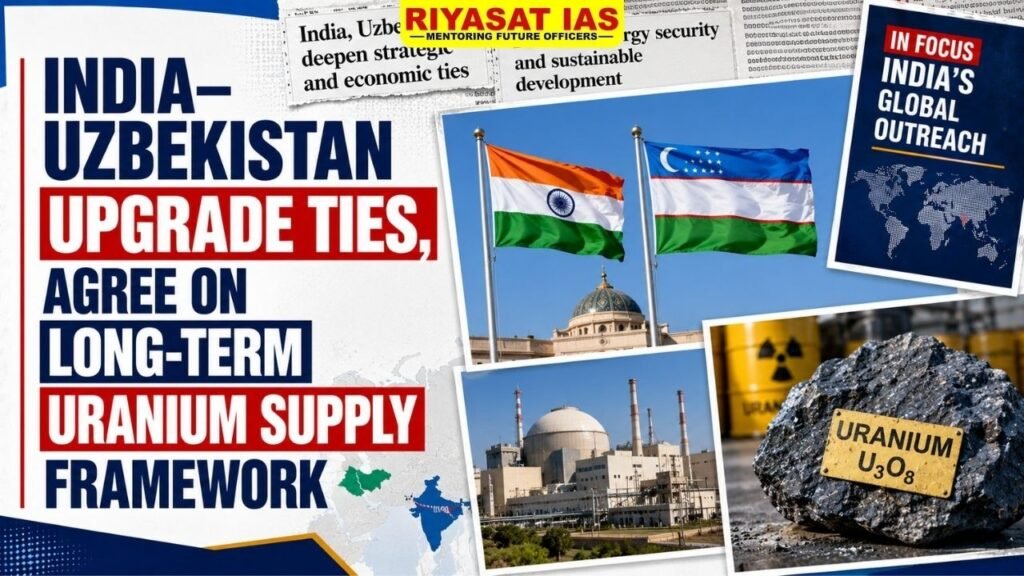
GS-II: International Relations | India’s Neighbourhood & Extended Neighbourhood | Central Asia | Strategic Partnerships | Energy Security
Context
- Comprehensive Strategic Partnership: India and Uzbekistan have decided to elevate bilateral relations to a Comprehensive Strategic Partnership following Prime Minister Narendra Modi’s meeting with President Shavkat Mirziyoyev in Tashkent.
- Uranium Cooperation: Both sides agreed to work towards a long-term framework for uranium supply to India, strengthening cooperation in civilian nuclear energy.
- Trade Target: The two countries have set an ambitious target of $5 billion in annual bilateral trade by 2030.
- Broader Cooperation: Discussions covered critical minerals, mining, defence, connectivity, digital public infrastructure, agriculture, pharmaceuticals, health, education and investment.
Why is Uzbekistan Important for India?
- Central Asian Gateway: Uzbekistan is Central Asia’s most populous country and occupies a strategically important position connecting the region with Afghanistan and wider Eurasia.
- Energy Security: Uranium supplies can support India’s expanding civil nuclear power programme and diversify its nuclear-fuel sources.
- Critical Minerals: Cooperation in geology, mining and critical minerals can strengthen India’s resource security and reduce excessive dependence on concentrated global supply chains.
- Strategic Connectivity: Uzbekistan can form an important component of India’s efforts to improve connectivity with Central Asia and Eurasia.
- Geopolitical Significance: Deeper ties strengthen India’s presence in a region where Russia, China, Türkiye and other powers have significant interests.
Significance of the Uranium Deal
- Nuclear Energy: Long-term uranium supplies can provide greater predictability for India’s civilian nuclear fuel requirements.
- Energy Transition: Nuclear power can complement renewables by providing reliable low-carbon electricity.
- Diversification: Uzbekistan adds another source to India’s international uranium-supply network.
- Strategic Autonomy: Diversified nuclear-fuel partnerships reduce vulnerability to disruptions in any single supplier or geopolitical corridor.
- Nuclear Diplomacy: The agreement demonstrates the continuing importance of India’s international civilian nuclear cooperation.

Why Does It Matter for India?
Strategic
- Central Asian Engagement: Reinforces India’s Connect Central Asia approach.
- China Factor: Deeper engagement provides India with greater strategic space in a region witnessing expanding Chinese economic and connectivity influence.
- Afghanistan: Uzbekistan’s geographical proximity to Afghanistan makes it relevant to India’s concerns regarding terrorism, radicalisation and regional stability.
- SCO: Both countries are members of the Shanghai Cooperation Organisation, providing an additional multilateral platform for cooperation.
Economic
- Trade Expansion: $5-billion trade target provides a framework for expanding bilateral commerce.
- Critical Minerals: Greater cooperation can strengthen India’s supply chains for strategically important minerals.
- Digital Cooperation: Expansion of UPI and digital public infrastructure can facilitate economic and financial linkages.
- Connectivity: Improved transport and logistics can help overcome the geographical constraints affecting India-Central Asia trade.
Energy
- Uranium Security: Long-term supplies support India’s nuclear-energy ambitions.
- Clean Energy: Nuclear energy can contribute to India’s energy transition and decarbonisation objectives.
- Resource Partnership: Cooperation can expand beyond uranium towards other minerals and energy resources.
Challenges
- Connectivity Deficit: India lacks direct land connectivity with Central Asia because of its geographical position and Pakistan-related constraints.
- Chinese Influence: China remains a major economic and connectivity actor in Central Asia.
- Trade Imbalance: Achieving the $5-billion target will require significant expansion in two-way trade and investment.
- Geopolitical Competition: Central Asia is an arena of overlapping interests involving Russia, China, Türkiye, Iran and Western powers.
- Implementation Gap: Agreements need effective institutional mechanisms and commercial follow-through to translate into tangible outcomes.
Opportunities for India
- Critical Minerals Partnership: Expand exploration, mining and processing cooperation.
- Nuclear Cooperation: Ensure reliable implementation of the long-term uranium framework.
- Connectivity: Leverage routes through Iran and the International North-South Transport Corridor (INSTC) to improve access to Central Asia.
- Defence Cooperation: Expand training, counter-terrorism and defence-industrial collaboration.
- Digital Diplomacy: Scale up UPI and India’s Digital Public Infrastructure (DPI) model.
- People-to-People Ties: Strengthen education, tourism, healthcare, Ayurveda and cultural cooperation.
Way Forward
- Accelerate Connectivity: Improve India’s access to Central Asia through INSTC, Chabahar and multimodal transport corridors.
- Diversify Economic Engagement: Move beyond traditional commodities towards technology, pharmaceuticals, digital services, critical minerals and manufacturing.
- Strengthen Energy Cooperation: Ensure predictable uranium supplies while expanding cooperation in clean-energy technologies.
- Institutionalise Strategic Dialogue: Use the newly proposed foreign-minister-level Coordination Council for regular monitoring and implementation.
- Deepen Multilateral Cooperation: Utilise SCO and other regional platforms for counter-terrorism, connectivity and economic cooperation.
- Build Central Asian Partnerships: Pursue a balanced engagement with all Central Asian republics rather than relying on bilateral ties with one country alone.
Conclusion
The elevation of India–Uzbekistan relations to a Comprehensive Strategic Partnership, coupled with long-term uranium cooperation, reflects India’s effort to build strategic depth in Central Asia. The partnership can simultaneously advance India’s energy security, critical-mineral security, connectivity and geopolitical interests.
For India, the priority should be to convert political goodwill into sustained economic integration, connectivity and strategic cooperation, thereby making Central Asia an important pillar of India’s extended-neighbourhood policy.
UPSC Mains Practice Question
Q. “India’s deepening partnership with Uzbekistan reflects the growing strategic importance of Central Asia for India’s energy and geopolitical security.” Discuss. (250 words, 15 marks)




 Ravi Raaz
 Hassan Khan
 Shadab Ali