
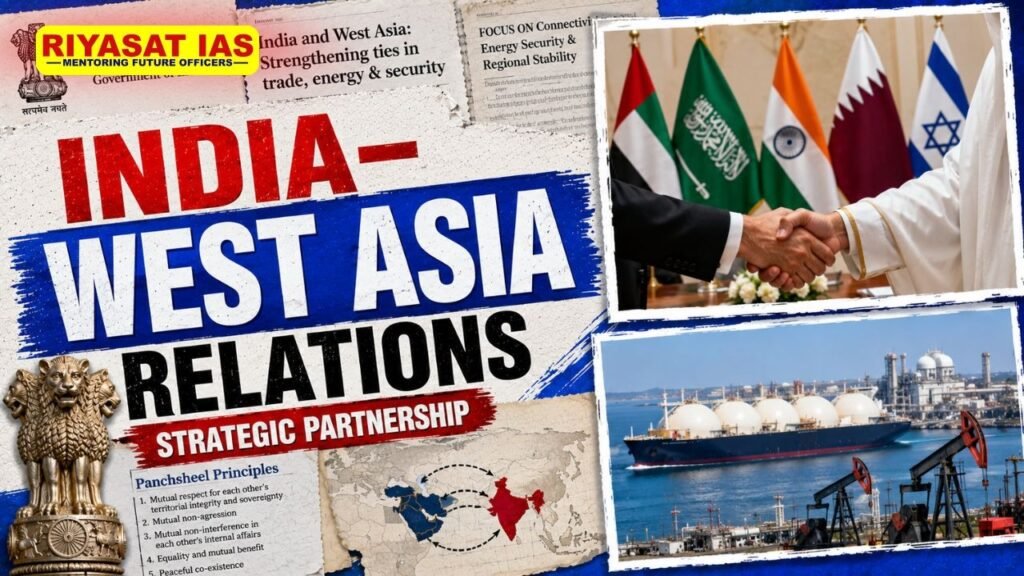
Geographically classification of West Asia?
· Arabian Peninsula and Gulf Region: This includes Saudi Arabia, United Arab Emirates, Qatar, Kuwait, Bahrain, Oman and Yemen. The region is particularly important for India because of its energy resources, trade, maritime routes and large Indian diaspora.
· Levant: The Levant broadly includes the eastern Mediterranean countries of Syria, Lebanon, Jordan, Israel and Palestine. The region has major geopolitical significance because of the Israel-Palestine conflict and continuing regional instability.
· Mesopotamian Region: Iraq forms the core of the historical Mesopotamian region, located between the Tigris and Euphrates rivers. Its strategic location connects the Gulf with the Levant and the wider West Asian region.
· Iranian Plateau: Iran occupies a strategically important position between the Persian Gulf, Central Asia and South Asia. For India, Iran is particularly significant because of Chabahar Port, connectivity with Central Asia and energy interests.
· Anatolia / Türkiye: Türkiye is geographically significant because it connects Asia and Europe and controls access between the Black Sea and the Mediterranean through the Turkish Straits.
India’s Look West Policy
· India’s Look West Policy, 2005 refers to its sustained diplomatic, economic and strategic engagement with West Asia and the Gulf region. Although India did not formally launch a policy with the same institutionalised terminology as the Look East Policy, the approach represents India’s effort to strengthen relations with West Asian countries in response to its growing energy, economic, security and diaspora interests.
· The policy has evolved from an earlier focus on oil and expatriate welfare towards a broader partnership encompassing trade, investment, defence, counter-terrorism, technology, food security, connectivity and strategic cooperation.
· India’s contemporary engagement with the region is therefore better understood as multi-dimensional and interest-driven rather than purely energy-centric.
Significance of West Asia for India
A. Energy and Economic Ties
· West Asia is crucial to India’s energy security because the Gulf region is a major source of India’s crude oil and other energy imports.
· India’s economic relationship with the region extends beyond energy and includes trade, investment, infrastructure, finance, technology and food security.
· The GCC is India’s largest regional grouping trade partner. According to the Ministry of External Affairs, bilateral trade between India and the GCC exceeded US$162 billion in 2023–24, while cumulative FDI from GCC countries was approximately US$20 billion.
· This makes West Asia important not only for India’s energy security but also for its economic growth and investment requirements.
B. Connectivity
West Asia occupies a strategically important position between India, Europe and Africa, making it critical for India’s connectivity ambitions.
India–Middle East–Europe Economic Corridor (IMEC)
o The proposed India–Middle East–Europe Economic Corridor seeks to improve connectivity between India and Europe through the Arabian Peninsula and the Middle East.
o Its broader objectives include facilitating the movement of goods, energy and digital connectivity, while creating opportunities for more resilient supply chains.
Strategic Importance
o West Asia can therefore serve as a strategic bridge connecting India with the Gulf, the Mediterranean and Europe, thereby strengthening India’s integration into global trade networks and international supply chains.
The International North-South Transport Corridor (INSTC) connects India with Central Asia and Russia through Iran’s Chabahar Port, thereby strengthening India’s connectivity and engagement with the Central Asian region.
C. Security and Counter-Terrorism Cooperation
o West Asia is strategically important for India’s security because instability in the region can affect energy supplies, maritime routes, Indian citizens and India’s wider security environment.



o India has consequently expanded cooperation with West Asian countries in areas such as counter-terrorism, intelligence sharing, cybersecurity, defence cooperation, maritime security and law enforcement.
o Cooperation with countries such as the UAE, Saudi Arabia, Israel, Oman and Qatar has increasingly acquired a security dimension.
o India has secured access to Oman’s strategically important Port of Duqm for military use and logistical support, strengthening India’s maritime presence and strategic reach in the Indian Ocean region.
o The region’s proximity to the Arabian Sea and western Indian Ocean also makes maritime security an important component of India’s West Asia policy.
D. Diaspora and Remittances
o The Indian diaspora is one of the strongest foundations of India’s relationship with West Asia, particularly the Gulf.
o According to the MEA Annual Report 2024, the Indian community in the Gulf countries numbered approximately 9.3 million, making it a major bridge between India and the Gulf region.
o Indian workers and professionals in the Gulf contribute significantly through remittances, skills, investment and people-to-people connections.
Remittance Significance
o The World Bank estimated India’s total remittance inflows at around US$129 billion in 2024, making India the world’s largest recipient. It also estimated that approximately 29% of India’s remittance flows originated from GCC countries, highlighting the importance of the Gulf labour market for India’s external finances.
o The welfare and protection of Indian workers abroad therefore remains an important element of India’s West Asia policy.
E. Multilateral Diplomacy
· India maintains relations with countries that often have competing geopolitical interests, including Iran, Israel, Saudi Arabia, UAE and other Gulf states.
· I2U2 Group: It is a strategic partnership between India, Israel, United Arab Emirates and United States, formed in October 2021.
· This requires India to pursue a balanced and multi-aligned diplomacy rather than taking sides in regional rivalries. This demonstrates India’s attempt to pursue issue-based partnerships according to national interests. For example, India simultaneously maintains:
o Strategic cooperation with Israel.
o Strong economic and energy relations with Gulf countries.
o Historical and connectivity interests with Iran.
o Growing strategic partnerships with UAE and Saudi Arabia.
West Asia and India’s Strategic Autonomy
· India’s West Asia policy is an important example of strategic autonomy in practice.
· Rather than viewing the region through a single geopolitical lens, India maintains engagement with multiple and sometimes competing regional actors.
· This approach enables India to simultaneously pursue its energy security, diaspora welfare, economic interests, strategic partnerships, regional connectivity and counter-terrorism objectives. without becoming excessively dependent on any single regional power.
Major Areas of India’s Engagement
India’s relationship with West Asia has gradually expanded beyond traditional oil diplomacy.
o Economic Cooperation: India is expanding cooperation in trade, investment, infrastructure, logistics, food security and financial services.
o Defence Cooperation: Defence exercises, military exchanges, maritime cooperation and defence technology have become increasingly important.
o Technology: India is developing partnerships in digital technology, artificial intelligence, cybersecurity, fintech and innovation.
o Food Security: India’s large agricultural market and West Asia’s dependence on food imports create opportunities for food-security partnerships and agricultural cooperation.
o Renewable Energy: Cooperation is expanding beyond hydrocarbons towards solar energy, hydrogen and other clean-energy technologies.
Challenges in India–West Asia Relations
Regional Conflicts and Instability
o Conflicts involving Israel-Palestine, Iran, Yemen, Syria and other regional flashpoints can directly affect India’s economic and security interests.
o Regional instability can disrupt energy supplies, shipping routes, trade and the safety of Indian nationals.
Energy Security Vulnerability
o Although India is diversifying its energy sources, dependence on West Asian hydrocarbons exposes India to oil-price volatility, geopolitical disruptions and supply-chain risks.
o A major conflict affecting the Gulf or important maritime chokepoints could have significant consequences for India’s economy.
Maritime Chokepoints
o India’s trade and energy security are vulnerable to disruptions around important maritime routes and chokepoints such as the Strait of Hormuz and Bab-el-Mandeb.
o Instability in these areas can increase shipping costs, insurance premiums and delivery times.
Balancing Competing Powers
o India faces the diplomatic challenge of maintaining strong relations with Israel, Iran and the Arab Gulf countries simultaneously, despite their competing strategic interests.
o Any major regional escalation can therefore create difficult diplomatic choices for India.
Welfare of Indian Migrant Workers
o Indian workers in the Gulf can face challenges relating to labour rights, employment conditions, wages, recruitment practices and social security.
o India therefore needs effective mechanisms for worker protection, grievance redressal and safe migration.
Terrorism and Radicalisation
o Political instability, extremist networks and terrorism in parts of West Asia can create security risks for India through terror financing, radicalisation, organised crime and transnational networks.
Way Forward
· Diversify Energy Sources: India should continue diversifying its energy basket through renewable energy, nuclear energy, strategic petroleum reserves and diversified international suppliers to reduce excessive dependence on any particular region.
· Deepen Economic Partnerships: India should move beyond an oil-centred relationship and expand cooperation in investment, manufacturing, technology, logistics, food security, fintech and renewable energy.
· Accelerate Connectivity Projects: India should actively develop IMEC and other multimodal connectivity initiatives, while simultaneously strengthening maritime and digital connectivity with West Asia.
· Strengthen Diaspora Protection: India should improve skill development, pre-departure training, labour agreements, consular assistance and social-security mechanisms for Indian workers in the region. Existing government initiatives already emphasise skill upgradation, pre-departure orientation and bilateral cooperation with Gulf countries.
· Maintain Balanced Diplomacy: India should continue its policy of strategic autonomy and multi-alignment, maintaining constructive relations with all major regional actors while avoiding unnecessary involvement in regional rivalries.
· Expand Security Cooperation: India should strengthen cooperation in counter-terrorism, maritime security, cybersecurity, intelligence sharing and disaster management.
· Focus on Emerging Sectors: The relationship should increasingly incorporate green hydrogen, renewable energy, critical minerals, digital technologies, artificial intelligence and advanced manufacturing.
Conclusion:
“India’s West Asia policy is a test of strategic autonomy in practice: India must simultaneously secure its energy and economic interests, protect its diaspora, expand connectivity and maintain balanced relations amid a deeply contested regional order.”
FAQs
1. Why is West Asia important for India?
Ans: West Asia is important for India’s energy security, trade, investment, connectivity, diaspora, remittances and strategic security.
2. What is India’s Look West approach?
Ans: It refers to India’s sustained engagement with West Asia and the Gulf, which has evolved from energy and diaspora concerns towards broader economic, strategic and security cooperation.
3. What is the significance of the Gulf for India?
Ans: The Gulf is a major energy source, trading partner and employment destination for Indians; the GCC accounted for over US$162 billion in India’s bilateral trade in 2023–24.
4. Why is the Indian diaspora important in West Asia?
Ans: The Gulf hosts around 9.3 million Indians, whose employment, remittances and people-to-people links make them an important bridge between India and the region.
5. What is the major challenge for India’s West Asia policy?
Ans: India must balance its relations with Israel, Iran and Arab Gulf countries while protecting its energy, trade, security and diaspora interests amid persistent regional conflicts.




 Ravi Raaz
 Hassan Khan
 Shadab Ali