
8. Ravi is a senior police officer with vast experience in riot control and cyber-policing. Since one year, he has been the Superintendent of Police (SP) of a district with a history of frequent rioting. Last year, Ravi had sought installation of an AI-enabled software for predictive policing. This new system has been operational for approximately six months. This system uses advanced algorithms for capturing the biometric data of people and swiftly relating it to a data library. This has enabled Ravi and his team to identify the persons involved in various crimes. The system has identified an immigrant and low-income neighbourhood as a centre for gang violence and drug trafficking. Aided by this AI analysis, the local police focused its patrolling, preventive detentions and establishing checkpoints. Consequently, public order and law enforcement have visibly improved. Last week, some community leaders, civil rights lawyers and human rights activists visited Ravi’s office. They submitted a memorandum that the new system is faulty as it is based on incorrect historical data caused by social biases and discriminatory policing. The memorandum also highlighted that surveillance has created a climate of tension amongst residents. This feeling is aggravated by the fact that the residents are not aware of the data noted against their names.
(a) What are the ethical issues including biases involved in the use of AI in data-driven policing?
(b) Place yourself in Ravi’s role and discuss the alternatives available. Justify the action that optimises compliance with ethics. (Answer in 250 words)
Introduction
The case presents a dilemma between better crime prevention and protection of citizens’ rights. Although AI has helped Ravi improve law and order, relying on historically biased data may cause the same communities to be repeatedly targeted, turning a useful technology into a source of discrimination and mistrust.
(a) Ethical Issues and Biases
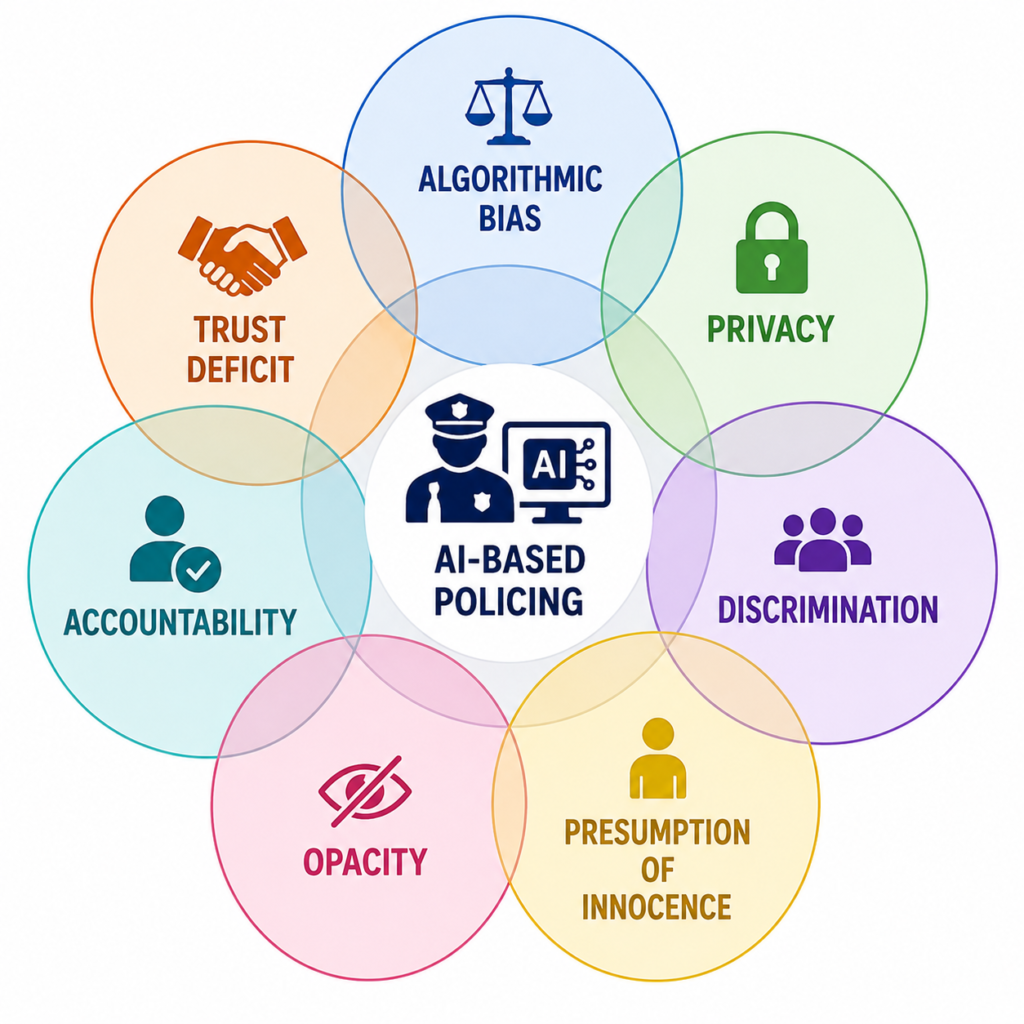
- Algorithmic bias: If historical policing data contains social or institutional bias, the AI may reproduce it. For example, if a neighbourhood was historically over-policed, higher arrest records may make the system wrongly identify it as inherently more crime-prone.
- Privacy: Large-scale collection of biometric information raises concerns about privacy, autonomy and possible misuse.
- Discrimination: Repeatedly targeting an immigrant and low-income locality may reinforce existing social stereotypes and create unequal treatment.
- Presumption of innocence: Being identified as “high risk” cannot itself become a basis for treating a person as a criminal.
- Opacity: Residents do not know what information is stored about them or how it influences police decisions, making it difficult to challenge errors.
- Accountability: When an algorithm contributes to a wrongful decision, responsibility can become blurred between the software and the police officer using it.
- Trust deficit: Excessive surveillance can make residents feel watched rather than protected, reducing cooperation with the police.



Example: Concerns surrounding predictive-policing systems such as PredPol and risk-assessment tools such as COMPAS have highlighted how historical data can reproduce existing patterns of bias.
(b) Alternatives and Recommended Action
1. Continue the system unchanged:
This may preserve the improvement in crime control, but risks discrimination, rights violations and further alienation.
2. Abandon the system completely:
This removes the immediate risks but also discards a potentially useful tool for intelligence-led policing.
3. Human-in-the-loop approach — Recommended:
As SP, Ravi should:
- temporarily suspend AI-based preventive or coercive action based solely on algorithmic outputs;
- conduct an independent accuracy, bias and privacy audit;
- use AI only as an intelligence lead, not as proof of wrongdoing;
- require human verification and documented reasons before police action;
- establish safeguards for biometric collection, retention and access;
- allow citizens to challenge and correct inaccurate information;
- periodically test the system for discriminatory outcomes; and
- engage community representatives to rebuild confidence.
Example: A transparent community-policing approach, combined with technology, can help ensure that AI complements local intelligence and human judgement rather than replacing them.
Conclusion
Ravi should pursue “smart policing with human safeguards.” Technology can help the police identify patterns, but it must never decide who deserves suspicion merely because of where they live or what the data predicts. The ethical priority should be to combine security with privacy, fairness, accountability and public trust.





 Ravi Raaz
 Hassan Khan
 Shadab Ali